Evaluating the integration of assistive devices in occupational therapy across North India
Article Sidebar
Main Article Content
Abstract
Background: Assistive devices (ADs) are central to occupational therapy (OT) for enhancing independence and participation, yet their use in North India remains underexplored.
Objectives: This study aimed to evaluate how occupational therapists in North India utilize assistive devices, their level of knowledge and training, and the barriers influencing ADs prescription. Understanding these patterns is essential, as improved ADs integration can strengthen rehabilitation outcomes, reduce long-term disability burden.
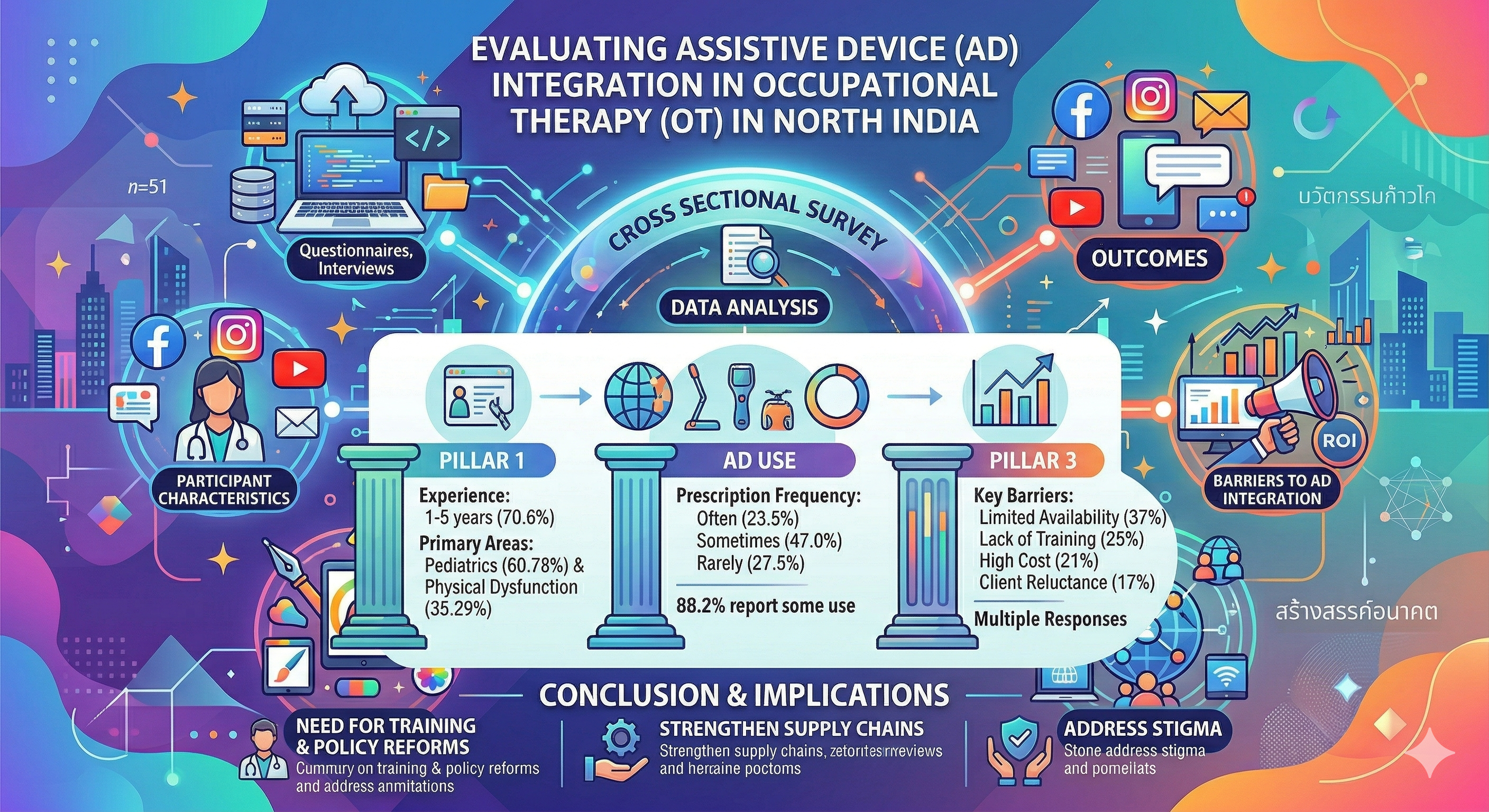
Materials and methods: A descriptive cross-sectional survey was conducted using a structured, self-administered questionnaire developed from existing literature and validated by three OT experts. The instrument captured demographic details, types and frequency of assistive devices (ADs) use, knowledge and training related to ADs, and perceived barriers. Participants were recruited through purposive and snowball sampling across hospitals, rehabilitation centers, community health facilities, and private clinics in North India. Data were collected online via Google Forms over a three-month period, and descriptive and chi-square analyses were performed.
Results: A total of 51 occupational therapists participated in the study. Mobility and self-care devices were the most frequently prescribed, with 88.2% of respondents reporting some level of ADs use. Major barriers included limited availability (37%), lack of training (25%), high cost (21%), and client reluctance (17%).
Conclusion: Although occupational therapists value ADs, systemic and cultural challenges limit their integration. Improved training, access to affordable devices, and contextually relevant strategies are needed to optimize ADs use in OT across North India.
Article Details

This work is licensed under a Creative Commons Attribution-NonCommercial-NoDerivatives 4.0 International License.
Personal views expressed by the contributors in their articles are not necessarily those of the Journal of Associated Medical Sciences, Faculty of Associated Medical Sciences, Chiang Mai University.
References
Federici S, Meloni F, Borsci S. The abandonment of assistive technology in Italy: a survey of National Health Service users. Eur J Phys Rehabil Med. 2016; 52(4): 516-26. PMID: 26637347.
World Health Organization. Global report on assistive technology. Geneva: WHO; 2022. Available from: https://www.who.int/publications/i/item/9789240068069.
Matter R, Harniss M, Oderud T, Borg J, Eide AH. Assistive technology in resource-limited environments: a scoping review. Disabil Rehabil
American Occupational Therapy Association. Occupational therapy practice framework: domain and process, 4th Edition). Am J Occup Ther. 2020; 74(Suppl 2): 7412410010; 1-48. doi: 10.5014/ajot.2020.74S2001.
Desmond D, Layton N, Bentley J. Assistive technology and people: a position paper from the Global Research, Innovation and Education on Assistive Technology (GREAT) Summit. Disabil Rehabil Assist Technol. 2018; 13(5): 437-44. doi: 10.1080/17483107.2018.1471169.
Steel EJ, Layton N, Foster M, Bennett S, van der Zalm J, Moodie M, et al. The economic case for assistive technology: systematic review. Int J Environ Res Public Health. 2022; 19(6): 3671. doi: 10.3390/ijerph19063671.
Mortenson WB, Demers L, Fuhrer MJ, Jutai JW, Lenker JA, Depa M. Effect of an assistive technology intervention on older adults’ activity engagement: a multicenter randomized controlled trial. Arch Phys Med Rehabil. 2018; 99(11): 2160-6. doi: 10.1016/j.apmr.2018.03.010.
Khasnabis C, Heinicke Motsch K, Achu K, Al Jubah K, Brodtkorb S, Chervin P, et al., editors. Assistive technology for children with disabilities: creating opportunities for education, inclusion and participation. Geneva: WHO; 2015.
Phillips B, Zhao H. Predictors of assistive technology abandonment. Assist Technol. 1993; 5(1): 36-45. doi: 10.1080/10400435.1993.10132205.
MacLachlan M, Banes D, Bell D, Borg J, Donnelly B, Fembek M, et al. Assistive technology policy: a position paper from the Global Research, Innovation and Education on Assistive Technology (GREAT) Summit. Disabil Rehabil Assist Technol. 2018; 13(5): 454-66. doi: 10.1080/17483107.2018.1468496.
Holloway C, Austin V, Barbareschi G, Ramos Barajas F, Dyble M, Gallagher B, et al. Scoping research report on assistive technology: London: Global Disability Innovation Hub; 2018.
Layton N, Borg J. Global perspectives on assistive technology: access, affordability, and sustainability. Technol Disabil. 2020; 32(1-2): 1-5. doi: 10.3233/TAD-200255.
Smith EM, Gowran RJ, Mannan H, Donnelly B, Alvarez L, Bell D, et al. Barriers and facilitators to access and use of assistive technology: a systematic review. Int J Environ Res Public Health. 2018; 15(12): 2624. doi: 10.3390/ijerph15122624.
Federici S, Borsci S. Providing assistive technology in Italy: the perceived adequacy of public services and the size of the phenomenon of abandonment. Disabil Rehabil Assist Technol. 2016; 11(1): 22-31. doi: 10.3109/17483107.2014.913710.
Bauer GF, Jenny GJ. Development, implementation and dissemination of occupational health management (OHM): Putting salutogenesis into practice. In: Mittelmark MB, Sagy S, Eriksson M, editors. The Handbook of Salutogenesis. Cham: Springer; 2017: pp 211-24. doi: 10.1007/978-3-319-04600-6_21.
Pettersson I, Appelros P, Ahlström G. Lifeworld perspectives utilizing assistive devices: individuals, lived experience after stroke. Scand J Occup Ther. 2020; 27(6): 446-56. doi: 10.1080/11038128.2019.1586780.
Layton N, Steel E, Manjak NJ. An analysis of Australian survey data on assistive technology use in daily living. Disabil Rehabil Assist Technol. 2022; 17(8): 868-75. doi: 10.1080/17483107.2021.1886452.
Borg J, Larsson S, Östergren PO. The right to assistive technology: for whom, for what, and by whom? Disabil Rehabil. 2011; 33(21-22): 1799-801. doi: 10.3109/09638288.2011.555999.
Visagie S, Duffield S, Unger M, Scheffler E, Schraner I. Developing a sustainable assistive technology service delivery model for South Africa: outcome of a national consultative process. Disabil Rehabil Assist Technol. 2013; 8(5): 386-93. doi: 10.3109/17483107.2013.764516.
Borg J, Larsson S, Östergren PO. Assistive technology provision: towards a national policy in Bangladesh. Disabil Rehabil. 2012; 34(10): 799-803. doi: 10.3109/0963 8288.2011.619621
Oderud T. Surviving spinal cord injury in low-income countries. Afr J Disabil. 2014; 3(2): 80. doi: 10.4102/ajod.v3i2.80.
Matter RA, Eide AH, Harniss M. Assistive technology in resource-limited settings: new evidence from Latin America. Disabil Rehabil Assist Technol. 2017; 12(3): 276-82. doi: 10.3109/17483107.2016.1188173.
Government of India. Census of India 2011: Data on disability. Office of the Registrar General and Census Commissioner, India. Available from: https://censusindia.gov.in.
Ghosh S, Banerjee R, Banerjee T. Assistive technology in India: unmet need, challenges, and opportunities. Indian J Public Health. 2021; 65(1): 95-9. doi: 10.4103/ijph.IJPH_611_20.
Ministry of Social Justice and Empowerment. Assistance to Disabled Persons for Purchase/Fitting of Aids and Appliances (ADIP) Scheme. Government of India; 2020.
Mukherjee S, Samanta R. Accessibility of assistive technologies for persons with disabilities in rural India. Disabil CBR Incl Dev. 2020; 31(1): 27-51. doi: 10.5463/dcid.v31i1.802.
John A, Samuel R, George P. Exploring accessibility and challenges in the use of assistive technology among persons with disabilities in Kerala, India. Disabil Rehabil Assist Technol. 2022; 17(5): 531-8. doi: 10.1080/17483107.2020.1835231.
Murthi KM. Evolution of occupational therapy practice in India: an overview of the historical foundation and current practice. Ann Int Occup Ther. 2019; 2(3): 141-8.
Senjam SS, Mannan H. Assistive technology: The current perspective in India. Indian Journal of Ophthalmology. 2023; 71(5): 1804-9.
Murthi KM. Evolution of occupational therapy practice in India: An overview of the historical foundation and current practice. Ann. Int. Occup. Ther. 2019: 2(3): 141-8. doi: 10.3928/24761222-20190314-01.
Brien M, Krishna D, Borish M, Coutinho F, Bernardo A, Shah SR, et al. Enabling local provision of assistive products in rural South India: an organisational survey of needs, barriers, and facilitators. Disabil Rehabil Assis Technol. 2024; 19(8): 2904-14. doi: 10.1080/17483107.2024.2321601.
Senjam SS, Manna S, Kishore J, Kumar A, Kumar R, Vashist P, et al. Assistive technology usage, unmet needs and barriers to access: a subpopulation-based study in India. The Lancet Reg Health Southeast Asia. 2023; 15: 100213 doi: 10.1016/j.lansea.2023.100213.
Singh P, Sharma R. Stigma and acceptance of assistive devices among persons with disabilities in India: a qualitative inquiry. Disabil Rehabil Assist Technol. 2022; 17(6): 623-31. doi: 10.1080/17483107.2020.1841309.
Kumar SG, Roy G, Kar SS. Disability and rehabilitation services in India: Issues and challenges. J Family Med and Prim Care. 2012; 1(1): 69-73. doi: 10.4103/2249-4863.94458.
Mani K. Utilization of assistive devices in occupational therapy practice in Tamil Nadu, India: a statewide survey. Indian J Occup Ther. 2020; 52(2): 43-9. doi: 10.4103/ijoth.ijoth_31_19.
Bondoc S, et al. Assistive technology and occupational performance. Am J Occup Ther. 2016; 70(Suppl 2).
Schaeffer RL, Mendenhall W, Ott L. Elementary survey sampling. 4th Ed. Belmont (CA): Duxbury Press; 1990.
World Medical Association. World Medical Association Declaration of Helsinki: Ethical principles for medical research involving human subjects.JAMA. 2013; 310(20): 2191-4. doi: 10.1001/jama.2013.281053.Assist Technol. 2017; 12(2): 105-14. doi: 10.3109/17483107.2016.1188170.
