
Prevalence and risk factors of elevated urinary albumin-to-creatinine ratio in a Thai academic population
Article Sidebar
Main Article Content
Abstract
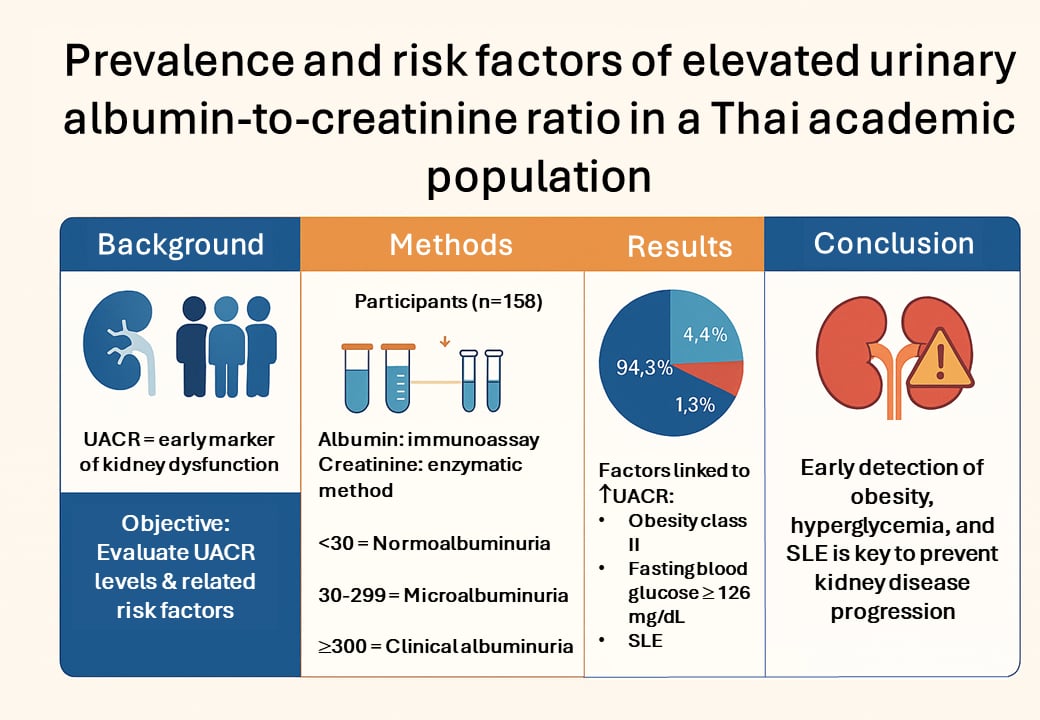
Background: The urinary albumin–to–creatinine ratio (UACR) is a key marker for early kidney dysfunction. This study assessed UACR levels and their associations with demographic and clinical factors in a Thai university population.
Materials and methods: A cohort of 158 participants (53 males, 105 females) was recruited from Chiang Mai University between January and May 2024. Urinary albumin and creatinine were measured by turbidimetric immunoassay and creatininase method, respectively, and expressed as UACR (mg/gm creatinine). UACR was categorized as normoalbuminuria (<30 mg/gm creatinine), microalbuminuria (30-299 mg/gm creatinine), or clinical albuminuria (≥300 mg/gm creatinine). Data on body mass index (BMI), blood
pressure, fasting blood glucose, physical activity, use of supplements or
medications, and the presence of chronic conditions were also collected.
Results: Most participants (94.3%) had normoalbuminuria, whereas microalbuminuria and clinical albuminuria were observed in 4.4% and 1.3% of participants, respectively. Overall, 71.5% were normotensive and 28.5% hypertensive. Based on BMI, 41.1% had normal weight, 18.4% were overweight, and 34.8% were obese. Nearly half reported no regular exercise, and the majority were non–smokers (98.1%) and non–drinkers (83.5%). Regular supplement or medication use was reported by 57.0%, mainly vitamins/minerals and fish oil. Chronic diseases occurred in 37.3%, with hypercholesterolemia (10.8%) and hypertension (8.9%) being most common. Hypercholesterolemia, hypertension, allergy, type II diabetes, lifestyle factors, and supplement or medication use were not associated with albuminuria (Chisquare, p>0.05), whereas obesity class II, elevated fasting blood glucose (≥126 mg/dL) and systemic lupus erythematosus (SLE) were significantly associated with increased urinary albumin excretion (Chi-square, p<0.05).
Conclusion: Elevated blood glucose, obesity, and SLE were significantly linked to increased UACR, emphasizing the importance of early identification and management of these risk factors to prevent kidney disease progression.
Article Details

This work is licensed under a Creative Commons Attribution-NonCommercial-NoDerivatives 4.0 International License.
Personal views expressed by the contributors in their articles are not necessarily those of the Journal of Associated Medical Sciences, Faculty of Associated Medical Sciences, Chiang Mai University.
References
Mahmoud T, Borgi L. The interplay between nutrition, metabolic, and endocrine disorders in chronic kidney disease. Semin Nephrol. 2021; 41(2): 180-8. doi: 10.1016/j.semnephrol.2021.03.012.
American Diabetes Association. Standards of medical care in diabetes-2021. Diabetes Care. 2021; 44: S1-S232. doi: 10.2337/dc21-S002.
Alicic RZ, Rooney MT, Tuttle KR. Diabetic kidney disease: Challenges, progress, and possibilities. Clin J Am Soc Nephrol. 2017; 12(12): 2032-45. doi: 10.2215/CJN.11491116.
Roscioni SS, Lambers Heerspink HJ, de Zeeuw D. Microalbuminuria: Target for renoprotective therapy pro. Kidney international. 2014; 86(1): 40-9. doi: 10.1038/ki.2013.490.
Zarshenas F, Dehghan A, Mirzaei M. Association between chronic kidney disease and cardiovascular disease risk factors in elderly: Results from the first phase of fasa and shahedieh cohort studies. BMC Nephrol. 2024; 25(1): 413. doi: 10.1186/s12882-024-03566-2.
Kang SH, Jung DJ, Choi EW, Cho KH, Park JW, Do JY. Hba1c levels are associated with chronic kidney disease in a non-diabetic adult population: A nationwide survey (knhanes 2011-2013). PloS one. 2015; 10(12): e0145827. doi: 10.1371/journal.pone.0145827.
Pranart Chiowanich TK, Srivadee Oravivattanakul, Viroj Wiwanitkit. Prevalence and risk factors of microalbuminuria in patient with diabetic mellitus at northern part referral hospital in thailand. Diabetes and Metabolic Syndrome: Clinical Research and Reviews. 2009; 3(3): 152-4. doi: 10.1016/J.DSX.2009.02.010.
Pongsathorn Gojaseni AP, Worawon Chailimpamontree, Thaweepong Pajareya, Anutra Chittinandana. Prevalence and risk factors of microalbuminuria in thai nondiabetic hypertensive patients. Vascular Health and Risk Management. 2010. doi: 10.2147/VHRM.S9739.
Lekskulchai V. Use of estimated glomerular filtration rate and urine albumin-to-creatinine ratio based on kdigo 2012 guideline in a thai community hospital: Prevalence of chronic kidney disease and its risk factors. Med Sci Monit Basic Res. 2022; 28: e938176. doi: 10.12659/MSMBR.938176.
Udom Krairittichai SP, Amporn Jongsareejit, Charnvate Sattaputh. Prevalence and risk factors of diabetic nephropathy among thai patients with type 2 diabetes mellitus. Journal of the Medical Association of Thailand. 2011. doi:
Tsai MC, Lojanapiwat B, Chang CC, Noppakun K, Khumrin P, Li SH, et al. Risk prediction model for chronic kidney disease in thailand using artificial intelligence and shap. Diagnostics (Basel). 2023; 13(23). doi: 10.3390/diagnostics13233548.
Garofalo C, Borrelli S, Minutolo R, Chiodini P, De Nicola L, Conte G. A systematic review and meta-analysis suggests obesity predicts onset of chronic kidney disease in the general population. Kidney international. 2017; 91(5): 1224-35. doi: 10.1016/j.kint.2016.12.013.
Ahmed MA, Ferede YM, Takele WW. Incidence and predictors of chronic kidney disease in type-ii diabetes mellitus patients attending at the amhara region referral hospitals, ethiopia: A follow-up study. PloS one. 2022; 17(1): e0263138. doi: 10.1371/journal.pone.0263138.
Pugliese G, Penno G, Natali A, Barutta F, Di Paolo S, Reboldi G, et al. Diabetic kidney disease: New clinical and therapeutic issues. Joint position statement of the italian diabetes society and the italian society of nephrology on "the natural history of diabetic kidney disease and treatment of hyperglycemia in patients with type 2 diabetes and impaired renal function". J Nephrol. 2020; 33(1): 9-35. doi: 10.1007/s40620-019-00650-x.
Moorhead JF, Chan MK, El-Nahas M, Varghese Z. Lipid nephrotoxicity in chronic progressive glomerular and tubulo-interstitial disease. Lancet. 1982; 2(8311): 1309-11. doi: 10.1016/s0140-6736(82)91513-6.
Bragg-Gresham JL, Annadanam S, Gillespie B, Li Y, Powe NR, Saran R. Using risk assessment to improve screening for albuminuria among us adults without diabetes. J Gen Intern Med. 2025; 40(13): 3159-69. doi: 10.1007/s11606-024-09185-9.
Hillege HL, Fidler V, Diercks GF, van Gilst WH, de Zeeuw D, van Veldhuisen DJ, et al. Urinary albumin excretion predicts cardiovascular and noncardiovascular mortality in general population. Circulation. 2002; 106(14): 1777-82. doi: 10.1161/01.cir.0000031732.78052.81.
Yang HY, Lu KC, Fang WH, Lee HS, Wu CC, Huang YH, et al. Impact of interaction of cigarette smoking with angiotensin-converting enzyme polymorphisms on end-stage renal disease risk in a han chinese population. J Renin Angiotensin Aldosterone Syst. 2015; 16(1): 203-10. doi: 10.1177/1470320313481837.
Yang L, Chu TK, Lian J, Lo CW, Lau PK, Nan H, et al. Risk factors of chronic kidney diseases in chinese adults with type 2 diabetes. Sci Rep. 2018; 8(1): 14686. doi: 10.1038/s41598-018-32983-1.
Tziomalos K, Athyros VG. Diabetic nephropathy: New risk factors and improvements in diagnosis. Rev Diabet Stud. 2015; 12(1-2): 110-8. doi: 10.1900/RDS.2015.12.110. [21] Jiang Y, Jia J, Li J, Huo Y, Fan F, Zhang Y. Impaired fasting blood glucose is associated with incidentnalbuminuria: Data from a chinese communitybasedncohort. J Diabetes Complications. 2022; 36(2): 108125. doi: 10.1016/j.jdiacomp.2022.108125.
Lichtnekert J, Anders HJ. Lupus nephritis-related chronic kidney disease. Nat Rev Rheumatol. 2024; 20(11): 699-711. doi: 10.1038/s41584-024-01158-w.
Pongkulkiat P, Foocharoen C, Onchan T, Suwannaroj S, Mahakkanukrauh A. Prevalence and incidence of systemic lupus erythematosus in thailand based on national health data. Lupus Sci Med. 2025; 12(2). doi: 10.1136/lupus-2025-001621.
Amorn Sankhaanuruk NK, Worawit Louthrenoo. Incidence of lupus nephritis flares after complete response in a thai population. Medical Research Archives. 2022; 10(5). doi: 10.18103/mra.v10i5.2831.
Nun Singpan RC, Boonyarit Cheunsuchon. Clinicopathological characteristics of lupus nephritis in thai males. Journal of Nephropathology. 2021; 10(2): 1-5. doi: 10.34172/jnp.2021.19.
Kim TB, Ahn SY, Oh J, Bae EH, Chin HJ, Kim MG, et al. The impact of obesity on kidney disease: Observational cohort study analyzing 14,492 kidney biopsy cases. J Korean Med Sci. 2024; 39(3): e12. doi: 10.3346/jkms.2024.39.e12.
Song SH, Oh TR, Suh SH, Choi HS, Kim CS, Ma SK, et al. Obesity is associated with incident chronic kidney disease in individuals with normal renal function. Korean J Intern Med. 2024; 39(5): 813-22. doi: 10.3904/kjim.2023.491.
