
Assessment of natural radioactivity concentrations in soil samples from Mae Chaem District, Chiang Mai Province, Thailand using a HPGe detector
Article Sidebar
Main Article Content
Abstract
Background: Understanding the existence of natural radioactivity in different soil origins is essential for evaluating associated radiological risks.
Objectives: The purpose of this study was to determine the natural radioactivity concentrations in soil samples from Mae Chaem district using a HPGe detector.
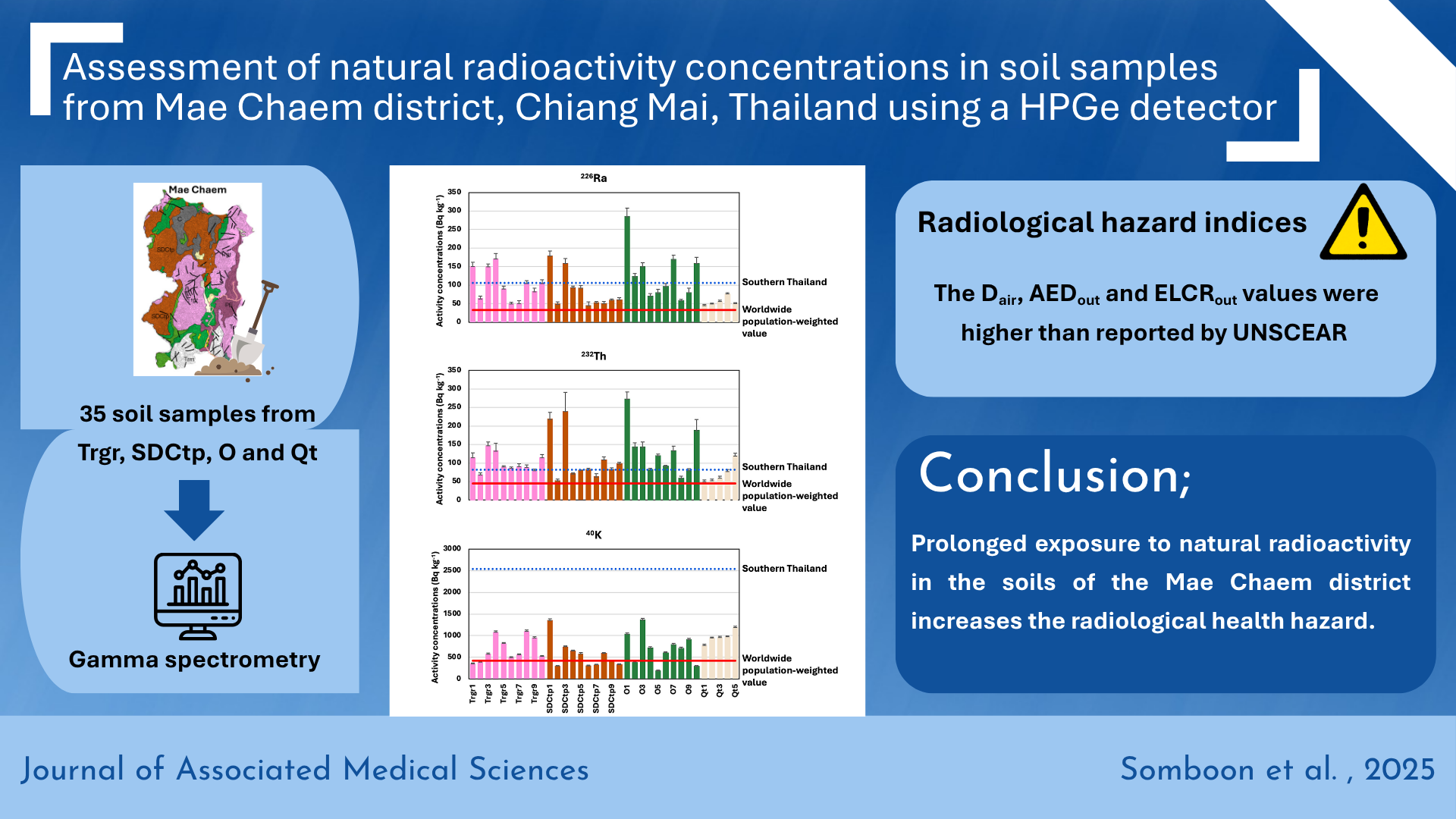
Materials and methods: Thirty-five soil samples were randomly collected for laboratory analysis from four geological regions, ten from Triassic granite (Trgr), Silurian Devonian-Carboniferous (SDCtp), and Ordovician (O) locations and five from the Quaternary sediments, namely the Terrace deposits (Qt) area. The radioactivity of 226Ra, 232Th, and 40K was measured using a gamma spectrometry with a high-purity germanium detector. The three radiation hazard indices for soil samples, including absorbed dose rate in outdoor air (Dair), the annual effective dose equivalent (AEDout), and the excess lifetime cancer risk outdoor (ELCRout) were determined.
Results: The concentration of natural radioactivity for 226Ra of Trgr, SDCtp, O, and Qt were found in the range of 50 to 172, 46 to 179, 59 to 285, and 46 to 77 Bq kg-1, respectively. The activity concentration of 232Th varied from 69 to 148, 53 to 239, 60 to 273, and 51 to 120 Bq kg-1, whereas the activity concentration of 40K ranged from 351 to 1100, 299 to 1356, 190 to 1364, and 779 to 1188 Bq kg-1, respectively. The Dair varied from 88 to 207, 68 to 275, 94 to 345, and 85 to 146 nGy h-1, with average values 139, 131, 170, and 110 nGy h-1 for Trgr, SDCtp, O and Qt samples, respectively. All sample values were higher than the worldwide population-weighted value of 59 nGy h-1 reported by the United Nations Scientific Committee on the Effects of Atomic Radiation (UNSCEAR, 2000). The AEDout and the ELCRout values also were higher than global average values by UNSCEAR.
Conclusion: In soil samples collected from four specific regions in the Mae Chaem district, the average natural activity concentrations of 226Ra, 232Th, and 40K were found to be above the worldwide population-weighted value. The Dair, AEDout in external terrestrial radiation from outdoor sources and ELCRout values were higher than reported by UNSCEAR. These results indicate a high radiological health risk associated with prolonged exposure to natural radionuclides in soils from the Mae Chaem district.
Article Details

This work is licensed under a Creative Commons Attribution-NonCommercial-NoDerivatives 4.0 International License.
Personal views expressed by the contributors in their articles are not necessarily those of the Journal of Associated Medical Sciences, Faculty of Associated Medical Sciences, Chiang Mai University.
References
UNSCEAR. Sources and effects of ionizing radiation. United Nations Scientific Committee on the Effects of Atomic Radiation, UNSCEAR 2000 Report to the general assembly, with scientific annexes, Volume I: Sources New York: United Nations; 2000. doi: 10.1016/j.chemosphere.2020.128459.
Khan R, Islam HMT, Islam A. Mechanism of elevated radioactivity in Teesta river basin from Bangladesh: Radiochemical characterization, provenance and associated hazards. Chemosphere. 2021; 264(Pt 1): 128459. doi: 10.1016/j.chemosphere. 2020.128459.
Merdanoglu B, Altinsoy N. Radioactivity concentrations and dose assessment for soil samples from Kestanbol granite area, Turkey. Radiat Prot Dosim. 2006; 121(4): 399-405. doi: 10.1093/rpd/ncl055
Kreuzer M, Sobotzki C, Fenske N, Marsh JW, Schnelzer M. Leukaemia mortality and low-dose ionising radiation in the WISMUT uranium miner cohort (1946-2013). Occup Environ Med. 2017; 74(4): 252-8. doi: 10.1136/oemed-2016-103795
Hsieh WH, Lin IF, Ho JC, Chang PW. 30 years followup and increased risks of breast cancer and leukaemia after long-term low-dose-rate radiation exposure. Br J Cancer. 2017; 117(12): 1883-7. doi: 10.1038/bjc.2017.350.
Leuraud K, Laurier D, Gillies M, Haylock R, KellyReif K, Bertke S, et al. Leukaemia, lymphoma, and multiple myeloma mortality after low-level exposure to ionising radiation in nuclear workers (INWORKS): updated findings from an international cohort study. Lancet Haematol. 2024; 11(10): e761-e9. doi: 10.1016/S2352-3026(24)00240-0.
Little MP, Wakeford R, Zablotska LB, Borrego D, Griffin KT, Allodji RS, et al. Radiation exposure and leukaemia risk among cohorts of persons exposed to low and moderate doses of external ionising radiation in childhood. Br J Cancer. 2023; 129(7): 1152-65. doi: 10.1038/s41416-023-02387-8.
ICRP. Protection of the public in situations of prolonged radiation exposure. The application of the Commission’s system of radiological protection to controllable radiation exposure due to natural sources and long-lived radioactive residues. Ann ICRP. 1999; 29(1-2): 1-109.
WHO Handbook on indoor radon: A public health perspective. WHO Guidelines approved by the Guidelines Review Committee. Geneva2009.
Mortazavi SMJ, Mortazavi Gh, Mortazavi SAR, Paknahad M. Is induction of anomalies in lymphocytes of the residents of high background radiation areas associated with increased cancer risk? J Biomed Phys Eng. 2019; 9(3): 367-72. doi: 10.31661/jbpe.v9i3Jun.654.
Bhongsuwan T, Auisui SA. A high natural radiation area in Khao-Than hot spring, Southern Thailand. Radiat Prot Dosim. 2015; 167(1-3): 284-8. doi: 10.1093/rpd/ncv263.
Kessaratikoon P, Boonkrongcheepa R, Polthum S. Measurement of radionuclides in surface soil and beach sand samples from Rayong Province (Thailand) and the evaluation of excess lifetime cancer risk. Scienceasia. 2021; 47: 120-9. doi: 10.2306/scienceasia1513-1874.2021.S016.
Kritsananuwat R, Arae H, Fukushi M, Sahoo SK, Chanyotha S. Natural radioactivity survey on soils originated from southern part of Thailand as potential sites for nuclear power plants from radiological viewpoint and risk assessment. J Radioanal Nucl Ch. 2015; 305(2): 487-99. doi: 10.1007/s10967-015-3994-8.
Pisapak P, Todorovic N, Bhongsuwan T. Correlation between radon and radium concentrations in soil and estimation of natural radiation hazards in Namom district, Songkhla province (Southern Thailand). Environ Earth Sci. 2017; 76(4): 1-11.
