
Genomic insights into colistin-resistant Escherichia coli from clinical isolates in Thailand: Diversity of sequence types, plasmid-borne mcr variants, and One Health implications
Article Sidebar
Main Article Content
Abstract
Background: Colistin is a last-resort antimicrobial agent for treating multidrugresistant Enterobacterales. However, resistance has emerged globally through plasmid-mediated mcr genes and chromosomal mutations. Reports of wholegenome sequencing of colistin-resistant Escherichia coli from clinical settings in Thailand remain limited.
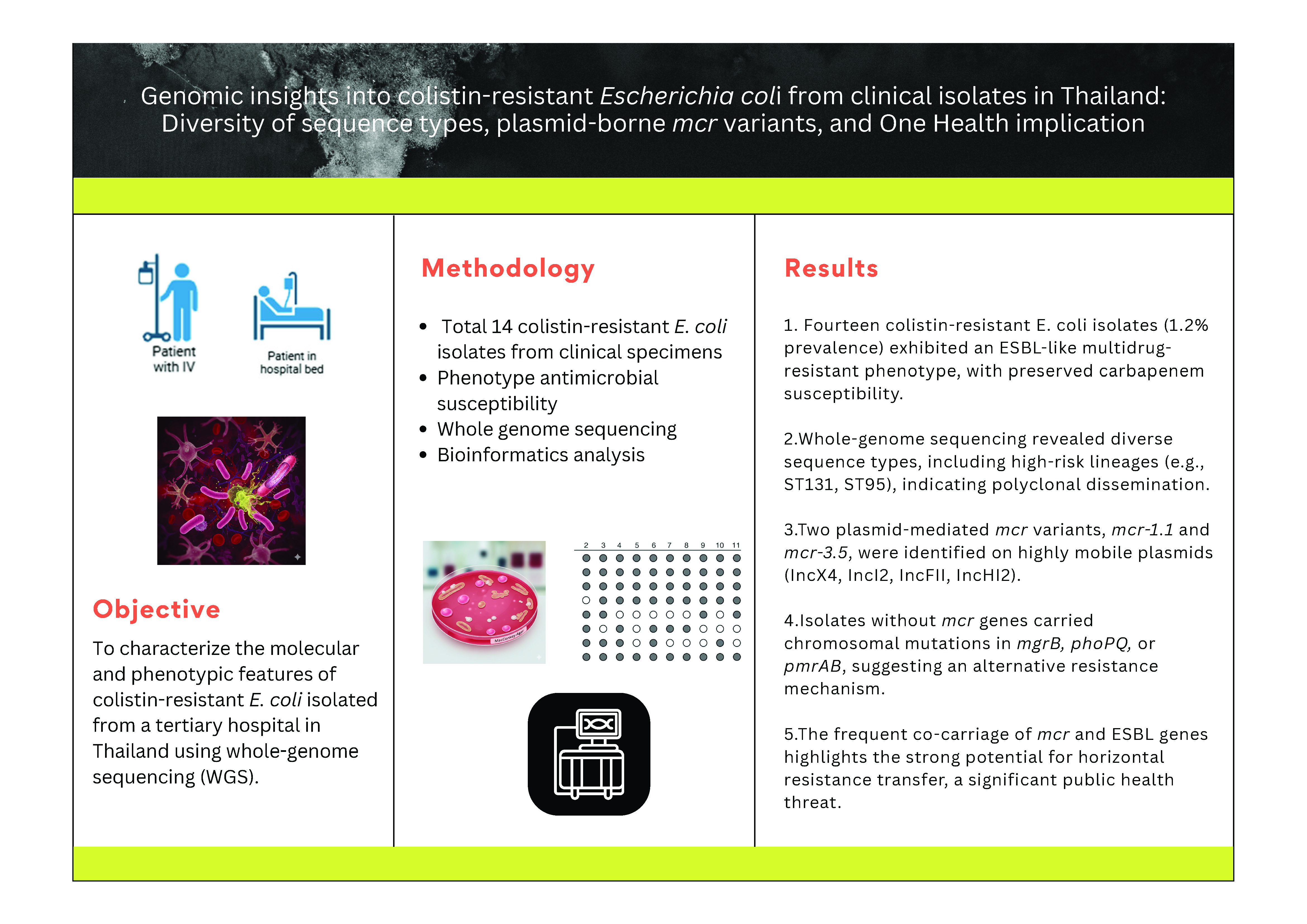
Objectives: To characterize the molecular and phenotypic features of colistinresistant E. coli isolated from a tertiary hospital in Thailand using wholegenome sequencing (WGS).
Materials and methods: Fourteen colistin-resistant E. coli isolates were collected from clinical specimens between 2021 and 2022. Antimicrobial susceptibility testing was performed using broth microdilution. WGS was applied to identify resistance determinants, plasmid replicons, virulence genes, phylogroups, and sequence types.
Results: The prevalence of colistin-resistant E. coli was 1.2% (14/1203 isolates). Most isolates exhibited an ESBL-like multidrug-resistant profile with preserved carbapenem susceptibility. WGS revealed diverse sequence types (including ST131, ST95, ST58, ST69) and phylogroups, indicating polyclonal dissemination. Two mcr variants (mcr-1.1 and mcr-3.5) were identified on mobile plasmids (IncX4, IncI2, IncFII, IncHI2), with some isolates carrying both variants. Several isolates without mcr carried chromosomal mutations in mgrB, phoPQ, or pmrAB. Virulence genes, particularly adhesins, siderophore systems, and capsule- related determinants, were widely distributed. The detection of mcr-3.5, previously reported in livestock, within clinical isolates highlights potential zoonotic or foodborne transmission.
Conclusion: Colistin-resistant E. coli in Thailand shows significant genetic diversity and frequent coexistence of mcr and ESBL genes, often on plasmids with high potential for horizontal transfer. These findings emphasize the importance of antimicrobial stewardship, stricter control of drug use in animals, and integrated genomic surveillance under a One Health framework to mitigate the dissemination of colistin resistance.
Article Details

This work is licensed under a Creative Commons Attribution-NonCommercial-NoDerivatives 4.0 International License.
Personal views expressed by the contributors in their articles are not necessarily those of the Journal of Associated Medical Sciences, Faculty of Associated Medical Sciences, Chiang Mai University.
References
Li H, Liu Y, Yang L, Wu X, Wu Y, Shao B. Prevalence of Escherichia coli and antibiotic resistance in animal-derived food samples - Six districts, Beijing, China, 2020. China CDC Wkly. 2021; 3(47): 999-1004. doi: 10.46234/ccdcw2021.243.
El-Sayed Ahmed MAE-G, Zhong L-L, Shen C, Yang Y, Doi Y, Tian G-B. Colistin and its role in the era of antibiotic resistance: an extended review (2000–2019). Emerg Microbes infect. 2020; 9(1): 868-85. doi: 10.1080/22221751.2020.1754133.
Eiamphungporn W, Yainoy S, Jumderm C, Tan-Arsuwongkul R, Tiengrim S, Thamlikitkul V. Prevalence of the colistin resistance gene mcr-1 in colistin-resistant Escherichia coli and Klebsiella pneumoniae isolated from humans in Thailand. J Glob Antimicrob resist. 2018; 15: 32-5. doi: 10.1016/j.jgar.2018.06.007.
Sumpradit N, Wongkongkathep S, Malathum K, Janejai N, Paveenkittiporn W, Yingyong T, et al. Thailand’s national strategic plan on antimicrobial resistance: progress and challenges. Bull World Health Organ. 2021; 99(9): 661-73. doi::10.2471/BLT.20.280644
Paveenkittiporn W, Kamjumphol W, Ungcharoen R, Kerdsin A. Whole-genome sequencing of clinically isolated carbapenem-resistant Enterobacterales harboring mcr genes in Thailand, 2016-2019. Front microbiol. 2021; 11: 586368. doi: 10.3389/fmicb.2020.586368
Tangsawad W, Kositamongkol C, Chongtrakool P, Phisalprapa P, Jitmuang A. The burden of carbapenem-resistant Enterobacterales infection in a large Thai tertiary care hospital. Front Pharmacol. 2022; 13: 972900. doi.org/10.3389/ fphar.2022.972900
Khanawapee A, Kerdsin A, Chopjitt P, Boueroy P, Hatrongjit R, Akeda Y, et al. Distribution and molecular characterization of Escherichia coli harboring mcr genes isolated from slaughtered pigs in Thailand. Microb Drug Resist. 2021; 27(7): 971-9. doi: 10.1089/mdr.2020.0242.
Nobthai P, Ruekit S, Peerapongpaisarn D, Sukhchat P, Swierczewski BE, Ruamsap N, et al. The coexistence of mcr-1.1 and mcr-3.5 in Escherichia coli isolated from clinical samples in Thailand. Antibiotics. 2025; 14(6): 596. doi.org/10.3390/antibiotics14060596
Thermo Scientific. Instructions for use sensititre susceptibility plates. 2021.
Clinical and Laboratory Standards Institute. Performance standards for antimicrobial susceptibility testing; Approved standard document M100S. 2021.
Jia B, Raphenya AR, Alcock B, Waglechner N, Guo P, Tsang KK. CARD 2017: expansion and modelcentric curation of the comprehensive antibiotic resistance database. Nucleic Acids Res. 2017; 45: D566-D573. doi: 10.1093/nar/gkw1004.
Siguier P, Perochon J, Lestrade L, Mahillon J, Chandler M. ISfinder: the reference centre for bacterial insertion sequences. Nucleic Acids Res. 2006; 34(Database issue): D32-6. doi: 10.1093/nar/gkj014.
Beghain J, Bridier-Nahmias A, Le Nagard H, Denamur E, Clermont O. ClermonTyping: an easy-to-use and accurate in silico method for Escherichia genus strain phylotyping. Microb Genom. 2018; 4(7): e000192. doi: 10.1099/mgen.0.000192.
Nakano A, Nakano R, Nishisouzu R, Suzuki Y, Horiuchi S, Kikuchi-Ueda T, et al. Prevalence and relatedness of mcr-1-mediated colistinresistant Escherichia coli isolated from livestock and farmers in Japan. Front Microbiol. 2021; 12: 664931. doi: 10.3389/fmicb.2021.664931
Kawano K, Masaki T, Kawaguchi T, Kuroda M. Persistence of colistin resistance and mcr-1.1-positive E. coli in poultry despite colistin ban in Japan. Antibiotics. 2025; 14(4): 360. doi: 10.3390/antibiotics14040360
Cho S-T, Mills EG, Griffith MP, Nordstrom HR, McElheny CL, Harrison LH, et al. Evolution of extended-spectrum β-lactamase-producing ST131 Escherichia coli at a single hospital over 15 years. Sci Rep. 2024; 14(1): 19750. doi: 10.1186/s13104-022-06079-z
Benlabidi S, Raddaoui A, Lengliz S, Cheriet S, Hynds P, Achour W, et al. Occurrence of highrisk clonal lineages ST58, ST69, ST224, and ST410 among extended-spectrum β-lactamaseproducing Escherichia coli isolated from healthy free-range chickens (Gallus gallus domesticus) in a rural region in Tunisia. Genes. 2023; 14(4): 875. doi: 10.3390/genes14040875.
Wranne MS, Karami N, Kk S, Jaén-Luchoro D, Yazdanshenas S, Lin Y-L, et al. Comparison of CTX-M encoding plasmids present during the early phase of the ESBL pandemic in western Sweden. Sci Rep. 2024; 14(1): 11880. doi: 10.1038/s41598-024-62663-2.
Dadashi M, Sameni F, Bostanshirin N, Yaslianifard S, Khosravi-Dehaghi N, Nasiri MJ, et al. Global prevalence and molecular epidemiology of mcrmediated colistin resistance in Escherichia coli clinical isolates: a systematic review. J of Glob Antimicrob Resist. 2022; 29: 444-61. doi: 10.1016/j.jgar.2021.10.022
Xu Y, Zhong LL, Srinivas S, Sun J, Huang M, Paterson DL, et al. Spread of MCR-3 Colistin Resistance in China: An Epidemiological, Genomic and Mechanistic Study. EBioMedicine. 2018; 34: 139-57. doi: 10.1016/j.ebiom.2018.07.027.
Chopjitt P, Boueroy P, Morita M, Iida T, Akeda Y, Hamada S, et al. Genetic characterization of multidrug-resistant Escherichia coli harboring colistin-resistant gene isolated from food animals in food supply chain. Front Cell Infect Microbiol. 2024;14: 1289134. doi::10.3389/fcimb.2024.1289134.
Sudatip D, Mostacci N, Tiengrim S, Thamlikitkul V, Chasiri K, Kritiyakan A, et al. The risk of pig and chicken farming for carriage and transmission of Escherichia coli containing extended-spectrum beta-lactamase (ESBL) and mobile colistin resistance (mcr) genes in Thailand. Microb Genom. 2023; 9(3): e000951. doi: 10.1099/mgen.0.000951.
Pungpian C, Lee S, Trongjit S, Sinwat N, Angkititrakul S, Prathan R, et al. Colistin resistance and plasmid-mediated mcr genes in Escherichia coli and Salmonella isolated from pigs, pig carcass and pork in Thailand, Lao PDR and Cambodia border provinces. J Vet Sci. 2021; 22(5): e68. doi: 10.4142/jvs.2021.22.e68
Boonyasiri A, Brinkac LM, Jauneikaite E, White RC, Greco C, Seenama C, et al. Characteristics and genomic epidemiology of colistin-resistant Enterobacterales from farmers, swine, and hospitalized patients in Thailand, 2014-2017. BMC Infect Dis. 2023; 23(1): 556. doi: 10.1186/s12879-023-08539-8.
Yamamoto Y, Higashi A, Ikawa K, Hoang HTT, Yamaguchi T, Kawahara R, et al. Horizontal transfer of a plasmid possessing mcr-1 marked with a single nucleotide mutation between Escherichia coli isolates from community residents. BMC Research Notes. 2022; 15(1):196. doi: 10.1186/s13104-022-06079-z
Leangapichart T, Stosic MS, Hickman RA, Lunha K, Jiwakanon J, Angkititrakul S, et al. Exploring the epidemiology of mcr genes, genetic context and plasmids in Enterobacteriaceae originating from pigs and humans on farms in Thailand. J Antimicrob Chemother. 2023; 78(6): 1395-405. doi: 10.1093/jac/dkad097
