
Radioprotective effect and antioxidant activities of Thai Gac fruit (Momordica cochinchinensis Spreng)
Article Sidebar
Main Article Content
Abstract
Background: Radiation therapy or radiotherapy has been used to treat cancer which often causes significant adverse effects due to its cytotoxicity on both cancer and nearby intact cells. In addition, ionizing radiation generates free radicals which can damage cellular component leading to DNA damage and cell death. All cells and tissues have variable sensitivity and response to radiation injury. An antioxidant, a stable molecule, which can donate an electron to neutralize free radical. It delays or inhibits cellular damage mainly through its free radical scavenging property. Recently, there has been increasing interest in the prevention of disease mediated by free radicals. Gac fruit (Momordica cochinchinensis Spreng) is a major source of β-carotene and lycopene which can be found mainly in the red seed membrane. Both are well known antioxidant agents that can resist the negative effects of free radicals.
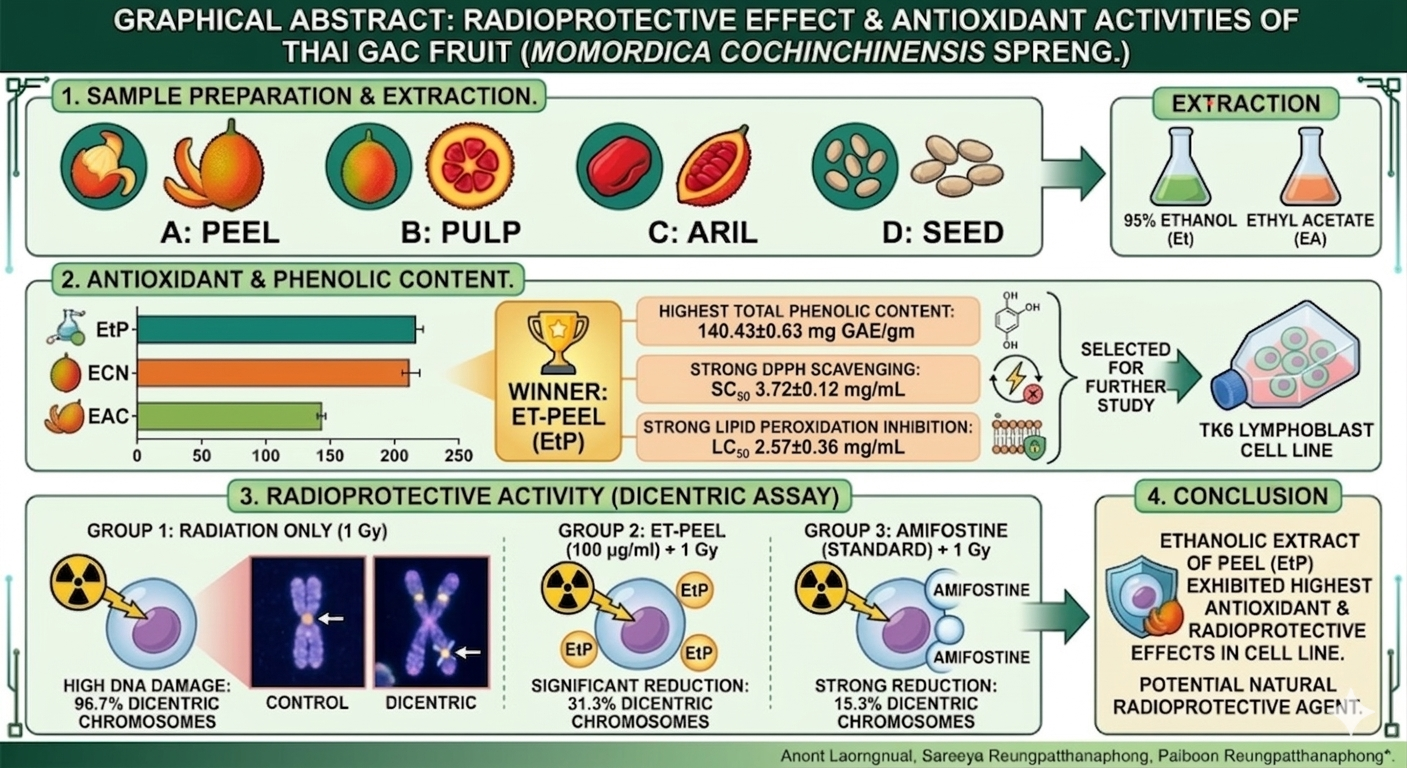
Objectives: The objective of this study was to determine the radioprotective effect, total phenolic content and antioxidant properties from various parts of Thai Gac fruit extracts.
Materials and methods: Each part of Thai Gac fruit including peel, pulp, aril, and seed were separately extracted using different solvents, 95% ethanol and ethyl acetate, for extraction. The total phenolic content and antioxidant activities were examined using DPPH radical scavenging assay and lipid peroxidation inhibition assay. Radioprotective effect of the extracts was evaluated by Dicentric Chromosome (DC) assay on TK6 lymphoblast cells after gamma irradiation.
Results: The ethanolic extraction of peel (EtP) showed the highest total phenolic content (140.43±0.63 mg GAE/gm), along with significant antioxidant activity which the values of SC50 were 3.72±0.12 mg/ml and 2.57±0.36 mg/ml for DPPH scavenging and lipid peroxidation inhibition, respectively. However, EtP and the ethyl acetate extract of pulp (EACN) exhibited higher LC50 values when compared to LC50 values of L-ascorbic acid (SC50=0.25±0.04 mg/ml) and α-tocopherol (LC50=0.85±0.14 mg/ml) as standard reagents. Cytotoxicity of Thai Gac fruit was studied on TK6 cells which revealed non-toxic at the concentrations up to 100 μg/ml and 25 μg/ml for EtP and EACN, respectively. Moreover, the DC assay showed that EtP exhibited radioprotective effect in a dose-dependent manner while EACN could reduce radiation-induced chromosomal abnormalities in TK6 lymphoblast cells.
Conclusion: The ethanolic extract of peel (EtP) exhibited the highest level of antioxidant activities and radioprotective effect when compared to those of other solvent extractions, suggesting it might be used as a potential natural radioprotective agent. It was found that EtP could reduce the damage caused by radiation. Our findings suggested that the peel of Thai Gac fruit extracted by 95% ethanol exhibited a potent antioxidant activity and radioprotective effects in cell line.
Article Details

This work is licensed under a Creative Commons Attribution-NonCommercial-NoDerivatives 4.0 International License.
Personal views expressed by the contributors in their articles are not necessarily those of the Journal of Associated Medical Sciences, Faculty of Associated Medical Sciences, Chiang Mai University.
References
Shivappa P, Bernhardt GV. Natural radioprotectors on current and future perspectives: A mini-review. J Pharm Bioallied Sci. 2022; 14(2): 57-71. doi: 10.4103/jpbs.jpbs_502_21.
Mun G-I, Kim S, Choi E, Kim CS, Lee Y-S. Pharmacology of natural radioprotectors. Arch Pharm Res. 2018; 41(11): 1033-50. doi: 10.1007/s12272-018-1083-6.
Yi J, Zhu J, Zhao C, Kang Q, Zhang X, Suo K, et al. Potential of natural products as radioprotectors and radiosensitizers: opportunities and challenges. Food & Function. 2021; 12(12): 5204-18. doi: 10.1039/d1fo00525a.
Maurya DK, Devasagayam TP, Nair CKK. Some novel approaches for radioprotection and the beneficial effect of natural products. Indian J Exp Biol. 2006;44(2):93.
Kumar S, Singh RK, Meena R. Emerging targets for radioprotection and radiosensitization in radiotherapy. Tumor Biology. 2016; 37(9): 11589-609. doi: 10.1007/s13277-016-5117-8.
Arora R, Gupta D, Chawla R, Sagar R, Sharma A, Kumar R, et al. Radioprotection by plant products: present status and future prospects. Phytother Res. 2005;19(1):1-22. doi: 10.1002/ptr.1605.
Shirazi A, Mihandoost E, Mahdavi SR, Mohseni M. Radio-protective role of antioxidant agents. Oncol Rev. 2012; 6(2): e16. doi: 10.4081/oncol.2012.e16.
Rithidech KN, Tungjai M, Reungpatthanaphong P, Honikel L, Simon SR. Attenuation of oxidative damage and inflammatory responses by apigenin given to mice after irradiation. Mutat Res Genet Toxicol Envirol Mutagen. 2012; 749(1): 29-38. doi: 10.1016/j.mrgentox.2012.08.001.
Chuyen HV, Nguyen MH, Roach PD, Golding JB, Parks SE. Gac fruit (Momordica cochinchinensis Spreng.): a rich source of bioactive compounds and its potential health benefits. Int J Food Sci Technol. 2015; 50(3): 567-77. doi: 10.1111/ijfs.12721.
Reungpatthanaphong S, Kirdin T, Chinnawong M, Bamrungchai M, Reungpatthanaphong P. Antioxidant activity of accelerated solvent extraction from different fractions of Thai gac fruit (Momordica cochinchinensis Spreng). TJPS. 2018; 42(2018): 37-40. Available from: http://www.tjps.pharm.chula.ac.th/proceedings/backend/proceeding_file/9_PN_FP_Sareeya%20Reungpatthanaphong%20(37-40).pdf
Abdulqader A, Ali F, Ismail A, Esa NM. Gac (Momordica cochinchinensis Spreng.) fruit and its potentiality and superiority in-health benefits. Journal of Contemporary Medical Sciences. 2018; 4(4). doi: 0.22317/jcms.v4i4.476
Reungpatthanaphong S, Chawananorasest K, Kirdin T, Bamrungchai M, Reungpatthanaphong P. Development of Thai Gac Fruit Extraction as a Multifunctional Cosmeceutical Ingredient for Antioxidant, Melanogenesis and Collagen Stimulating Activities. Key Engineering Materials. 2019; 819: 104-10. doi: 10.4028/www.scientific.net/KEM.819.104.
Srinivasan M, Devipriya N, Kalpana KB, Menon VP. Lycopene: An antioxidant and radioprotector against γ-radiation-induced cellular damages in cultured human lymphocytes. Toxicology. 2009; 262(1): 43-9. doi: 10.1016/j.tox.2009.05.004.
Boonpisuttinant K, Taka T, Ruksiriwanich W, Chutoprapat R, Udompong S, Kansawang R, et al. Assessment of in vitro anti-skin aging activities of Phyllanthus indofischeri Bennet extracts for dermatological and aesthetic applications. Sci Rep. 2023; 13(1): 18661. doi: 10.1038/s41598-023-45434-3.
Sudprasert W. Radiation dosimetry using biological methods. Bangkok: Extension and Training Office, Kasetsart University; 2018.
Abdulqader A, Ali F, Ismail A, Esa NM. Antioxidant compounds and capacities of Gac (Momordica cochinchinensis Spreng) fruits. Asian Pac J Trop Biomed. 2019; 9(4): 158-67. doi: 10.4103/2221-1691.256729.
Kubola J, Siriamornpun S. Phytochemicals and antioxidant activity of different fruit fractions (peel, pulp, aril and seed) of Thai gac (Momordica cochinchinensis Spreng). Food Chem. 2011; 127(3): 1138-45. doi: 10.1016/j.foodchem.2011.01.115.
Tinrat S, Akkarachaneeyakorn S, Singhapol C. Evaluation of antioxidant and antimicrobial activities of Momordica Cochinchinensis Spreng (Gac fruit) ethanolic extract. Int J Pharm Sci Res. 2014; 5(8): 3163. doi: 10.13040/IJPSR.0975-8232.5(8).3163-69.
Afanas’ev IB, Dcrozhko AI, Brodskii AV, Kostyuk VA, Potapovitch AI. Chelating and free radical scavenging mechanisms of inhibitory action of rutin and quercetin in lipid peroxidation. Biochem Pharmacol. 1989; 38(11): 1763-9. doi: 10.1016/0006-2952(89)90410-3.
Aherne SA, O’Brien NM. Mechanism of protection by the flavonoids, quercetin and rutin, against tert-butylhydroperoxide- and menadione-induced DNA single strand breaks in Caco-2 cells. Free Radic Biol Med. 2000; 29(6): 507-14. doi: 10.1016/S0891-5849(00)00360-9.
Cavusoglu K, Yalcin E. Radioprotective effect of lycopene on chromosomal aberrations (CAs) induced by gamma radiation in human lymphocytes. J Environ Biol. 2009; 30(1): 113-7. PMID: 20112872. https://www.jeb.co.in/journal_issues/200901_jan09_spl/paper_18.pdf
