
Comprehensive benchmarking of machine learning models for blood glucose classification and prediction: new approach for improved hyperglycemia and hypoglycemia detection and prediction
Article Sidebar
Main Article Content
Abstract
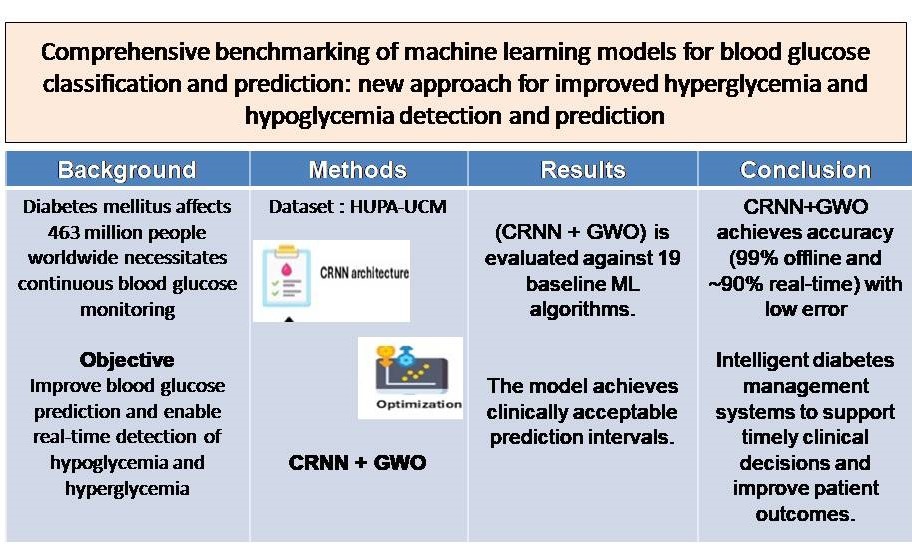
Background: Diabetes mellitus affects 463 million people worldwide and necessitates continuous blood glucose monitoring. Current glucose prediction systems often lack efficiency, and real-time prediction is essential for timely clinical intervention.
Objectives: This study aims to develop and validate a novel Convolutional Recurrent Neural Network (CRNN) enhanced with bio-inspired algorithms to improve blood glucose prediction and enable real-time detection of hypoglycemia and hyperglycemia.
Materials and methods: The proposed framework employs a CRNN architecture that combines Convolutional Neural Networks (CNNs) for feature extraction with Long Short-Term Memory (LSTM) layers for temporal sequence learning. The model was trained and evaluated using the HUPA-UCM diabetes dataset. Additionally, the study benchmarks the proposed model against 19 traditional Machine Learning (ML) algorithms and compares it with state-of-the-art methods from the literature.
Results: The proposed approach demonstrates superior predictive capability, consistently delivering promising results across multiple evaluation frameworks. The model achieves clinically acceptable prediction intervals, confirming its effectiveness in enhancing the accuracy and reliability of blood glucose prediction for diabetes management.
Conclusion: The findings demonstrate that the proposed CRNN model, enhanced with bio-inspired algorithms, provides an effective and reliable solution for real-time blood glucose prediction. By outperforming conventional ML methods and achieving clinically acceptable accuracy levels, the model shows strong potential for integration into intelligent diabetes management systems to support timely clinical decisions and improve patient outcomes.
Article Details

This work is licensed under a Creative Commons Attribution-NonCommercial-NoDerivatives 4.0 International License.
Personal views expressed by the contributors in their articles are not necessarily those of the Journal of Associated Medical Sciences, Faculty of Associated Medical Sciences, Chiang Mai University.
References
ElSayed NA, McCoy RG, Aleppo G, Balapattabi K, Beverly EA, Briggs Early K, et al. Diagnosis and classification of diabetes: Standards of care in diabetes—2025. Diabetes Care. 2025; 48(Suppl 1): S27-S49. doi:10.2337/dc25-S002.
Vaiyapuri T, Alharbi G, Muttipoll Dharmarajlu S, Bouteraa Y, Misra S, Venkata Naga Ramesh J, et al. IoT-Enabled early detection of diabetes diseases using deep learning and dimensionality reduction techniques. IEEE Access. 2024; 12: 143016-28.
Albahli S. Predictive analytics for diabetic patient care: Leveraging AI to forecast readmission and hospital stays. Comput Model Eng Sci. 2025; 143(1): 1095-128. doi:10.32604/cmes.2025. 05882.
Lin J, Song Z, Li Y, Chiang C, Hirakawa Y, Nakano Y, Hong YJ, Matsunaga M, Ota A, Tamakoshi K, Yatsuya H. Nonrestorative sleep and type 2 diabetes incidence: The Aichi workers’ cohort study. J Epidemiol. 2024; 34(9): 428-33. doi:10.2188/jea.JE20230184.
Bliss M. Who discovered insulin? In: The discovery of insulin. London: Palgrave Macmillan; 1982: pp189-211.
Umpierrez GE, Davis GM, ElSayed NA, Fadini GP, Galindo RJ, Hirsch IB, et al. Hyperglycemic crises in adults with diabetes: A consensus report. Diabetes Care. 2024; 47(8): 1257-75. doi:10.2337/dci24-0032.
Yang T, Yu X, Tao R, Li H, Zhou J. Blood glucose prediction for type 2 diabetes using clusteringbased domain adaptation. Biomed Signal Process Control. 2025; 105: 107629. doi:10.1016/j.bspc.2025.107629.
Mazgouti L, Laamiri N, Ben Ali J, El Amrani El Idrissi N, Di Costanzo V, Naeck R, et al. Optimization of blood glucose prediction with LSTM-XGBoost fusion and integration of statistical features for enhanced accuracy. Biomed Signal Process Control. 2025; 107: 107814. doi:10.1016/j.bspc.2025.107814.
Gao J, Guo C, Liu Y, Li P, Zhang J, Liu M. Dynamicstatic feature fusion with multi-scale attention for continuous blood glucose prediction. In: Proc IEEE Int Conf Acoust Speech Signal Process (ICASSP); 2025 Apr; Hyderabad; India: pp 1-5.
Sharma SK, Zamani AT, Abdelsalam A, Muduli D, Alabrah AA, Parveen N, Alanazi SM. A diabetes monitoring system and healthmedical service composition model in cloud environment. IEEE Access. 2023; 11: 32804-19. doi:10.1109/ACCESS.2023.3258549.
Ghosh M, Bora V. Evolution in blood glucose monitoring: from invasive to noninvasive devices and sensors. Discover Med. 2025; 2: 74. doi:10.1007/s44337025002731.
El Bouhissi H, Al-Qutaish RE, Ziane A, Amroun K, Yaya N, Lachi M. Towards diabetes mellitus prediction based on machine learning. In: Proc Int Conf Smart Computing and Application (ICSCA); 2023: pp 1-6.
El Bouhissi H, Ziane A, Rahmani L, Medbal M, Kostiuk M. RF-PSO: An optimized approach for diabetes prediction. In: Proc Int Conf Smart Technologies (ICST); 2023: pp 227-38.
Tomic D, Harding JL, Jenkins AJ, Shaw JE, Magliano DJ. The epidemiology of type 1 diabetes mellitus in older adults. Nat Rev Endocrinol. 2025; 21(2): 92-104. doi:10.1038/s4157402401046z.
Alfian G, Syafrudin M, Ijaz MF, Syaekhoni MA, Fitriyani NL, Rhee J. A personalized healthcare monitoring system for diabetic patients using BLEbased sensors. Sensors (Basel). 2018; 18(7): 2183. doi:10.3390/s18072183.
Jaloli M, Cescon M. Longterm prediction of blood glucose levels in type 1 diabetes using a CNNLSTM based deep neural network. J Diabetes Sci Technol. 2023; 17(6): 1590-601. doi:10.1177/19322968221092785.
Zhu T, Li K, Chen J, Herrero P, Georgiou P. Dilated recurrent neural networks for glucose forecasting in type 1 diabetes. J Healthc Inform Res. 2020; 4(3): 308-24. doi:10.1007/s41666020000682.
Hidalgo JI, Alvarado J, Botella M, Aramendi A, Velasco JM, Garnica O. HUPAUCM diabetes dataset. Data Brief. 2024; 55: 110559. doi:10.1016/j.dib.2024.110559.
Tena F, Garnica O, Lanchares J, Fernándezde Vega F, Hidalgo JI. Ensemble deep neural networks for blood glucose prediction. Sensors (Basel). 2021; 21(21): 7090. doi:10.3390/s21217090.
Ruan Y, Bellot A, Moysova Z, Tan GD, Lumb A, Davies J, van der Schaar M, Rea R. Predicting the risk of inpatient hypoglycemia with machine learning using electronic health records. Diabetes Care. 2020; 43(7): 1504-11. doi:10.2337/dc191743.
Shi M, Yang A, Lau ESH, Luk AOY, Ma RCW, Kong APS, Wong RSM, Chan JCM, Chan JCN, Chow E. A novel electronic health recordbased, machinelearning model to predict severe hypoglycemia leading to hospitalizations in older adults with diabetes: a territorywide cohort and modeling study. PLoS Med. 2024; 21(4): e1004369. doi:10.1371/journal.pmed.1004369.
Tsichlaki S, Koumakis L, Tsiknakis M. Type 1 Diabetes hypoglycemia prediction algorithms: Systematic review. JMIR Diabetes. 2022; 7(3): e34699. doi:10.2196/34699.
Aiello EM, Lisanti G, Magni L, Musci M, Toffanin C. Therapydriven deep glucose forecasting. Eng Appl Artif Intell. 2020; 87: 103255. doi:10.1016/j.engappai.2019.103255.
Karagoz MA, Breton MD, Fathi AE. A comparative study of transformerbased models for multihorizon blood glucose prediction. arXiv. 2025: arXiv: 2505.08821. doi:10.48550/arXiv.2505.08821.
Munoz-Organero M. Deep physiological model for blood glucose prediction in T1DM patients. Sensors (Basel). 2020; 20(14): 3896. doi:10.3390/s20143896.
Alvarado J, Velasco JM, Chavez F, Fernándezde Vega F, Hidalgo JI. Combining wavelet transform with convolutional neural networks for hypoglycemia prediction from CGM data. Chemometr Intell Lab Syst. 2023; 243: 105017. doi:10.1016/j.chemolab.2023.105017.
Mirshekarian S, Bunescu R, Marling C, Schwartz F. Using LSTMs to learn physiological models of blood glucose behavior. In: Proc IEEE EMBS Int Conf (EMBC); 2017; Jeju; Korea: pp 2887-91.
Sun Q, Jankovic MV, Bally L, Mougiakakou SG. Predicting blood glucose with LSTM and Bi-LSTM deep neural networks. In: Proc Int Symp Neural Networks Appl (NEUREL); 2018; Belgrade: pp 1-5.
El Idrissi T, Idri A, Abnane I, Bakkoury Z. Predicting blood glucose using an LSTM neural network. 2019 Federated Conference on Computer Science and Information Systems (FedCSIS). 2019: 35-41. doi:10.15439/2019F159.
Iacono F, Magni L, Toffanin C. Personalized LSTMbased alarm systems for hypoglycemia and hyperglycemia prevention. Biomed Signal Process Control. 2023; 86: 105167. doi:10.1016/j.bspc.2023.105167.
Li K, Daniels J, Liu C, HerreroVinas P, Georgiou P. Convolutional recurrent neural networks for glucose prediction. IEEE J Biomed Health Inform. 2019; 24(2): 603-13. doi:10.1109/JBHI.2019.29084 88.
Kavakiotis I, Tsave O, Salifoglou A, Maglaveras N, Vlahavas I, Chouvarda I. Machine learning and data mining methods in diabetes research. Comput Struct Biotechnol J. 2017; 15: 104-16. doi:10.1016/j.csbj.2016.12.005.
Rghioui A, Lloret J, Sendra S, Oumnad A. A smart architecture for diabetic patient monitoring using machine learning algorithms. Healthcare (Basel). 2020; 8(3): 348. doi:10.3390/healthcare8030348.
Kodama S, Fujihara K, Shiozaki H, Horikawa C, Yamada MH, Sato T, et al. Ability of current machine learning algorithms to predict and detect hypoglycemia in patients with diabetes mellitus: a metaanalysis. JMIR Diabetes. 2021; 6(1): e22458. doi:10.2196/22458.
Wang G, Liu X, Ying Z, Yang G, Chen Z, Liu Z, et al. Optimized glycemic control of type 2 diabetes with reinforcement learning: a proofofconcept trial. Nat Med. 2023; 29: 2633-42. doi:10.1038/s41591023025529.
LópezGómez JA, Romero FP, Angulo E. Bioinspired algorithms for the characterization of excellent performance in handball players: A datadriven methodology. Expert Syst Appl. 2025; 274: 126821. doi:10. 1016/ j.eswa.2025.126821.
Mirjalili S, Saremi S, Mirjalili SM, dos S. Coelho L. Multiobjective grey wolf optimizer: a novel algorithm for multicriterion optimization. Expert Syst Appl. 2016; 47: 106-19. doi:10.1016/j.eswa.2015.10.039.
