
Effectiveness of individualized multicomponent intervention for sensory food aversion feeding disorder in children: A case series
Article Sidebar
Main Article Content
Abstract
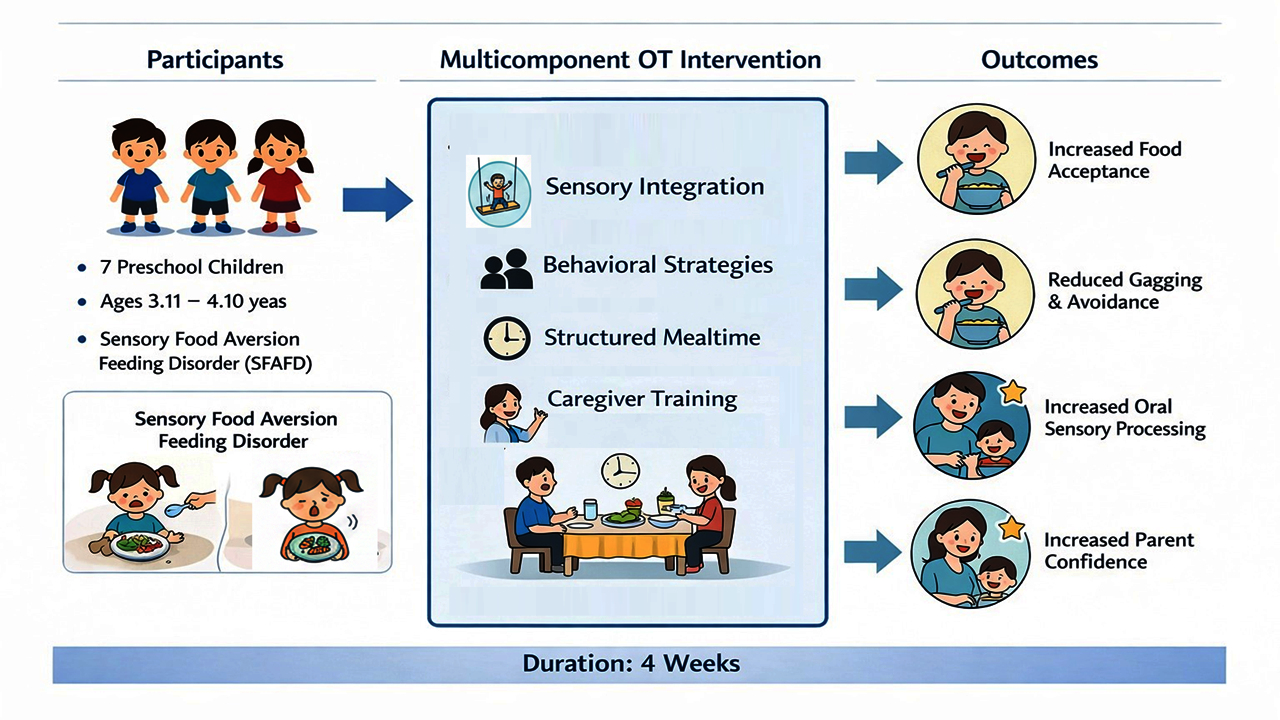
Background: Sensory food aversion feeding disorder is a feeding problem in which children refuse to eat all or most foods. This condition can be treated effectively using a multicomponent intervention that combines both sensory and behavioral strategies.
Objectives: This study aimed to determine the effectiveness of a multicomponent intervention for children with sensory food aversion feeding disorder. The specific objective was to increase acceptance and consumption of non-preferred foods and to improve parents’ positive coping attitude towards the child’s mealtime.
Materials and methods: This case series highlights seven cases that met the inclusion criteria. Informed consent was obtained from the parents. There were four boys and three girls, with ages ranging from 3.11 years to 4.9 years. The multicomponent intervention included sensory integration and behavioral modification strategies. Additionally, parents received education on the causes of food refusal and strategies for increasing food acceptance during meals.
Results: Seven children with sensory food aversion feeding disorder demonstrated increased food acceptance of previously refused foods. The incidence of food refusal behaviors, including gagging, spitting, and vomiting during mealtime, was also reduced.
Conclusion: This case series study provides information that may inform treatment strategies for sensory food aversion feeding disorder and may serve as a catalyst for larger-scale clinical trials.
Article Details

This work is licensed under a Creative Commons Attribution-NonCommercial-NoDerivatives 4.0 International License.
Personal views expressed by the contributors in their articles are not necessarily those of the Journal of Associated Medical Sciences, Faculty of Associated Medical Sciences, Chiang Mai University.
References
Estrem HH, Park J, Thoyre S, McComish C, McGlothen-Bell K. Mapping the gaps: a scoping review of research on pediatric feeding disorder. Clin Nutr ESPEN. 2022; 49: 1-9. doi.org/10.1016/j.clnesp.2021.12.028.
Galai T, Friedman G, Moses M, Shemer K, Gal DL, Yerushalmy-Feler A, et al. Demographic and clinical parameters are comparable across different types of pediatric feeding disorder. Sci Rep. 2022; 12(1): 8596. doi.org/10.1038/s41598-022-12562-1.
Silverman AH. Interdisciplinary care for feeding problems in children. Nutr Clin Pract. 2010; 25(2): 160-5. doi.org/10.1177/0884533610361609.
Stanislavskaia J. Behavioral feeding problems of normally developing children under 4 years of age [master’s thesis]. London (ON): University of Western Ontario; 2014. Available from: https://ir.lib.uwo.ca/etd/2331.
Chatoor I. Feeding disorders in infants and toddlers: diagnosis and treatment. Child Adolesc Psychiatr Clin N Am. 2002; 11(2): 163-83. doi.org/10.1016/S1056-4993(01)00002-5.
Silverman AH. Behavioral management of feeding disorders of childhood. Ann Nutr Metab. 2015; 66(Suppl 5): 33-42. doi.org/10.1159/000381375.
Kivilcim M, Dogan DG, Kortay Canaloglu S, Varol FI, Selimoglu MA. Assessment of behavioral feeding difficulties in young children. Ann Med Res. 2019; 26(10): 2459-65. doi.org/10.5455/annalsmedres.2019.06.320.
Chilman L, Kennedy Behr A, Frakking T, Swanepoel L, Verdonck M. Picky eating in children: a scoping review to examine its intrinsic and extrinsic features and how they relate to identification. Int J Environ Res Public Health. 2021; 18(17): 9067. doi.org/10.3390/ijerph18179067.
Angell A. Selective eaters and tactile sensitivity: a review of classification and treatment methods that address anxiety and support a child’s need for a sense of control. ICAN Infant Child Adolesc Nutr. 2010; 2(5): 299-303. doi.org/10.1177/1941406410382904.
Suarez MA, Bush E. Pilot study of the just right challenge feeding protocol for treatment of food selectivity in children. Open J Occup Ther. 2020; 8(2): 1-9. doi.org/10.15453/2168-6408.1648.
Steinberg C. Feeding disorders of infants, toddlers, and preschoolers. BC Med J. 2007;49(4):183-6.
Suarez MA. Multicomponent treatment for food selectivity in children: description and case report. Nutr Clin Pract. 2015; 30(3): 425-31. doi.org/10.1177/0884533614553638.
Miyajima A, Tateyama K, Fuji S, Nakaoka K, Hirao K, Higaki K. Development of an intervention programme for selective eating in children with autism spectrum disorder. Hong Kong J Occup Ther. 2017; 30(1): 22-32. doi.org/10.1016/j.hkjot.2017.10.001.
Hoyo V, Kadlec MB. From syringe to spoon feeding: a case report of how occupational therapy treatment successfully guided the parents of a child with autism spectrum disorder and prematurity in an outpatient clinic. J Autism Dev Disord. 2021; 51(7): 2561-5. hdoi.org/10.1007/s10803-020-04713-y.
Alaimo C, Seiverling L, Anderson K, Sturmey P. A comparison of two multicomponent treatment packages for food refusal. Behav Intervent. 2018; 33(1): 93-101. doi.org/10.1002/bin.1503.
Addison LR, Piazza CC, Patel MR, Bachmeyer MH, Rivas KM, Milnes SM, et al. A comparison of sensory integrative and behavioral therapies as treatment for pediatric feeding disorders. J Appl Behav Anal. 2012; 45(3): 455-71. doi.org/10.1901/jaba.2012.45-455.
Pichardo D, Franke K, Smith HM, Suarez LV, Kozlowski AM. A systematic review of food preference assessments for children with pediatric feeding disorders: a need for modifications and technological descriptions. Behav Dev. 2020; 25(2): 66-87. doi.org/10.1037/bdb0000097.
Notch L, Simenson B. A study examining the effectiveness of a sensory-based feeding group for children with problematic eating behaviors [capstone project]. Grand Forks (ND): University of North Dakota; 2014. Available from: https://commons.und.edu/ot-grad/329.
