
Factors increasing telemedicine adoption across adult non-healthcare professionals: A systematic review of observational studies published between 2021 and 2025
Article Sidebar
Main Article Content
Abstract
Background: Telemedicine has emerged as a key digital healthcare platform, offering convenient access to medical services for the public. Despite its potential, widespread adoption remains hindered by lingering consumer skepticism.
Objectives: The aim of this systematic review was to investigate the factors increasing telemedicine adoption across adult non-healthcare professionals.
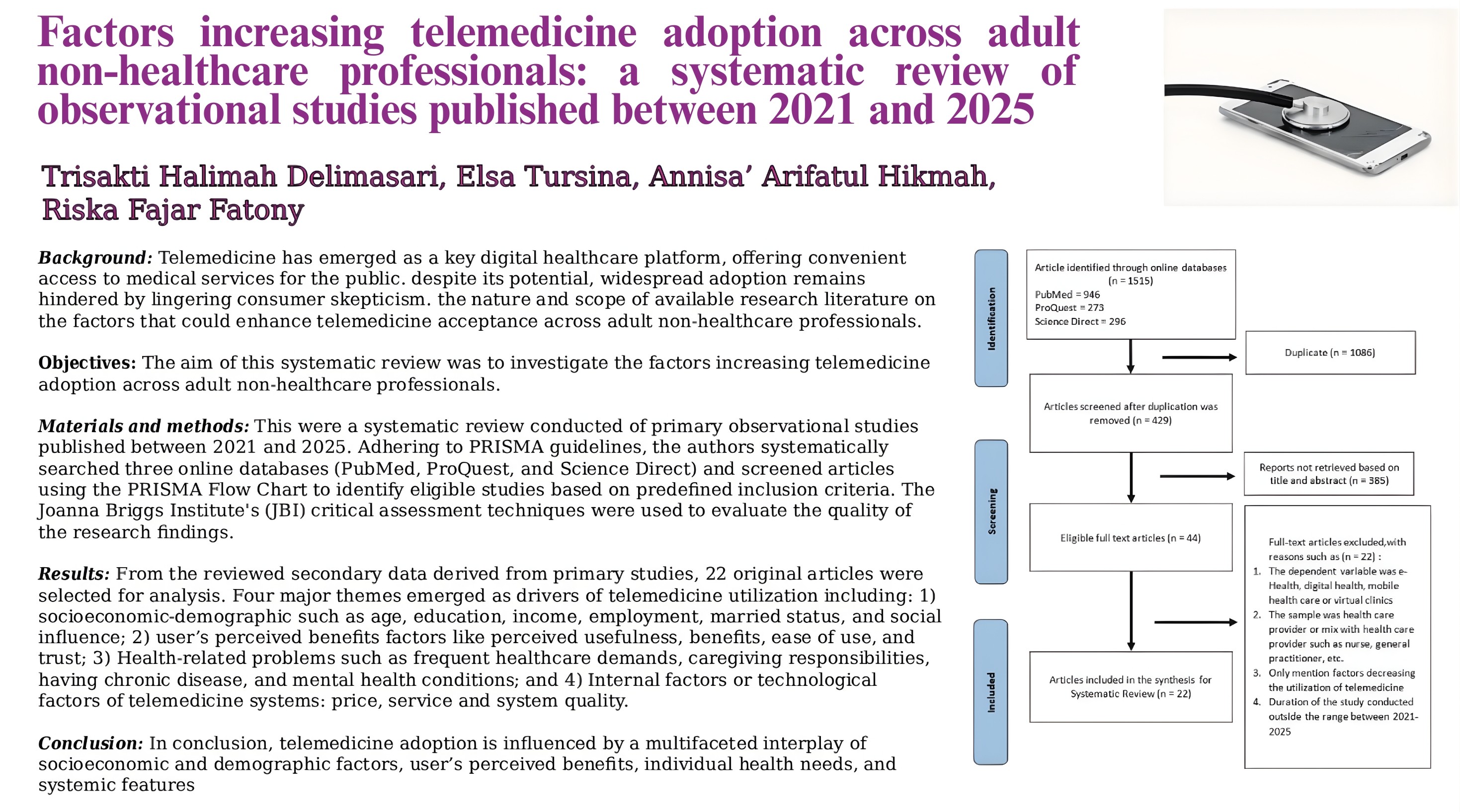
Materials and methods: This was a systematic review conducted of primary observational studies published between 2021 and 2025. Adhering to PRISMA guidelines, the authors systematically searched three online databases (PubMed, ProQuest, and Science Direct) and screened articles using the PRISMA Flow Chart to identify eligible studies based on predefined inclusion criteria. The Joanna Briggs Institute’s (JBI) critical assessment techniques were used to evaluate the quality of the research findings.
Results: From the reviewed secondary data derived from primary studies, 22 original articles were selected for analysis. Four major themes emerged as drivers of telemedicine utilization, including: 1) socioeconomic-demographic, such as age, education, income, employment, marital status, and social influence, 2) user’s perceived benefits factors like perceived usefulness, benefits, ease of use, and trust, 3) health-related problems, such as frequent healthcare demands, caregiving responsibilities, having chronic disease, and
mental health conditions, and 4) internal factors or technological factors of telemedicine systems: price, service, and system quality.
Conclusion: In conclusion, telemedicine adoption is influenced by a multifaceted interplay of socioeconomic and demographic factors, a user’s perceived benefits, individual health needs, and systemic features.
Article Details

This work is licensed under a Creative Commons Attribution-NonCommercial-NoDerivatives 4.0 International License.
Personal views expressed by the contributors in their articles are not necessarily those of the Journal of Associated Medical Sciences, Faculty of Associated Medical Sciences, Chiang Mai University.
References
Kabir H, Hasan MK, Akter N, et al. Factors associated with the intention of telehealth service utilization among Bangladeshi people: a crosssectional study. F1000Res. 2022; 11: 996. doi: 10.12688/f1000research.124410.2
Williams C, Shang D. Telehealth Usage Among Low-Income Racial and Ethnic Minority Populations During the COVID-19 Pandemic: Retrospective Observational Study. J Med Internet Res. 2023; 25: e43604. doi: 10.2196/43604
Yao L, Li Q, Li Q, et al. Factors influencing the adoption of telemedicine services among middleaged and older patients with chronic conditions in rural China: a multicentre cross-sectional study. BMC Health Serv Res. 2025; 25: 775. doi: 10.1186/s12913-025-12931-2
Tan S-H, Yap Y-Y, Tan S-K, et al. Determinants of Telehealth Adoption Among Older Adults: Cross- Sectional Survey Study. JMIR Aging. 2025; 8: e60936.doi: 10.2196/60936
Bhuyan SS, Kalra S, Mahmood A, et al. Motivation and Use of Telehealth Among People with Depression in the United States. J Prim Care Community Health. 2024; 15: 21501319241266515. doi: 10.1177/21501319241266515
Muehlensiepen F, Petit P, Knitza J, et al. Prediction of the acceptance of telemedicine among rheumatic patients: a machine learning-powered secondary analysis of German survey data. Rheumatol Int 2024; 44: 523-34. doi: 10.1007/s00296-023-05518-9
Odebunmi OO, Hughes TD, Waters AR, et al. Findings from a national survey of older US adults on patient willingness to use telehealth services: Cross-sectional survey. J Med Internet Res 2024; 26: e50205. doi: 10.2196/50205
Mackwood MB, Tosteson TD, Alford-Teaster JA, et al. Factors Influencing telemedicine use at a Northern New England Cancer Center during the COVID-19 pandemic. JCO Oncol Pract 2022; 18: e1141-e1153. doi: 10.1200/OP.21.00750
Shao H, Liu C, Tang L, et al. Factors Influencing the behavioral intentions and use behaviors of telemedicine in patients with diabetes: Webbased survey study. JMIR Hum Factors 2023; 10: e46624. doi: 10.2196/46624
Praha N, Sriyuktasuth A, Puwarawuttipanit W, et al. Factors influencing telehealth service use and health outcomes in patients undergoing continuous ambulatory peritoneal dialysis: Cross-sectional study. J Med Internet Res 2023; 25: e48623. doi: 10.2196/48623
Cobb S, Dillard A, Yaghmaei E, et al. Telehealth perceived benefits and self-efficacy do not mediate the effects of demographic, health, and social determinants on telehealth use of lowincome African American and Latino residents of public housing in Los Angeles. Healthcare 2025; 13: 286. doi: 10.3390/healthcare13030286
Anil Kumar Vaidhyam S, Huang K-T. Social determinants of health and patients’ technology acceptance of telehealth during the COVID-19 pandemic: Pilot survey. JMIR Hum Factors 2023; 10: e47982. doi: 10.2196/47982
Jeon H, Lee J, Jang J, et al. Willingness to use and pay for telemedicine and teleconsultation across five clinical domains in South Korea: Crosssectional survey. J Med Internet Res 2025; 27: e65304. doi: 10.2196/65304
Meraya AM, Khardali A, Ahmad S, et al. Telehealth perceptions and associated factors among older adults with chronic conditions in Saudi Arabia: a comparative study of users and non-users. Front Public Health 2025; 13: 1542974. doi: 10.3389/fpubh.2025.1542974
Tsatsos M, Rodafinos A, Athanasiadis IK, et al. Patients’ intentions to use telemedicine for ophthalmic medical care during the COVID-19 pandemic. Cureus 2024; 16: e54709. doi: 10.7759/cureus.54709
Wang M-Y, Chen H, Gong C, et al. Understanding the use intention and influencing factors of telerehabilitation in people with rehabilitation needs: a cross-sectional survey. Front Public Health 2023; 11: 1274080. doi: 10.3389/fpubh.2023.1274080
An MH, You SC, Park RW, et al. Using an extended technology acceptance model to understand the factors influencing telehealth utilization after flattening the COVID-19 curve in South Korea: Cross-sectional survey study. JMIR Med Inform 2021; 9: e25435. doi: 10.2196/25435
Li W, Guo J, Liu W, et al. Effect of older adults’ willingness on telemedicine usage: an integrated approach based on technology acceptance and decomposed theory of planned behavior model. BMC Geriatr 2024; 24: 765. doi: 10.1186/s12877-024-05361-y
Lin Y, Xu X, Liu Y, et al. Perception and acceptance of telemedicine use in health care among the general public in China: Web-based crosssectional survey. J Med Internet Res 2024; 26. Doi: 10.2196/53497
Yan C, Samphanwattanachai B, Ratarat C, et al. Factors influencing user decision of telemedicine applications in Thailand. PLoS One 2025; 20: e0325512. doi: 10.1371/journal.pone.0325512
Mao L, Mohan G, Normand C. Use of information communication technologies by older people and telemedicine adoption during COVID-19: a longitudinal study. J Am Med Inform Assoc 2023; 30: 2012–2020. doi: 10.1093/jamia/ocad165
Athavale P, Wong RJ, Satre DD, et al. Telehepatology Use and Satisfaction Among Vulnerable Cirrhosis Patients Across Three Healthcare Systems in the Coronavirus Disease Pandemic Era. Gastro hep advances 2024; 3: 201-9. doi: 10.1016/j.gastha.2023.11.006
Curtis ME, Clingan SE, Guo H, et al. Disparities in digital access among American rural and urban households and implications for telemedicinebased services. The Journal of Rural Health 2022; 38: 512-8. doi: 10.1111/jrh.12614
Kim S, Chow BC, Park S, et al. The Usage of Digital Health Technology Among Older Adults in Hong Kong and the Role of Technology Readiness and eHealth Literacy: Path Analysis. J Med Internet Res 2023; 25: e41915. doi: 10.2196/41915
Han J, Ko D. Mobile Financial Service Adoption Among Elderly Consumers: The Roles of Technology Anxiety, Familiarity, and Age. FinTech 2025; 4: 36. doi: 10.3390/fintech4030036
Jokisch MR, Schmidt LI, Doh M. Acceptance of digital health services among older adults: Findings on perceived usefulness, self-efficacy, privacy concerns, ICT knowledge, and support seeking. Front Public Health; 10. Epub ahead of print 13 December 2022. doi: 10.3389/fpubh.2022.1073756.
Ronzani P, Panizza F, Martini C, et al. Countering vaccine hesitancy through medical expert endorsement. Vaccine 2022; 40: 4635-43. doi: 10.1016/j.vaccine.2022.06.031
