
Impact of ergonomic workstation interventions and scapular bracing on neck muscle performance, postural alignment, neck disability and work productivity in bankers with non-specific neck pain
Article Sidebar
Main Article Content
Abstract
Background: Musculoskeletal disorders among bankers are linked to personal traits, prolonged working posture, repetitive tasks, and workstation design. Scapular bracing has been endorsed as an intervention for improving upper-body posture; however, evidence in symptomatic office workers is inadequate.
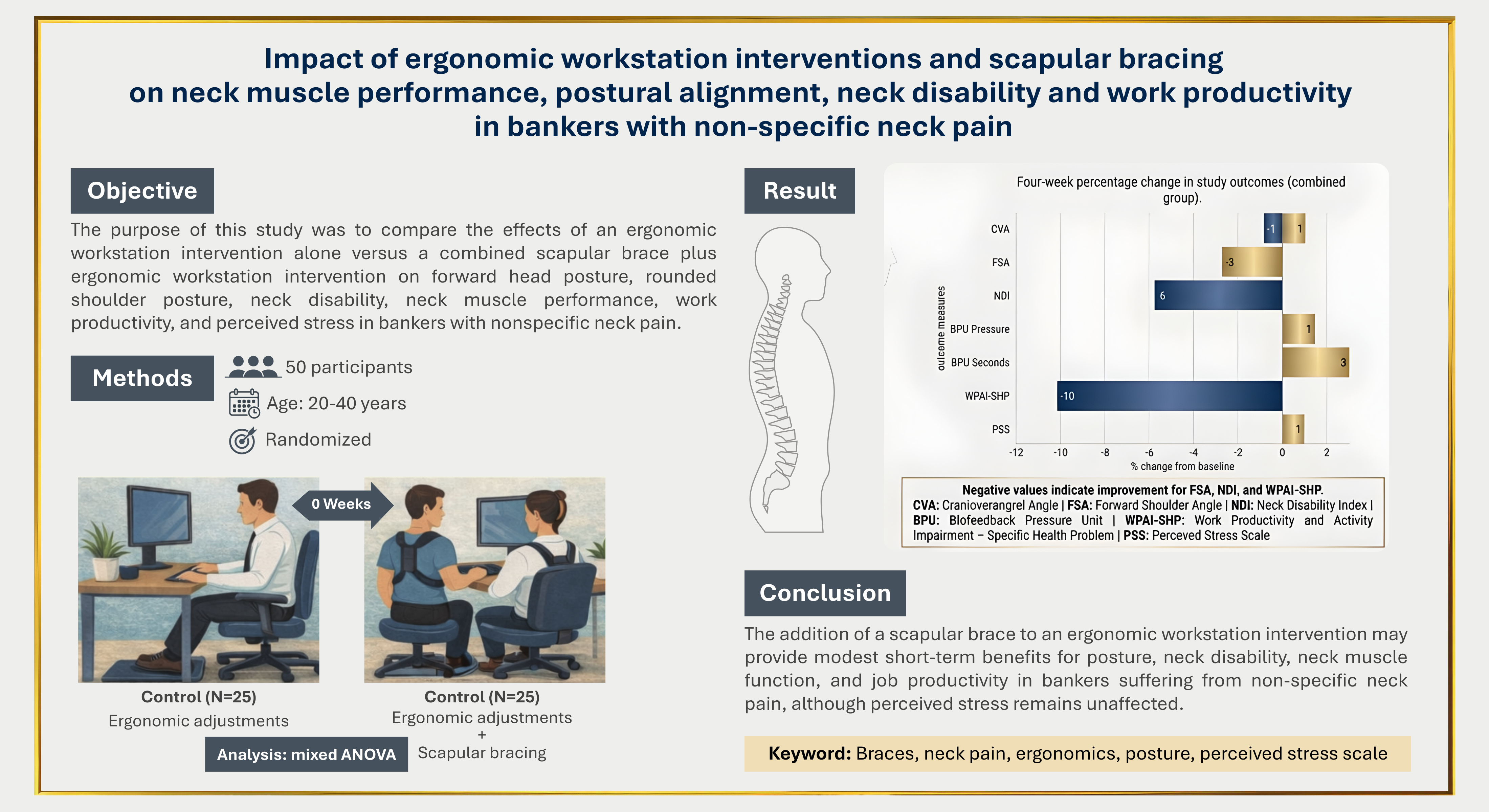
Objective: The purpose of this study was to compare the effects of an ergonomic workstation intervention alone versus a combined scapular brace plus ergonomic workstation intervention on forward head posture, rounded shoulder posture, neck disability, neck muscle performance, work productivity, and perceived stress in bankers with nonspecific neck pain.
Materials and Methods: Fifty bankers with non-specific neck pain were randomly assigned to one of two groups: ergonomic workstation intervention (control, N=25) or scapular brace plus ergonomic workstation intervention (experimental, N=25). Craniovertebral angle (CVA), forward shoulder angle (FSA), Neck Disability Index (NDI), neck muscle performance, work productivity, and Perceived Stress Scale (PSS) were all measured at baseline and four weeks later. The data were analysed with mixed-model repeated-measures ANOVA.
Results: Significant time × group interaction effects favoured the experimental group for CVA (p=0.005), FSA (p=0.001), NDI (p=0.017), neck muscle performance (p=0.004), and work productivity (p=0.003), indicating greater postural, functional, and productivity-related improvements as opposed to the control group. There were no significant between-group differences in perceived stress.
Conclusion: The addition of a scapular brace to an ergonomic workstation intervention may provide modest short-term benefits for posture, neck disability, neck muscle function, and job productivity in bankers suffering from non-specific neck pain, although perceived stress remains unaffected.
Article Details

This work is licensed under a Creative Commons Attribution-NonCommercial-NoDerivatives 4.0 International License.
Personal views expressed by the contributors in their articles are not necessarily those of the Journal of Associated Medical Sciences, Faculty of Associated Medical Sciences, Chiang Mai University.
References
Tella B, Akodu A, Fasuba O. The prevalence of neck and upper extremity repetitive stress injury among bank workers in Surulere, Lagos, Nigeria. J Rheumatol. 2011; 6(2): 1-6. Available from: https://ispub.com/IJRH/6/2/13522.
Akrouf QAS, Crawford JO, AlShatti AS, Kamel MI. Musculoskeletal disorders among bank office workers in Kuwait. East Mediterr Health J. 2010; 16(1): 94100. doi: 10.26719/2010.16.1.94.
Yu IT, Wong TW. Musculoskeletal problems among VDU workers in a Hong Kong bank. Occup Med (Lond). 1996; 46(4): 27580. doi:10.1093/occmed/46.4.275.
Mekhora K, Liston C, Nanthavanij S, Cole JH. The effect of ergonomic intervention on discomfort in computer users with tension neck syndrome. Int J Ind Ergon. 2000; 26(3): 36779. doi: 10.1016/S0169-8141(00)00012-3
Robertson M, Amick III BC, DeRango K, Rooney T, Bazzani L, Harrist R, et al. The effects of an office ergonomics training and chair intervention on worker knowledge, behavior and musculoskeletal risk. Appl Ergon. 2009; 40(1): 12435. doi:10.1016/j.apergo.2007.12.009.
Smith C. The effects of an ergonomic workstation intervention and exercise on office workers with neck pain. Faculty of Health Sciences: University of Cape Town; 2014.
Esmaeilzadeh S, Ozcan E, Capan N. Effects of ergonomic intervention on workrelated upper extremity musculoskeletal disorders among computer workers: a randomized controlled trial. Int Arch Occup Environ Health. 2014; 87(1): 7383. doi: 10.1007/s00420-012-0838-5
Jull G, Sterling M, Falla D, Treleaven J, O’Leary S. Whiplash, headache, and neck pain: researchbased directions for physical therapies. 1st Edition. London, United Kingdom: Elsevier Health Sciences; 2008.
Cagnie B, Dolphens M, Peeters I, Achten E, Cambier D, Danneels L. Use of muscle functional magnetic resonance imaging to compare cervical flexor activity between patients with whiplash-associated disorders and healthy controls. Phys Ther. 2010; 90(8): 115764. doi: 10.2522/ptj.20090351.
Cagnie B, Struyf F, Cools A, Castelein B, Danneels L, O’Leary S. The relevance of scapular dysfunction in neck pain: a brief commentary. J Orthop Sports Phys Ther. 2014; 44(6): 4359. doi: 10.2519/jospt.2014.5038.
Kim EK, Kim JS. Correlation between rounded shoulder posture, neck disability indices, and degree of forward head posture. J Phys Ther Sci. 2016; 28(10): 292932. doi: 10.1589/jpts.28.2929.
Cole AK, McGrath ML, Harrington SE, Padua DA, Rucinski TJ, Prentice WE. Scapular bracing and alteration of posture and muscle activity in overhead athletes with poor posture. J Athl Train. 2013; 48(1): 1224. doi: 10.4085/1062-6050-48.1.13.
Uhl T, Kibler W, Tripp B, Spigelman T, McClelland R, editors. Effects of S3 brace on scapular resting position and kinematics. Proceedings of Annual meeting of the American Orthopaedic Society for Sports Medicine; 2006.
Leung M, Kan MMP, Cheng HMH, De Carvalho DE, Anwer S, Li H, et al. Effects of using a shoulder/scapular brace on the posture and muscle activity of healthy university students during prolonged typing-A randomized controlled crossover trial. Healthcare (Basel). 2023; 11(11): 1555. doi: 10.3390/healthcare11111555.
Aronsson G, Gustafsson K, Dallner M. Sick but yet at work: an empirical study of sickness presenteeism. J Epidemiol Community Health. 2000; 54(7): 5029. doi: 10.1136/jech.54.7.502
van Leeuwen MT, Blyth FM, March LM, Nicholas MK, Cousins MJ. Chronic pain and reduced work effectiveness: the hidden cost to Australian employers. Eur J Pain. 2006; 10(2): 1616. doi: 10.1016/j.ejpain.2005.02.007.
Edmondston S, Björnsdóttir G, Pálsson T, Solgård H, Ussing K, Allison G. Endurance and fatigue characteristics of the neck flexor and extensor muscles during isometric tests in patients with postural neck pain. Man Ther. 2011; 16(4): 3328. doi: 10.1016/j.math.2010.12.005.
Shaghayeghfard B, Ahmadi A, Maroufi N, Sarrafzadeh J. Evaluation of forward head posture in sitting and standing positions. Eur Spine J. 2016; 25: 357782. doi: 10.1007/s00586-015-4254-x.
Thigpen CA, Padua DA, Michener LA, Guskiewicz K, Giuliani C, Keener JD, et al. Head and shoulder posture affect scapular mechanics and muscle activity in overhead tasks. J Electromyogr Kinesiol. 2010; 20(4): 7019. doi: 10.1016/j.jelekin.2009.12.003.
Childs JD, Cleland JA, Elliott JM, Teyhen DS, Wainner RS, Whitman JM, et al. Neck pain: clinical practice guidelines linked to the ICF from the orthopaedic section of the APTA. J Womens Health Phys Ther. 2011; 35(2): 5790. doi: 10.2519/jospt.2008.0303.
Noordin NB, Chyi LK, Ting A, Wah YC. Innovation of forward head posture orthosis with kyphosis brace. J Posit Sch Psychol. 2022: 351724.
Bankhele JR, Yeradkar RS, Mulye MM. Effect of upper back brace with auditory feedback for forward head rounded shoulder posture among office workers with chronic neck pain-A prepost single group study. Indian J Occup Ther. 2020; 52(3): 859. doi: 10.4103/ijoth.ijoth_26_20
Wilmarth M, Hilliard T. Measuring head posture via the craniovertebral angle. Orthop Phys Ther Pract [Internet]. 2002; 14(1): 13-15. Available from: https://sid.ir/paper/630774/en
FernándezdelasPeñas C, AlonsoBlanco C, Cuadrado M, Pareja J. Forward head posture and neck mobility in chronic tensiontype headache: a blinded, controlled study. Cephalalgia. 2006; 26(3): 3149. doi: 10.1111/j.1468-2982.2005.01042.x.
Kadu DV, Shetye JV. Reliability of “MBRuler Software” to measure craniovertebral angle using the photographic method. J Health Allied Sci NU. 2022; 12(3): 30711. doi: 10.1055/s-0041-1741415
Cleland JA, Fritz JM, Whitman JM, Palmer JA. The reliability and construct validity of the Neck Disability Index and patient specific functional scale in patients with cervical radiculopathy. Spine (Phila Pa 1976). 2006; 31(5): 598602. doi: 10.1097/01.brs.0000201241.90914.22.
Reilly MC, Zbrozek AS, Dukes EM. The validity and reproducibility of a work productivity and activity impairment instrument. Pharmacoeconomics. 1993; 4: 35365. doi: 10.2165/00019053-199304050-00006.
Blumenfeld AM, Patel AT, Turner IM, Mullin KB, Manack Adams A, Rothrock JF. Patientreported outcomes from a 1year, realworld, headtohead comparison of onabotulinumtoxinA and topiramate for headache prevention in adults with chronic migraine. J Prim Care Community Health. 2020; 11. doi: 10.1177/2150132720959936.
Cohen S, Kamarck T, Mermelstein R. A global measure of perceived stress. J Health Soc Behav. 1983: 38596. Available from: https://doi.org/10.2307/2136404
Brunton J, Brunton E, Ni Mhuiri A. Reliability of measuring natural head posture using the craniovertebral angle. Proceedings of Irish Ergonomics Review; 2003.
Quek J, Pua YH, Clark RA, Bryant AL. Effects of thoracic kyphosis and forward head posture on cervical range of motion in older adults. Man Ther. 2013; 18(1): 6571. doi: 10.1016/j.math.2012.07.005.
Singla D, Veqar Z. Methods of postural assessment used for sports persons. J Clin Diagn Res. 2014; 8(4): LE01. doi: 10.7860/JCDR/2014/6836.4266
Caneiro JP, O’Sullivan P, Burnett A, Barach A, O’Neil D, Tveit O, et al. The influence of different sitting postures on head/neck posture and muscle activity. Man Ther. 2010; 15(1): 5460. doi: 10.1016/j.math.2009.06.002.
Kim D, Cho M, Park Y, Yang Y. Effect of an exercise program for posture correction on musculoskeletal pain. J Phys Ther Sci. 2015; 27(6): 17914. doi: 10.1589/jpts.27.1791
Falla D, Jull G, Russell T, Vicenzino B, Hodges P. Effect of neck exercise on sitting posture in patients with chronic neck pain. Phys Ther. 2007; 87(4): 40817. doi: 10.2522/ptj.20060009.
Thorsteinsson EB. The relationship between workstress, psychological stress and staff health and work outcomes in office workers. Psychology. 2014. 5(10): 1301-11. doi: 10.4236/psych.2014.510141
