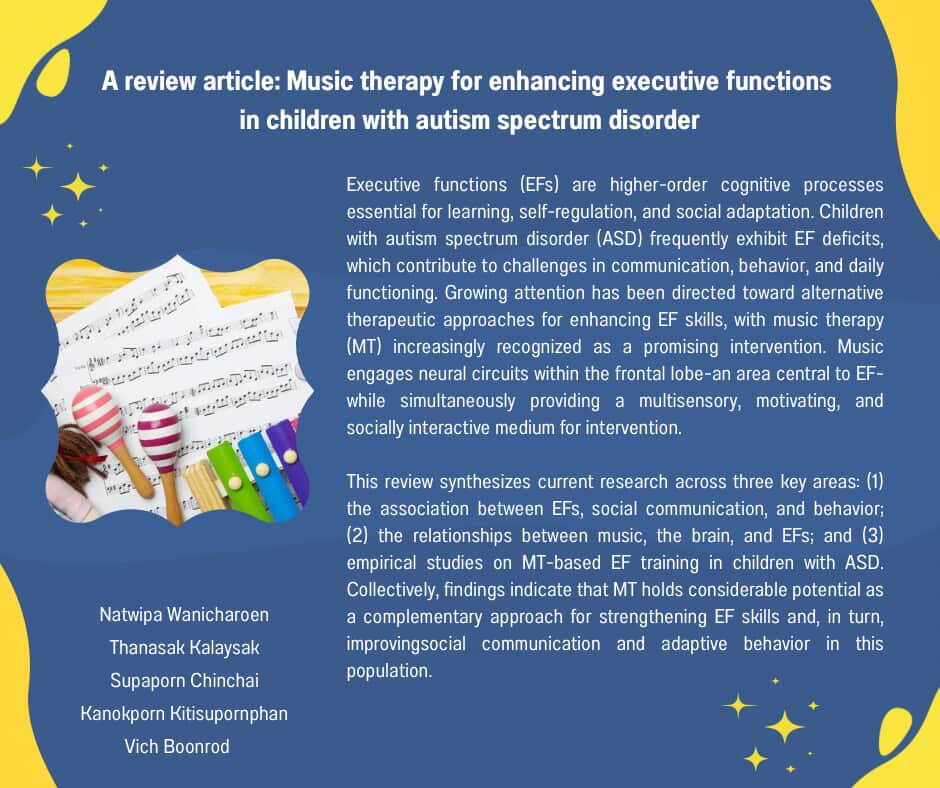
A review article: Music therapy for enhancing executive functions in children with autism spectrum disorder
Article Sidebar
Main Article Content
Abstract
Executive functions (EFs) are higher-order cognitive processes essential for learning, self-regulation, and social adaptation. Children with autism spectrum disorder (ASD) frequently exhibit EF deficits, which contribute to challenges in communication, behavior, and daily functioning. Growing attention has been directed toward alternative therapeutic approaches for enhancing EF skills, with music therapy (MT) increasingly recognized as a promising intervention. Music engages neural circuits within the frontal lobe-an area central to EF-while simultaneously providing a multisensory, motivating, and socially interactive medium for intervention. This review synthesizes current research across three key areas: (1) the association between EFs, social communication, and behavior; (2) the relationships between music, the brain, and EFs; and (3) empirical studies on MT-based EF training in children with ASD. Collectively, findings indicate that MT holds considerable potential as a complementary approach for strengthening EF skills and, in turn, improving social communication and adaptive behavior in this population.
Article Details

This work is licensed under a Creative Commons Attribution-NonCommercial-NoDerivatives 4.0 International License.
Personal views expressed by the contributors in their articles are not necessarily those of the Journal of Associated Medical Sciences, Faculty of Associated Medical Sciences, Chiang Mai University.
References
American Psychiatric Association. Diagnostic and statistical manual of mental disorders: DSM-5. 5th ed. Washington, DC: American Psychiatric Association; 2013.
Demetriou EA, Lampit A, Quintana DS, Naismith SL, Song YJC, Pye JE, et al. Autism spectrum disorders: a meta-analysis of executive function. J Autism Dev Disord. 2018; 48(8): 2555-73. doi:10.1007/s10803-018-3523-2.
Schreibman L, Dawson G, Stahmer AC, Landa R, Rogers SJ, McGee GG, et al. Naturalistic developmental behavioral interventions: Empirically validated treatments for autism spectrum disorder spectrum disorder. J Autism Dev Disord. 2015; 45: 2411-28. doi:10.1007/s10803-015-2407-8.
Patel AD. Music, language, and the brain. Oxford: Oxford University Press; 2010. doi:10.1093/acprof: oso/9780195123753.001.0001.
Rodriguez-Gomez DA, Talero-Gutiérrez C. Effects of music training on executive function performance in children: a systematic review. Front Psychol. 2022; 13 :968144. doi:10.3389/fpsyg.2022.968144.
Diamond A. Executive functions. Annu Rev Psychol. 2013; 64: 135-68. doi: 10.1146/annurev-psych-113011-143750.
Davidson M,Amso D, Anderson L, Diamond A. Development of cognitive control and executive functions from 4 to 13 years: evidence from manipulations of memory, inhibition, and task switching. Neuropsychologia. 2006; 44(11): 2037-78. doi: 10.1016/j.neuropsychologia.2006.02.006.
Miyake A, Friedman NP, Emerson MJ, Witzki AH, Howerter A, Wager TD. The unity and diversity of executive functions and their contributions to complex “frontal lobe” tasks: A latent variable analysis. Cogn Psychol. 2000; 41(1): 49-100. doi:10.1006/cogp.1999.0734.
Baddeley A. Working memory. Curr Biol. 2010; 20(4): 136-40. doi:10.1016/j.cub.2009.12.014.
Canas JJ, Fajardo I, Salmeron L. Cognitive flexibility. Int Encycl Ergonom Hum Factors. 2006; 1(3): 297-301.
Cowan N. Working memory underpins cognitive development, learning, and education. Educ Psychol Rev. 2014; 26: 197-223. doi:10.1007/s10648-013-9246-y.
Zelazo PD, Müller U. Executive function in typical and atypical development. In: Goswami U, editor. Blackwell handbook of childhood cognitive development. Oxford: Blackwell Publishing; 2002. pp. 445-69. doi: 10.1002/9780470996652.ch20.
Blair C. Educating executive function. Wiley Interdiscip Rev Cogn Sci. 2017; 8(1-2): e1403. doi: 10.1002/wcs.1403.
Howard J, Herold B, Major S, Leahy C, Ramseur K, Franz L, et al. Associations between executive function and attention abilities and language and social communication skills in young children with autism spectrum disorder. Autism. 2023; 27(7): 2135-44. doi:10.1177/13623613231154310.
Cascia J, Barr JJ. Associations among vocabulary, executive function skills and empathy in individuals with autism spectrum disorder spectrum disorder. J Appl Res Intellect Disabil. 2017; 30(4): 627-37. doi:10.1111/jar.12257.
Ellis Weismer S, Kaushanskaya M, Larson C, Mathée J, Bolt D. Executive function skills in school-age children with autism spectrum disorder spectrum disorder: Association with language abilities. J Speech Lang Hear Res. 2018; 61(11): 2641-58. doi: 10.1044/2018_jslhr-l-rsaut-18-0026.
McEvoy RE, Rogers SJ, Pennington BF. Executive function and social communication deficits in young children with autism spectrum disorder. J Child Psychol Psychiatry. 1993; 34(4): 563-78. doi: 10.1111/j.1469-7610.1993.tb01036.x.
Gilotty L, Kenworthy L, Sirian L, Black DO, Wagner AE. Adaptive skills and executive function in autism spectrum disorder spectrum disorders. Child Neuropsychol. 2002; 8(4): 241-58. doi: 10.1076/chin.8.4.241.13504.
Iversen RK, Lewis C. Executive function skills are linked to restricted and repetitive behaviors: Three correlational meta-analyses. Autism Res. 2021; 14(6): 1163-85. doi:10.1002/aur.2468.
Berenguer C, Roselló B, Colomer C, Baixauli I, Miranda A. Children with autism spectrum disorder and attention deficit hyperactivity disorder: Relationships between symptoms and executive function, theory of mind, and behavioral problems. Res Dev Disabil. 2018; 83: 260-9. doi:10.1016/j.ridd.2018.10.001.
Brondino N, Fusar-Poli L, Rocchetti M, Provenzani U, Barale F, Politi P. Complementary and alternative therapies for autism spectrum disorder spectrum disorder. Evid Based Complement Alternat Med. 2015; 2015: 258589. doi:10.1155/2015/258589.
Boonrod V, Wanicharoen N. A systematic review of the effect of music therapy compared to speech therapy on social communication skills in preschool children with autism spectrum disorder spectrum disorder. J Assoc Med Sci. 2025; 58(2): 130-8. doi:10.12982/JAMS.2025.046.
Sharma M, Mehta A. Music therapy improves executive functioning in children with autism spectrum disorder spectrum disorder. Int J Res Spec Educ. 2023;4(2): 46-50.
Rupsuwan T, Chiengchana N, Buranaprapuk A. The effect of virtual music therapy interventions on the executive function of a child with autism spectrum disorder spectrum disorder: A Single-case study. J Ratchasuda Inst Res Dev Persons Disabil. 2023; 19(1): 39-60.
Shonkoff JP, Phillips DA. From neurons to neighborhoods: The science of early childhood development. Washington, DC: National Academy Press; 2000. doi:10.17226/9824.
Gerry D, Unrau A, Trainor LJ. Active music classes in infancy enhance musical, communicative and social development. Dev Sci. 2012; 15(3): 398-407. doi:10.1111/j.1467-7687.2012.01142.x.
Johansson BB. Music and brain plasticity. Eur Rev. 2006; 14(1): 49-64. doi:10.1017/S1062798706000056.
Reybrouck M. Music and the plastic brain. How sounds can generate neuroplastic adaptations. Biomed J Sci Tech Res. 2023; 52(3): 43689-93. doi:10.26717/BJSTR.2023.52.008246.
Bruscia KE. Defining music therapy. 2nd ed. Gilsum, NH: Barcelona Publishers; 1989.
American Music Therapy Association (AMTA). American Music Therapy Association (AMTA) [Internet]. 2015 [cited 2025 April 11]. Available from: https://musictherapy.org.
Srinivasan SM, Bhat AN. A review of “music and movement” therapies for children with autism: embodied interventions for multisystem development. Front in integr Neurosci. 2013; 7: 22. doi:10.3389/fnint.2013.00022.
Sutikno PY, Jazuli M, Utomo U. The effects of singing activities on children’s memory, learning motivation, and creativity in an indonesian kindergarten for preschoolers. J Law Sustain Dev. 2024; 12(1): e3123. doi: 10.55908/sdgs.v12i1.3123.
