
Gamma ray interaction of germanoborate glasses for radiation shielding applications
Article Sidebar
Main Article Content
Abstract
Background: Ionizing radiation is essential in medical imaging and therapy, but it also poses health risks to medical staff and patients. Traditional shielding materials like lead are effective but toxic, while concrete lacks transparency. Therefore, glass systems incorporating high-Z oxides offer a promising alternative by combining optical clarity with enhanced radiation shielding performance.
Objectives: This study aims to develop and investigate germanoborate glasses doped with Gd2O3, with a particular focus on their photon attenuation properties. The findings are intended to development of transparent, lead-free radiation shielding materials suitable for medical and industrial applications.
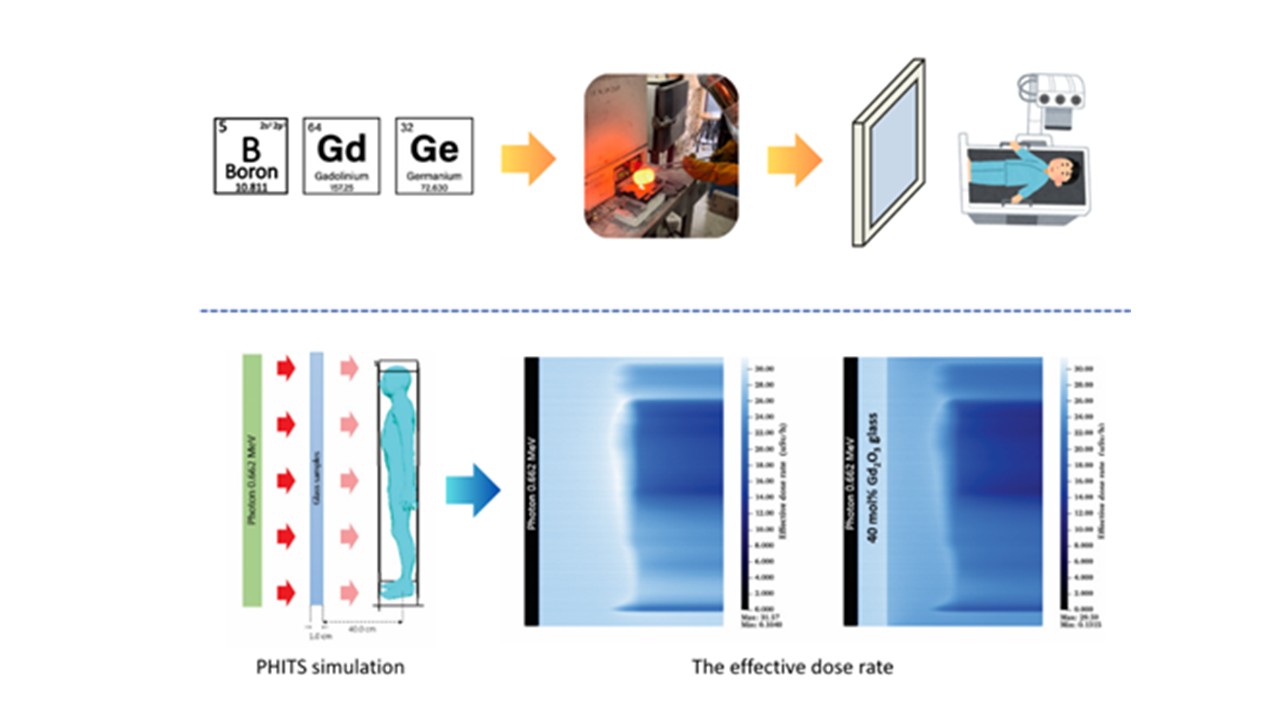
Materials and methods: The Gd2O3 added germanoborate glasses in the system (60-x)B2O3-GeO2-x Gd2O3 (with x=10, 20, 30 and 40 mol%) were synthesized via melting at 1400 oC followed by melt quenching method. The densities were measured by Archimedes’ method. The mass attenuation coefficients (μm), the effective atomic number (Zeff), the effective electron density (Neff), and half-value layers (HVL) were computed using the WinXCom program (NIST XCOM Database) to assess shielding properties. PHITS Monte Carlo simulations were employed to calculate the effective dose rate.
Results: The addition of Gd2O3 increased the glass density from 3.7546 gm/cm³ to 5.4604 gm/cm3. Replacing B2O3 with Gd2O3 enhanced the mass attenuation coefficients (μm), effective atomic number (Zeff) and effective electron density (Neff). HVL values decreased, Pb equivalent values increased, and the effective dose was reduced.
Conclusion: The incorporation of Gd2O3 into germanoborate glasses significantly enhances their gamma-ray attenuation capabilities, confirming their effectiveness as lead-free shielding materials. The developed glasses exhibit optimized radiation protection properties, highlighting their potential for transparent shielding applications in medical, industrial, and nuclear fields. and infliximab exert protective effects on liver function in acetic acid induced UC model. These findings suggest potential benefits of these therapies in mitigating liver damage associated with UC, highlighting the importance of considering liver health in UC management.
Article Details

This work is licensed under a Creative Commons Attribution-NonCommercial-NoDerivatives 4.0 International License.
Personal views expressed by the contributors in their articles are not necessarily those of the Journal of Associated Medical Sciences, Faculty of Associated Medical Sciences, Chiang Mai University.
References
Safari A, Rafie P, Taeb S, Najafi M, Mortazavi SMJ. Development of lead-free materials for radiation shielding in medical settings: A review. JBPE. 2024; 14: 229-44. doi: 10.31661/jbpe.v0i0.2404-1742.
Geist WH, Santi PA, Swinhoe Editors MT. Nondestructive assay of nuclear materials for safeguards and security.
Bektasoglu M, Ali Mohammad M. Investigation of radiation shielding properties of TeO2–ZnO–Nb2O5–Gd2O3 glasses at medical diagnostic energies. Ceram Int. 2020; 46(10): 16217-23. doi: 10.1016/j.ceramint.2020.03.177.
Al-Buriahi MS, Kurtulus R, Eke C, Alomairy S, Olarinoye IO. An insight into advanced glass systems for radiation shielding applications: A review on different modifiers and heavy metal oxides-based glasses. Vol. 10, Heliyon. Elsevier Ltd. 2024; doi: 10.1016/j.heliyon.2024.e40249.
Hordieiev Y, Zaichuk A. Structural, thermal, and radiation shielding properties of antimony-doped zinc borate glasses. Sci Rep. 2025; 15(1): 16158. doi: 10.1038/s41598-025-96015-5.
Hongtong W, Kaewjaeng S, Kothan S, Meejitpaisan P, Cheewasukhanont W, Limkitjaroenporn P, et al. Development of gadolinium doped calcium phosphate oxyfluoride glasses for X-ray shielding materials. Vol. 5, Materials Today: Proceedings. 2018; https://doi.org/10.1016/j.matpr.2018.02.062
Gerward L, Guilbert N, Jensen KB, Levring H. WinXCom - A program for calculating X-ray attenuation coefficients. In: Radiation Physics and Chemistry. 2004; pp 653-4. doi: 10.1016/j.radphyschem.2004.04.040.
Özdoğan H, Üncü YA, Akman F, Polat H, Kaçal MR. Investigation of gamma ray shielding characteristics of binary composites containing polyester resin and lead oxide. Polymers (Basel). 2024; 16(23): 3324. doi: 10.3390/polym16233324.
Elmahroug Y, Tellili B, Souga C. Determination of total mass attenuation coefficients, effective atomic numbers and electron densities for different shielding materials. Ann Nucl Energy. 2015; 75: 268-74. doi: 10.1016/j.anucene.2014.08.015.
Shamshad L, Rooh G, Limkitjaroenporn P, Srisittipokakun N, Chaiphaksa W, Kim HJ, et al. A comparative study of gadolinium-based oxide and oxyfluoride glasses as low energy radiation shielding materials. Prog Nucl Energy. 2017; 97: 53-9. doi: 10.1016/j.pnucene.2016.12.014.
Limkitjaroenporn P, Cheewasukhanont W, Kothan S, Kaewkhao J. Development of new high transparency Pb-free radiation shielding glass. Integr Ferroelectr. 2021; 214(1): 181-204. doi:10.1080/10584587.2020.1857196.
Gerward L, Guilbert N, Bj(rn Jensen K, Levring H. X-ray absorption in matter. Reengineering XCOM [Internet]. Vol. 60, Radiat Phys Chem. 2001; doi:10.1016/S0969-806X(00)00324-8.
Kim CH, Yeom YS, Petoussi-Henss N, Zankl M, Bolch WE, Lee C, et al. ICRP Publication 145: Adult mesh-type reference computational phantoms. Ann ICRP. 2020; 49(3): 13-201. doi: 10.1177/0146645319893605. PMID: 33231095.
Petoussi-Henss N, Bolch WE, Eckerman KF, Endo A, Hertel N, Hunt J, et al. Conversion coefficients for radiological protection quantities for external radiation exposures. Ann ICRP. 2010; 40(2-5): 1-257. doi: 10.1016/j.icrp.2011.10.001.
Sato T, Iwamoto Y, Hashimoto S, Ogawa T, Furuta T, Abe SI, et al. Recent improvements of the particle and heavy ion transport code system–PHITS version 3.33. J Nucl Sci Technol. 2024; 61(1): 127-35. doi: 10.1080/00223131.2023.2275736.
Chaiphaksa W, Yonphan S, Mutuwong C, Kothan S, Intachai N, Kaewkhao J. Experimental, theoretical, and Monte Carlo simulation study of radiation shielding properties of La2O3-Added lithium borate glasses. Radiat Phys Chem. 2024; 224: 111994. doi: 10.1016/j.radphyschem.2024.111994.
Madshal MA, El-Damrawi G, Abdelghany AM, Abdelghany MI. Structural studies and physical properties of Gd2O3-doped borate glass. J Mater Sc: Mater Electron. 2021; 32(11): 14642-53. doi: 10.1007/s10854-021-06022-1.
Chandra SRM, Prabhakar RA, Krishnamurthy GK, Appa RB. Physical and optical properties of PbOSb2O3-B2O3 glasses doped with Gd2O3. In: Materials Today: Proceedings. Elsevier Ltd. 2016; pp 3970-5. doi: 10.1016/j.matpr.2016.11.058.
Al-Buriahi MS, Alajerami YSM, Abouhaswa AS, Alalawi A, Nutaro T, Tonguc B. Effect of chromium oxide on the physical, optical, and radiation shielding properties of lead sodium borate glasses. J Non Cryst Solids. 20205; 544: 120171. doi: 10.1016/j.jnoncrysol.2020.120171.
Madbouly AM, Alazab HA, Borham E, Ezz-ElDin FM. Study of gamma radiation dosimeter and radiation shielding parameters of commercial window glass. Appl Phys A Mater Sci Process. 2021; 127(10): doi: 10.1007/s00339-021-04889-9.
Singh K, Singh H, Sharma V, Nathuram R, Khanna A, Kumar R, et al. Gamma-ray attenuation coefficients in bismuth borate glasses. NIM-B. 2002; 194(10): 1-6. doi: 10.1016/S0168-583X(02)00498-6.
Hussein EMA, Madbouly AM. Chemical and radiation shielding effectiveness of some heavy metal oxide glasses for immobilizing radioactive wastes. J Aust Ceram Soc. 2024; 60(1): 127-42. doi: 10.1007/s41779-023-00951-2.
