Long-term effects of a structured training program on physical fitness in male football players aged 18-22 years
Article Sidebar
Main Article Content
Abstract
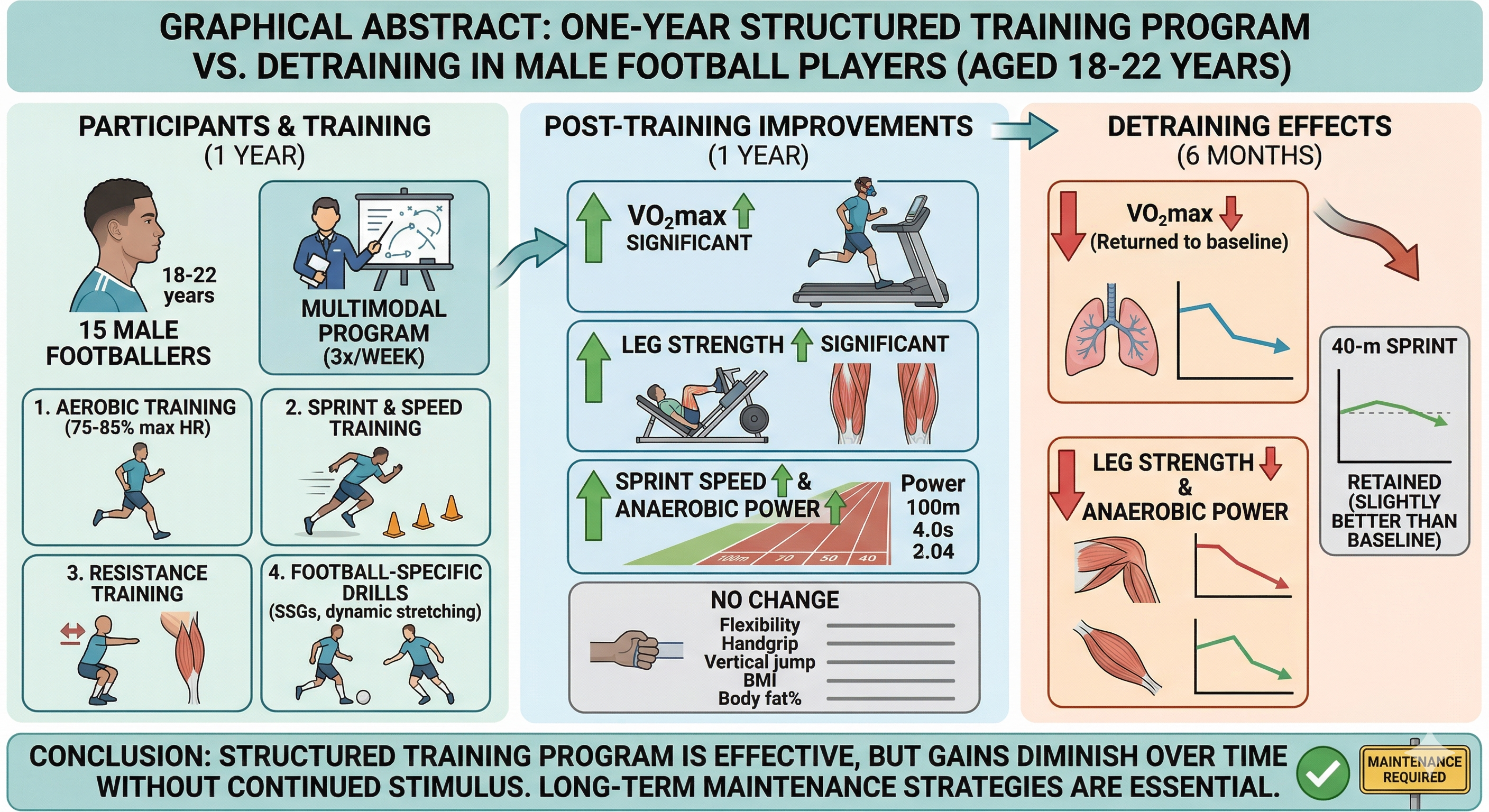
Background: Football performance relies on multiple physical capacities, including aerobic endurance, anaerobic power, muscle strength, speed, agility, and technical skills. Comprehensive training programs that integrate various conditioning elements may lead to multidimensional improvements in player performance. However, limited evidence exists regarding the long-term effects of such integrated programs, particularly whether physical performance gains can be sustained after training cessation.
Objectives: This study aims to evaluate the long-term effects of a one-year structured training program on physical fitness components in male university football players, including assessment of sustained outcomes after a sixmonth detraining period.
Materials and methods: A retrospective-prospective cohort study was conducted involving 15 male university-level competitive football players aged 18-22 years. Participants underwent a structured training regimen that incorporated aerobic, anaerobic, strength, speed, and football-specific drills. Physical fitness parameters were measured before the training period, immediately after one year of training, and again at six months post-training. Statistical analysis involved repeated-measures ANOVA and Bonferroni post hoc testing.
Results: The program significantly improved VO₂max, leg strength, sprint speed, and anaerobic power (p<0.05). However, these gains were not sustained at the six-month follow-up. Other measures, such as handgrip strength, flexibility, and vertical jump, did not show significant changes.
Conclusion: Structured multimodal training is effective in improving essential f itness attributes for football performance. However, without continued stimulus, performance gains diminish over time, suggesting the need for long-term maintenance strategies.
Article Details

This work is licensed under a Creative Commons Attribution-NonCommercial-NoDerivatives 4.0 International License.
Personal views expressed by the contributors in their articles are not necessarily those of the Journal of Associated Medical Sciences, Faculty of Associated Medical Sciences, Chiang Mai University.
References
Chen Y, Lo TY, Xu F, Chang JH. Biomechanical characteristics for identifying the cutting direction of professional soccer players. Appl Sci. 2021; 11(16): 7193. doi:10.3390/app11167193.
França C, Gouveia É, Caldeira R, Marques A, Martins J, Lopes H, et al. Speed and agility predictors among adolescent male football players. Int J Environ Res Public Health. 2022; 19(5): 2856. doi:10.3390/ijerph19052856.
Stolen T, Chamari K, Castagna C, Wisløff U. Physiology of soccer. Sports Med. 2005; 35(6): 501-36. doi:10.2165/00007256-200535060-00004.
Zaharia G, Badau D, Tudor V, Costache R, Geambasu A, Damian M, et al. The effects of 8 aerobic endurance training weeks of 4vs.4+GK small-sided games versus traditional training on physical f itness and skills among U18 football players. Appl Sci. 2023; 13(13): 7963. doi:10.3390/app131 37963.
Hoff J, Helgerud J. Endurance and strength training for soccer players: physiological considerations. Sports Med. 2004; 34(3): 165-80. doi: 10.2165/00 007256-200434030-00003.
Chmura P, Chmura J, Chodor W, Drozdzowski A, Rokita A, Konefał M. The effects of high-intensity interval training at the anaerobic and psychomotor fatigue thresholds on physiological parameters in young soccer players: a prospective study. Front Physiol. 2023; 14: 1221121. doi:10.3389/fphys.2023. 1221121.
Díaz-Hidalgo S, Ranchal-Sanchez A, Jurado-Castro JM. Improvements in jump height, speed, and quality of life through an 8-week strength program in male adolescent soccer players. Sports. 2024; 12(3): 67. doi:10.3390/sports12030067.
Wisløff U, Castagna C, Helgerud J, Jones R, Hoff J. Strong correlation of maximal squat strength with sprint performance and vertical jump height in elite soccer players. Br J Sports Med. 2004; 38(3): 285-8. doi: 10.1136/bjsm.2002.002071.
Owen AL, Wong DP, Paul D, Dellal A. Effects of a periodized small-sided game training intervention on physical performance in elite professional soccer. J Strength Cond Res. 2012; 26(10): 274854. doi: 10.1519/JSC.0b013e318242d2d1.
Sousa H, Gouveia ÉR, Marques A, Sarmento H, Pestana M, Quintal T, et al. The influence of small- sided football games with numerical variability in external training load. Sustainability. 2022; 14(2): 1000. doi:10.3390/su14021000.
Helgerud J, Engen LC, Wisløff U, Hoff J. Aerobic endurance training improves soccer performance. Med Sci Sports Exerc. 2001; 33(11): 1925-31. doi: 10.1097/00005768-200111000-00019.
Jackson AW, Baker AA. The relationship of the sit and reach test to criterion measures of hamstring and back flexibility in young females. Res Q Exerc Sport. 1986; 57(3): 183-6. doi: 10.1080/ 02701367.1986.10605395.
Markovic G, Dizdar D, Jukic I, Cardinale M. Reliability and factorial validity of squat and countermovement jump tests. J Strength Cond Res. 2004; 18(3): 551-5. doi: 10.1519/1533-4287(2004)18<551:RAFVOS> 2.0.CO;2.
Heyward VH, Gibson AL. Advanced fitness assessment and exercise prescription. 7th Ed. Champaign, IL: Human Kinetics; 2014.
Little T, Williams AG. Specificity of acceleration, maximum speed, and agility in professional soccer players. J Strength Cond Res. 2005; 19(1): 76-8. doi: 10.1519/14253.1.
Miller MG, Herniman JJ, Ricard MD, Cheatham CC, Michael TJ. The effects of a 6-week plyometric training program on agility. J Sports Sci Med. 2006; 5(3): 459-65.
Léger LA, Mercier D, Gadoury C, Lambert J. The multistage 20 metre shuttle run test for aerobic f itness. J Sports Sci. 1988; 6(2): 93-101. doi: 10. 1080/02640418808729800.
Zagatto AM, Beck WR, Gobatto CA. Validity of the running anaerobic sprint test for assessing anaerobic power and predicting short-distance performances. J Strength Cond Res. 2009; 23(6): 1820-7. doi: 10.1519/JSC.0b013e3181b3df32.
Slimani M, Nikolaidis PT. Anthropometric and physiological characteristics of male soccer players according to their competitive level, playing position and age group: a systematic review. J Sports Med Phys Fitness. 2019; 59(1): 141-63. doi: 10.23736/ S0022-4707.17.07950-6.
Suchomel TJ, Nimphius S, Stone MH. The importance of muscular strength in athletic performance. Sports Med. 2016; 46(10): 1419-49. doi: 10.1007/ s40279-016-0486-0.
Buchheit M, Mendez-Villanueva A, Delhomel G, Brughelli M, Ahmaidi S. Improving repeated sprint ability in young elite soccer players: repeated shuttle sprints vs. explosive strength training. J Strength Cond Res. 2010; 24(10): 2715-22. doi: 10.1519/JSC.0b013e3181bf0223.
Silva JR, Nassis GP, Rebelo A. Strength training in soccer with a specific focus on highly trained players. Sports Med Open. 2015; 1(1): 17. doi:10.1186/ s40798-015-0012-8.
Mujika I, Halson S, Burke LM, Balagué G, Farrow D. An integrated, multifactorial approach to periodization for optimal performance in individual and team sports. Int J Sports Physiol Perform. 2018; 13(5): 538-61. doi: 10.1123/ijspp.2018-0093.
Grgic J, Schoenfeld BJ, Davies TB, Lazinica B, Krieger JW, Pedisic Z. Effect of resistance training frequency on gains in muscular strength: a systematic review and meta-analysis. Sports Med. 2018; 48(5): 1207-20. doi: 10.1007/s40279018-0872-x.
Faigenbaum AD, Kraemer WJ, Blimkie CJ, Jeffreys I, Micheli LJ, Nitka M, et al. Youth resistance training: updated position statement paper from the National Strength and Conditioning Association. J Strength Cond Res. 2009; 23(5 Suppl): S60-S79. doi:10. 1519/JSC.0b013e31819df407.
Loturco I, Pereira LA, Kobal R, Zanetti V, Kitamura K, Abad CCC, et al. Transference of strength and power training to sports performance: a meta- analytical review. Sports Med. 2019; 49(2): 215-36. doi: 10.2478/hukin-2014-0054. eCollection 2014 Jun 28.
