
Performance comparisons of three rapid screening methods for the G6PD deficiency test in newborns
Article Sidebar
Main Article Content
Abstract
Background: Glucose-6-phosphate dehydrogenase (G6PD) deficiency is an X-linked recessive disorder that affects over 400 million people worldwide. The deficit causes individuals susceptible to hemolysis during oxidative stress. In newborns, G6PD deficiency can lead to hyperbilirubinemia, bilirubin-induced neurologic dysfunction, and kernicterus, making early detection and screening crucial.
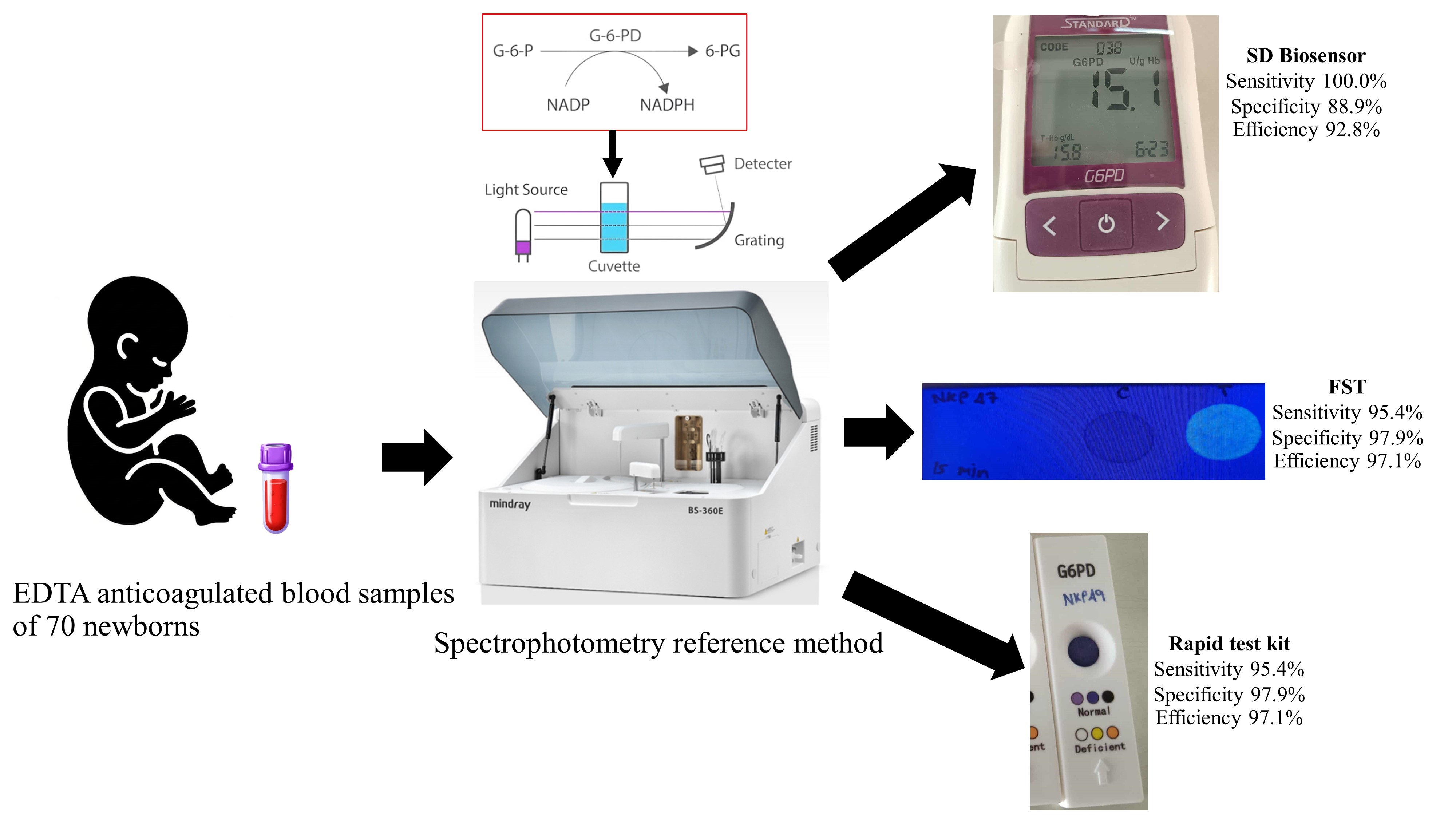
Objectives: This study aimed to compare the diagnostic performance of three rapid screening tests for G6PD deficiency in newborns: the fluorescent spot test (FST), G6PD rapid test kit, and SD Biosensor, using spectrophotometry as the gold standard.
Materials and methods: Blood samples from 70 newborns were tested using these three methods. The diagnostic performances, including sensitivity, specificity, positive predictive value (PPV), negative predictive value (NPV), and efficiency of each method were analyzed.
Results: Both the FST and G6PD rapid test kit exhibited higher specificity, PPV, and efficiency compared to the SD Biosensor. Nonetheless, the SD Biosensor exhibited superior sensitivity and NPV, but it was unable to identify G6PD activity in 16.4% of instances due to elevated hemoglobin concentrations.
Conclusion: The FST and G6PD rapid test kit are reliable and suitable for G6PD deficiency screening in newborns, especially in settings with limited resources, due to their high efficiency, specificity, and rapid results. The SD Biosensor remains a valuable tool in clinical contexts requiring high sensitivity. For newborns with high hemoglobin levels, the FST or G6PD rapid test is recommended for accurate screening. Further studies with larger sample sizes are necessary to confirm the reliability of these tests in diverse populations.
Article Details

This work is licensed under a Creative Commons Attribution-NonCommercial-NoDerivatives 4.0 International License.
Personal views expressed by the contributors in their articles are not necessarily those of the Journal of Associated Medical Sciences, Faculty of Associated Medical Sciences, Chiang Mai University.
References
Cappellini MD, Fiorelli G. Glucose-6-phosphate dehydrogenase deficiency. Lancet. 2008; 371 (9606): 64-74. doi: 10.1016/S0140-6736(08)60073-2.
Vulliamy T, Othman A, Town M, Nathwani A, Falusi A, Mason P, et al. Polymorphic sites in the African population detected by sequence analysis of the glucose-6-phosphate dehydrogenase gene outline the evolution of the variants A and A-. Proc Natl Acad Sci U S A. 1991; 88(19): 8568-71. doi: 10.1073/pnas.88.19.8568.
Howes RE, Battle KE, Satyagraha AW, Baird JK, Hay SI. G6PD deficiency: global distribution, genetic variants and primaquine therapy. Adv Parasitol. 2013; 81: 133-201. doi: 10.1016/B978-0-12-407826-0.00004-7.
Nuchprayoon I, Sanpavat S, Nuchprayoon S. Glucose-6-phosphate dehydrogenase (G6PD) mutations in Thailand: G6PD Viangchan (871G>A) is the most common deficiency variant in the Thai population. Hum Mutat. 2002; 19(2): 185. doi: 10.1002/humu.9010.
Nuinoon M, Krithong R, Pramtong S, Sasuk P, Ngeaiad C, Chaimusik S, et al. Prevalence of G6PD deficiency and G6PD variants amongst the southern Thai population. Peer J. 2022; 10:e14208. doi: 10.7717/peerj.14208.
Charoenkwan P, Tantiprabha W, Sirichotiyakul S, Phusua A, Sanguansermsri T. Prevalence and molecular characterization of glucose-6-phosphate dehydrogenase deficiency in northern Thailand. Southeast Asian J Trop Med Public Health. 2014; 45(1): 187-93.
Ratrisawadi V, Horpaopan S, Chotigeat U, Sangtawesin V, Kanjanapattanakul W, Ningsanond V, et al. Neonatal screening program in Rajavithi Hospital, Thailand. Southeast Asian J Trop Med Public Health. 1999; 30 (Suppl 2):28-32.
Pimpakan T, Mungkalasut P, Tansakul P, Chanda M, Jugnam-Ang W, Charucharana S, et al. Effect of neonatal reticulocytosis on glucose 6-phosphate dehydrogenase (G6PD) activity and G6PD deficiency detection: a cross-sectional study. BMC Pediatr. 2022; 22(1): 678. doi: 10.1186/s12887-022-03740-1.
WHO. Glucose-6-phosphate dehydrogenase deficiency. WHO Working Group. Bull World Health Organ. 1989; 67(6): 601-11.
Lee HY, Ithnin A, Azma RZ, Othman A, Salvador A, Cheah FC. Glucose-6-phosphate dehydrogenase deficiency and neonatal hyperbilirubinemia: insights on pathophysiology, diagnosis, and gene variants in disease heterogeneity. Front Pediatr. 2022; 10: 875877. doi: 10.3389/fped.2022.875877.
Stocker R, Yamamoto Y, McDonagh AF, Glazer AN, Ames BN. Bilirubin is an antioxidant of possible physiological importance. Science. 1987; 235(4792): 1043-6. doi: 10.1126/science.3029864.
Brouillard RP. Measurement of Red Blood Cell Life-Span. JAMA. 1974; 230(9): 1304-5.
Dennery PA, Seidman DS, Stevenson DK. Neonatal hyperbilirubinemia. N Engl J Med. 2001; 344(8): 581-90. doi: 10.1056/NEJM200102223440807.
Ip S, Chung M, Kulig J, O’Brien R, Sege R, Glicken S, et al. An evidence-based review of important issues concerning neonatal hyperbilirubinemia. Pediatrics. 2004; 114(1): e130-53. doi: 10.1542/peds.114.1.e130.
Liu H, Liu W, Tang X, Wang T. Association between G6PD deficiency and hyperbilirubinemia in neonates: a meta-analysis. Pediatr Hematol Oncol. 2015; 32(2): 92-8. doi: 10.3109/08880018.2014.887803.
Huang CS, Chang PF, Huang MJ, Chen ES, Chen WC. Glucose-6-phosphate dehydrogenase deficiency, the UDP-glucuronosyl transferase 1A1 gene, and neonatal hyperbilirubinemia. Gatroenterology. 2002; 123(1): 127-33. doi: 10.1053/gast.2002.34173.
Ley B, Bancone G, von Seidlein L, Thriemer K, Richards JS, Domingo GJ, et al. Methods for the field evaluation of quantitative G6PD diagnostics: a review. Malar J. 2017; 16(1): 361. doi: 10.1186/s12936-017-2017-3.
Pfeffer DA, Ley B, Howes RE, Adu P, Alam MS, Bansil P, et al. Quantification of glucose-6-phosphate dehydrogenase activity by spectrophotometry: A systematic review and meta-analysis. PLoS Med. 2020; 17(5): e1003084. doi: 10.1371/journal.pmed.1003084.
Saejeng A, Khantikul N, Boonin P, Anantasuk P, Srithep S, Pornprasert S. Modified Fluorescent Spot Test for screening G6PD deficiency among malaria patients in remote health care services, Northern Thailand. LPHJ. 2018; 14(2): 12-21.
Pal S, Bansil P, Bancone G, Hrutkay S, Kahn M, Gornsawun G, et al. Evaluation of a Novel 1 Quantitative Test for Glucose-6-Phosphate Dehydrogenase Deficiency: Bringing Quantitative Testing for Glucose-6-Phosphate Dehydrogenase Deficiency Closer to the Patient. Am J Trop Med Hyg. 2019; 100(1): 213-21. doi: 10.4269/ajtmh.18-0612.
Sadhewa A, Satyagraha AW, Alam MS, Adissu W, Anvikar A, Bancone G, et al. Performance of quantitative point-of-care tests to measure G6PD activity: An individual participant data meta-analysis. PLoS Negl Trop Dis. 2025; 19(3): e0012864. doi: 10.1371/journal.pntd.0012864.
Yamane T. Statistics: An Introductory Analysis. 3rd ed. New York: Harper and Row; 1973.
Beutler E, Blume KG, Kaplan JC, Löhr GW, Ramot B, Valentine WN. International Committee for Standardization in Haematology: recommended screening test for glucose-6-phosphatedehydrogenase (G-6-PD) deficiency. Br J Haematol. 1979; 43(3): 465-7. doi: 10.1111/j.1365-2141.1979.tb03774.x.
Adu-Gyasi D, Asante KP, Newton S, Dosoo D, Amoako S, Adjei G, et al. Evaluation of the diagnostic accuracy of CareStart G6PD deficiency Rapid Diagnostic Test (RDT) in a malaria endemic area in Ghana, Africa. PLoS One. 2015; 10(4): e0125796. doi: 10.1371/journal.pone.0125796.
Jiang J, Ma X, Song C, Lin B, Cao W, Wu S, et al. Using the fluorescence spot test for neonatal screening of G6PD deficiency. Southeast Asian J Trop Med Public Health. 2003; 34 (Suppl 3): 140-2.
Thielemans L, Gornsawun G, Hanboonkunupakarn B, Paw MK, Porn P, Moo PK, et al. Diagnostic performances of the fluorescent spot test for G6PD deficiency in newborns along the Thailand-Myanmar border: A cohort study. Wellcome Open Res. 2018; 3(1). doi: 10.12688/wellcomeopenres.13373.1.
Tinley KE, Loughlin AM, Jepson A, Barnett ED. Evaluation of a rapid qualitative enzyme chromatographic test for glucose-6-phosphate dehydrogenase deficiency. Am J Trop Med Hyg. 2010; 82(2): 210-4. doi: 10.4269/ajtmh.2010.09-0416.
