Effect of home-based isometric handgrip training on vascular function in middle-aged women with elevated pulse pressure
Article Sidebar
Main Article Content
Abstract
Background: Wide pulse pressure (PP) is a significant predictor of cardiovascular events. Isometric handgrip exercise (IHG) is a form of exercise used to manage blood pressure (BP). However, research on its effects in individuals with abovenormal pulse pressure remains limited.
Objectives: This study aimed to examine the impact of a home-IHG program on arterial stiffness and blood pressure in middle-aged individuals with prehypertension or stage 1 hypertension and elevated PP.
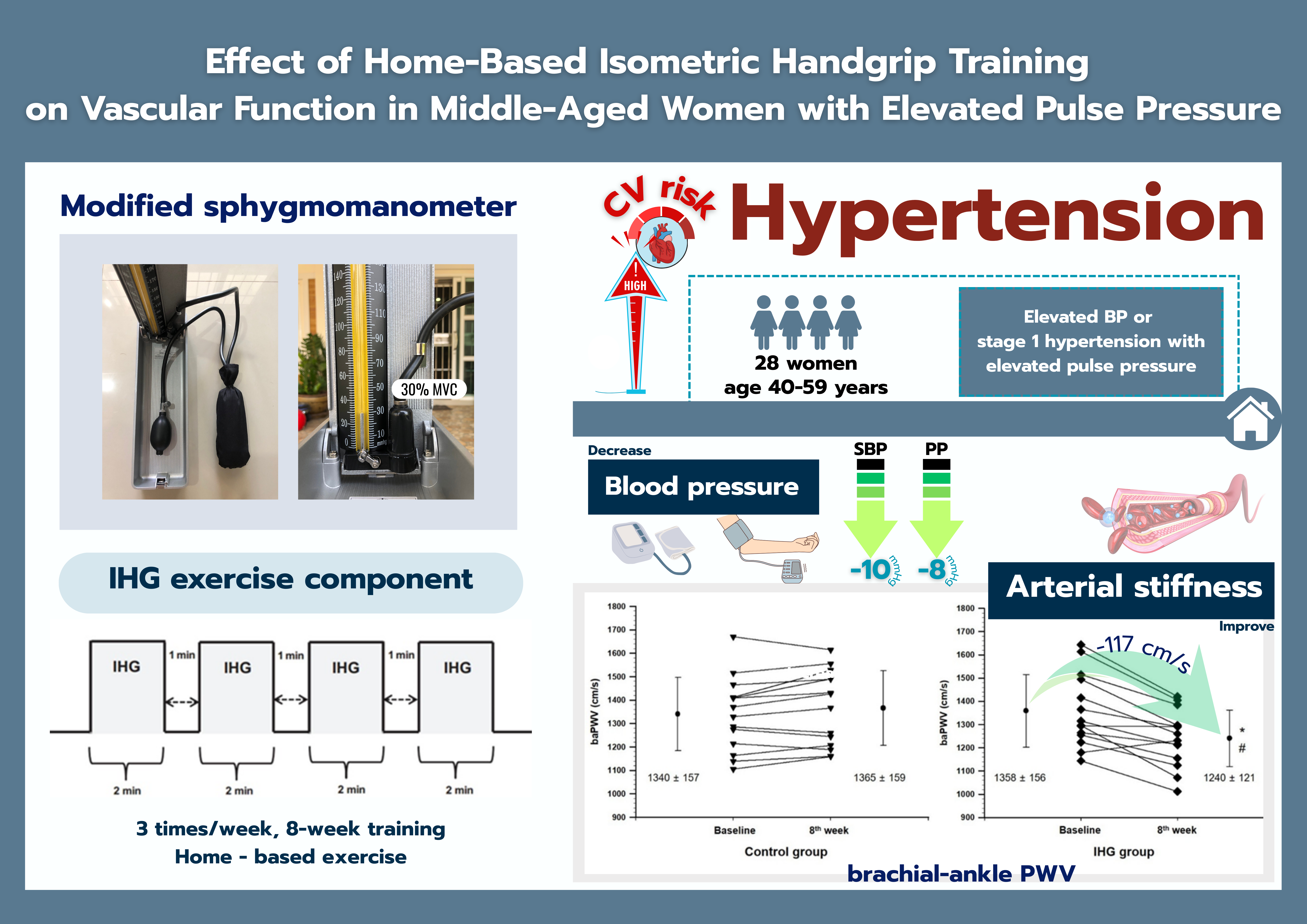
Materials and methods: Twenty-eight participants were randomly assigned to either the IHG group (IHG, N=14) or the control group (CON, N=14). The IHG group performed IHG at 30% of their maximum voluntary contraction, using a modified mercury sphygmomanometer as the exercise device, 3 times/week, for 8 weeks. Brachial-ankle pulse wave velocity (baPWV) and BP were assessed at baseline and post-intervention.
Results: The results demonstrated an improvement in vascular function following IHG implementation, indicated by a significant decrease in baPWV in the IHG group compared with the control group (IHG: 1240±121 cm/s vs CON: 1365±159 cm/s; p<0.05). IHG also significantly reduced systolic blood pressure (SBP) compared with the control group (IHG: 119.86±5.26 mmHg vs CON: 131.21±3.64 mmHg; p<0.05). Moreover, changes in baPWV were positively correlated with changes in SBP (r=0.65, p<0.001) and PP (r=0.52, p<0.01).
Conclusion: An 8-week home-based IHG program using a mercury sphygmomanometer for training reduced BP and arterial stiffness in middle-aged women with elevated PP.
Article Details

This work is licensed under a Creative Commons Attribution-NonCommercial-NoDerivatives 4.0 International License.
Personal views expressed by the contributors in their articles are not necessarily those of the Journal of Associated Medical Sciences, Faculty of Associated Medical Sciences, Chiang Mai University.
References
Lewington S, Clarke R, Qizilbash N, Peto R, Collins R, Prospective Studies Collaboration. Age-specific relevance of usual blood pressure to vascular mortality: a meta-analysis of individual data for one million adults in 61 prospective studies. Lancet Lond Engl. 2002; 360(9349): 1903-13. doi: 10.1016/s0140-6736(02)11911-8.
Steppan J, Barodka V, Berkowitz DE, Nyhan D. Vascular stiffness and increased pulse pressure in the aging cardiovascular system. Cardiol Res Pract. 2011; 2011: 263585. doi: 10.4061/2011/263585.
Riebe DK, Ehrman J, Liguori G, Magal M. ACSM’s guidelines for exercise testing and prescription. Wolters Kluwer; 2022.
Whelton PK, Carey RM, Aronow WS, Casey DE, Collins KJ, Dennison Himmelfarb C, et al. 2017 ACC/AHA/AAPA/ABC/ACPM/AGS/APhA/ASH/ASPC/NMA/PCNA guideline for the prevention, detection, evaluation, and management of high blood pressure in adults: a report of the American College of Cardiology/American Heart Association Task Force on Clinical Practice Guidelines. J Am Coll Cardiol. 2018; 71(19): e127-248. doi:10.1161/HYP.0000000000000066.
] Edwards JJ, Deenmamode AHP, Griffiths M, Arnold O, Cooper NJ, Wiles JD, et al. Exercise training and resting blood pressure: a large-scale pairwise and network meta-analysis of randomised controlled trials. Br J Sports Med. 2023; 57(20): 1317-26. doi: 10.1136/bjsports-2022-106503.
Widyastari DA, Saonuam P, Pongpradit K, Wongsingha N, Choolers P, Kesaro S, et al. Results from the Thailand 2022 report card on physical activity for children and youth. J Exerc Sci Fit. 2022; 20(4): 276-82. doi:10.1016/j.jesf.2022.06.002.
Justine M, Azizan A, Hassan V, Salleh Z, Manaf H. Barriers to participation in physical activity and exercise among middle-aged and elderly individuals. Singapore Med J. 2013; 54(10): 581-6. doi: 10.11622/smedj.2013203.
Edwards JJ, Coleman DA, Ritti-Dias RM, Farah BQ, Stensel DJ, Lucas SJE, et al. Isometric exercise training and arterial hypertension: An updated review. Sports Med Auckl NZ. 2024 May 19. doi: 10.1007/s40279-024-02036-x.
Hansford HJ, Parmenter BJ, McLeod KA, Wewege MA, Smart NA, Schutte AE, et al. The effectiveness and safety of isometric resistance training for adults with high blood pressure: a systematic review and metaanalysis. Hypertens Res Off J Jpn Soc Hypertens.2021; 44(11): 1373-84. doi: 10.1038/s41440-021-00720-3.
Oliveira PC, Silva MR, Lehnen AM, Waclawovsky G. Isometric handgrip training, but not a single session, reduces blood pressure in individuals with hypertension: a systematic review and meta-analysis. J Hum Hypertens. 2023; 37(9): 844-53. doi: 10.1038/s41371-022-00778-7.
Rodrigues SLC, Farah BQ, Silva G, Correia M, Pedrosa R, Vianna L, et al. Vascular effects of isometric handgrip training in hypertensives. Clin Exp Hypertens N Y N 1993. 2020; 42(1): 24-30. doi: 10.1080/10641963.2018.1557683.
Edwards JJ, Jalaludeen N, Beqiri A, Wiles JD, Sharma R, O’Driscoll JM. The effect of isometric exercise training on arterial stiffness: A randomized crossovercontrolled study. Physiol Rep. 2023; 11(10): e15690. doi: 10.14814/phy2.15690.
Lopes S, Afreixo V, Teixeira M, Garcia C, Leitão C, Gouveia M, et al. Exercise training reduces arterial stiffness in adults with hypertension: a systematic review and meta-analysis. J Hypertens. 2021; 39(2): 214-22. doi: 10.1097/HJH.0000000000002619.
Brito SAF de, Santana M de M, Benfica P do A, Aguiar LT, Gomes G de C, Faria CDC de M. The modified sphygmomanometer test for assessment of muscle strength of community-dwelling older adults in clinical practice: reliability and validity. Disabil Rehabil. 2022; 44(1): 131-8. doi: 10.1080/09638288.2020.1758804.
Seephim B, Nualnetr N. Intra-rater reliability of grip strength measurement by using a manual sphygmomanometer in patients with rheumatoid arthritis. Phys Ther J. 2021; 43(2): 59-66.
Souza LAC, Martins JC, Moura JB, Teixeira-Salmela LF, De Paula FVR, Faria CDCM. Assessment of muscular strength with the modified sphygmomanometer test: what is the best method and source of outcome values? Braz J Phys Ther. 2014; 18(2): 191-200. doi: 10.1590/S1413-35552012005000149.
Punia S, Kulandaivelan S. Home-based isometric handgrip training on RBP in hypertensive adults-Partial preliminary findings from RCT. Physiother Res Int. 2020; 25(1): e1806. doi: 10.1002/pri.1806.
Külkamp W, Ache-Dias J, Kons RL, Detanico D, Dal Pupo J. The ratio standard is not adequate for scaling handgrip strength in judo athletes and nonathletes. J Exerc Rehabil. 2020 Apr;16(2):175–82. doi:10.12965/jer.2040108.054.
Unger T, Borghi C, Charchar F, Khan NA, Poulter NR, Prabhakaran D, et al. 2020 International Society of Hypertension Global Hypertension Practice Guidelines. Hypertens Dallas Tex 1979. 2020; 75(6): 1334-57. doi:10.1161/HYPERTENSIONAHA.120.15026.
Munakata M. Brachial-Ankle Pulse Wave Velocity: Background, Method, and Clinical Evidence. Pulse Basel Switz. 2016; 3(3-4): 195-204. doi: 10.1159/000443740.
Vlachopoulos C, Aznaouridis K, Terentes-Printzios D, Ioakeimidis N, Stefanadis C. Prediction of cardiovascular events and all-cause mortality with brachial-ankle elasticity index: a systematic review and meta-analysis. Hypertens Dallas Tex 1979. 2012; 60(2): 556-62. doi: 10.1161/HYPERTENSIONAHA.112.194779.
Patil SG, Aithala MR, Das KK. Effect of yoga on arterial stiffness in elderly subjects with increasedComplement Ther Med. 2015; 23(4): 562-9. doi: 10.1016/j.ctim.2015.06.002.
Rodrigues SLC, Farah BQ, Silva G, Correia M, Pedrosa R, Vianna L, et al. Vascular effects of isometric handgrip training in hypertensives. Clin Exp Hypertens N Y N 1993. 2020; 42(1): 24-30. doi: 10.1080/10641963.2018.1557683.
Ettehad D, Emdin CA, Kiran A, Anderson SG, Callender T, Emberson J, et al. Blood pressure lowering for prevention of cardiovascular disease and death: a systematic review and meta-analysis. The Lancet. 2016; 387(10022): 957-67. doi:10.1016/S0140-6736(15)01225-8.
Asmar R, Vol S, Brisac AM, Tichet J, Topouchian J. Reference values for clinic pulse pressure in a nonselected population. Am J Hypertens. 2001; 14(5Pt1): 415-8. doi: 10.1016/s0895-7061(01)01284-5.
Betancur AFL, Medrano IC. Is low-intensity isometric handgrip exercise an efficient alternative in lifestyle blood pressure management? A systematic review. Sports Health. 2020; 12(5): 470-7. doi: 10.1177/1941738120943882.
Millar PJ, Bray SR, McGowan CL, MacDonald MJ, McCartney N. Effects of isometric handgrip training among people medicated for hypertension: a multilevel analysis. Blood Press Monit. 2007; 12(5): 307-14. doi:10.1097/MBP.0b013e3282cb05db.
Inder JD, Carlson DJ, Dieberg G, McFarlane JR, Hess NC, Smart NA. Isometric exercise training for blood pressure management: a systematic review and meta-analysis to optimize benefit. Hypertens Res Off J Jpn Soc Hypertens. 2016; 39(2): 88-94. doi:10.1038/hr.2015.111.
Cornelissen VA, Smart NA. Exercise training for blood pressure: a systematic review and meta‐analysis. J Am Heart Assoc. 2013; 2(1): e004473. doi:10.1161/JAHA.112.004473.
Almeida JPA de S, Bessa M, Lopes LTP, Gonçalves A, Roever L, Zanetti HR. Isometric handgrip exercise training reduces resting systolic blood pressure but does not interfere with diastolic blood pressure and heart rate variability in hypertensive subjects: a systematic review and meta-analysis of randomized clinical trials. Hypertens Res Off J Jpn Soc Hypertens. 2022; 45(5): 930-1. doi:10.1038/s41440-021-00681-7.
Millar PJ, McGowan CL, Cornelissen VA, Araujo CG, Swaine IL. Evidence for the role of isometric exercise training in reducing blood pressure: potential mechanisms and future directions. Sports Med Auckl NZ. 2014; 44(3): 345-56. doi:10.1007/s40279-013-0118-x.
Safar ME, Asmar R, Benetos A, Blacher J, Boutouyrie P, Lacolley P, et al. Interaction Between Hypertension and Arterial Stiffness. Hypertens Dallas Tex 1979. 2018; 72(4): 796-805. doi:10.1161/HYPERTENSIONAHA.118.11212.
Wilson J, Webb AJS. Systolic blood pressure and longitudinal progression of arterial stiffness: A quantitative meta-analysis. J Am Heart Assoc. 2020; 9(17): e017804. doi:10.1161/JAHA.120.017804.
Tomiyama H, Yamashina A, Arai T, Hirose K, Koji Y, Chikamori T, et al. Influences of age and gender on results of noninvasive brachial-ankle pulse wave velocity measurement--a survey of 12517 subjects. Atherosclerosis. 2003; 166(2): 303-9. doi:10.1016/s0021-9150(02)00332-5.
Vivodtzev I, Minet C, Wuyam B, Borel JC, Vottero G, Monneret D, et al. Significant improvement in arterial stiffness after endurance training in patients with COPD. Chest. 2010; 137(3): 585-92. doi:10.1378/chest.09-1437.
Figueroa A, Wong A, Hooshmand S, Sanchez-Gonzalez MA. Effects of watermelon supplementation on arterial stiffness and wave reflection amplitude in postmenopausal women. Menopause. 2013; 20(5): 573. doi:10.1097/GME.0b013e3182733794.
Javidi M, Ahmadizad S, Argani H, Najafi A, EbrahimK, Salehi N, et al. Effect of Lower- versus Higher-Intensity Isometric Handgrip Training in Adults with Hypertension: A Randomized Controlled Trial. J Cardiovasc Dev Dis. 2022; 9(9): 287. doi:10.3390/jcdd9090287.
