
Elevated Sall4 Expression Correlates with Prostate Cancer Gleason Score and Metastasis using Immunohistochemistry and RNAscope®
Article Sidebar
Main Article Content
Abstract
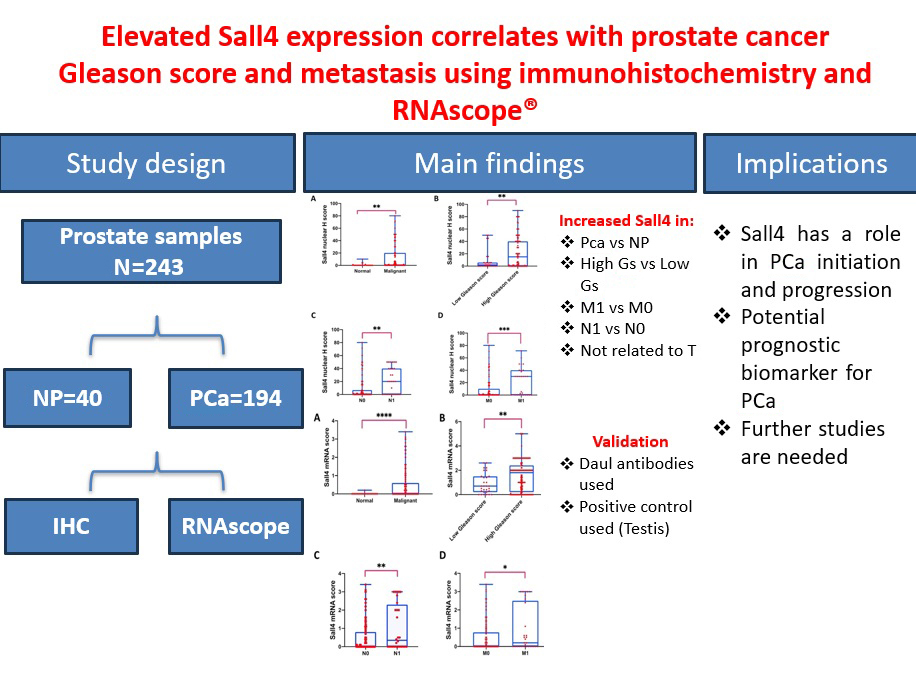
Background: Prostate cancer lacks reliable biomarkers to distinguish between indolent and aggressive forms, posing diagnostic and prognostic challenges. Sall4, primarily found in embryonic stem cells, is reactivated in various cancers, but its role in prostate cancer remains unclear.
Objectives: This study aims to evaluate Sall4 protein and mRNA levels in malignant and normal prostate tissues and explore their association with clinical data.
Materials and methods: This study was conducted from December 2022 to April 2024 at Al-Hussein Teaching Hospital, Thi-Qar, Iraq. Sall4 protein and mRNA expression levels were assessed in 40 normal tissues and 194 malignant prostate tissues using immunohistochemistry and RNAscope® methods. The data were analyzed using unpaired t-tests.
Results: The study identified a significant increase in nuclear Sall4 protein expression, assessed by immunohistochemistry, in prostate cancer tissues compared to normal tissues (p=0.001). Similarly, Sall4 mRNA levels, measured using RNAscope®, were significantly higher in malignant tissues (p<0.001). Increased Sall4 expression at both protein and mRNA levels was significantly associated with higher Gleason scores (protein: p=0.003; mRNA: p=0.009), lymph node involvement (protein: p=0.002; mRNA: p=0.006), and metastasis (protein: p=0.001; mRNA: p=0.017). However, no significant correlation was found between Sall4 expression and tumor size.
Conclusion: Elevated Sall4 expression may be associated with prostate tumorigenesis and aggressiveness. Further studies are needed to clarify its role and evaluate its potential as a prognostic biomarker for prostate cancer.
Article Details

This work is licensed under a Creative Commons Attribution-NonCommercial-NoDerivatives 4.0 International License.
Personal views expressed by the contributors in their articles are not necessarily those of the Journal of Associated Medical Sciences, Faculty of Associated Medical Sciences, Chiang Mai University.
References
Lang SH, Frame FM, Collins AT. Prostate cancer stem cells. J Pathol. 2009; 217(2): 299-306. doi: 10.1002/path.2478.
Alghezi DA. Identifying potential new stem cell biomarkers for prostate cancer [Doctoral Thesis]: University of Bath; 2019. doi: 10.13140/RG.2.2.15345.08802.
Swami U, McFarland TR, Nussenzveig R, Agarwal N. Advanced prostate cancer: Treatment advances and future directions. Trends Cancer. 2020; 6(8): 702-15. doi: 10.1016/j.trecan.2020.04.010.
Al Alwan N A . Cancer Control and Oncology Care in Iraq. J Contemp Med Sci. 2022; 8(1): 82-5. doi.org/10.22317/jcms.v8i1.1154.
Dunn MW, Kazer MW. Prostate cancer overview. Semin Oncol Nurs. 2011; 27(4): 241-50. doi: 10.1016/j.soncn.2011.07.002.
Andriole GL, Catalona WJ. The diagnosis and treatment of prostate cancer. Annu Rev Med. 1991; 42: 9-15. doi: 10.1146/annurev.me.42.020191.000301.
Alghezi DA, Whitley P, Beresford M, Bowen R, Mitchard J, Chalmers AD. Decreased ABCG2 expression in prostate cancer and negativelyassociated with poorly differentiated grade and biochemical recurrence. Thi-Qar Med J. 2020; 20(2): 242-56. doi.org/10.32792/jmed.v20i2.144.
Alghezi D, Aljawher R, Musawi S. Increased CD73 expression is associated with poorly differentiated Gle ason score and tumor size in prostate cancer. J Adv Biotechnol Exp Ther. 6(1): 161. doi: 10.5455/jabet.2023.d115.
Matoso A, Epstein JI. Grading of prostate cancer: Past, present, and future. Curr Urol Rep. 2016; 17(3): 25. doi: 10.1007/s11934-016-0576-4.
Sharpe B, Alghezi DA, Cattermole C, Beresford M, Bowen R, Mitchard J, et al. A subset of high Gleason grade prostate carcinomas contain a large burden of prostate cancer syndecan-1 positive stromal cells. The Prostate. 2017; 77(13): 1312-24. doi: 10.1002/pros.23391.
Goldstein AS, Huang J, Guo C, Garraway IP, Witte ON. Identification of a cell of origin for human prostate cancer. Science. 2010; 329(5991): 568-71. doi: 10.1126/science.1189992.
Zhang X, Yuan X, Zhu W, Qian H, Xu W. SALL4: an emerging cancer biomarker and target. Cancer Lett. 2015; 357(1): 55-62. doi: 10.1016/j.canlet.2014.11.037.
Tatetsu H, Kong NR, Chong G, Amabile G, Tenen DG, Chai L. SALL4, the missing link between stem cells, development and cancer. Gene. 2016; 584(2): 111-9. doi: 10.1016/j.gene.2016.02.019.
Abouelnazar FA, Zhang X, Wang M, Zhang J, Yu D, Zang X, et al. The new advance of SALL4 in cancer: Function, regulation, and implication. J Clin Lab Anal. 2023; 37(9-10): e24927. doi: 10.1002/jcla.24927.
Jiang L, Li J, Song L. Bmi-1, stem cells and cancer. Acta Biochim Biophys Sin (Shanghai). 2009; 41(7): 527-34. doi: 10.1093/abbs/gmp040.
Wang F, Zhao W, Kong N, Cui W, Chai L. The next new target in leukemia: The embryonic stem cell gene SALL4. Mol Cell Oncol. 2014; 1(4): e969169. doi: 10.4161/23723548.2014.969169.
Álvarez C, Quiroz A, Benítez-Riquelme D, Riffo E, Castro AF, Pincheira R. SALL Proteins: Common and antagonistic roles in cancer. Cancers (Basel). 2021; 13(24). doi: 10.3390/cancers13246292.
Yang J, Chai L, Gao C, Fowles TC, Alipio Z, Dang H, et al. SALL4 is a key regulator of survival and apoptosis in human leukemic cells. Blood. 2008; 112(3): 805-13. doi: 10.1182/blood-2007-11-126326.
Alalwany O, Alghezi DA, Aljawher RQ, Harb A. Increased CD3 immunostaining associated with high grade and tumor size in colorectal carcinoma. Egypt J Med Microbiol. 2025; 34(1): 205-12. doi: 10.21608/ejmm.2024.331363.1364.
Zhou J, Peng S, Fan H, Li J, Li Z, Wang G, et al. SALL4 correlates with proliferation, metastasis, and poor prognosis in prostate cancer by affecting MAPK pathway. Cancer Med. 2023; 12(12): 13471-85. doi: 10.1002/cam4.5998.
Rodriguez E, Chen L, Ao MH, Geddes S, Gabrielson E, Askin F, et al. Expression of transcript factors SALL4 and OCT4 in a subset of non-small cell lung carcinomas (NSCLC). Transl Respir Med. 2014; 2(1): 10. doi: 10.1186/s40247-014-0010-7.
Kilic E, Tennstedt P, Högner A, Lebok P, Sauter G, Bokemeyer C, et al. The zinc-finger transcription factor SALL4 is frequently expressed in human cancers: association with clinical outcome in squamous cell carcinoma but not in adenocarcinoma of the esophagus. Virchows Arch. 2016; 468(4): 483-92. doi: 10.1007/s00428-016-1908-y.
Wang F, Flanagan J, Su N, Wang LC, Bui S, Nielson A, et al. RNAscope: a novel in situ RNA analysis platform for formalin-fixed, paraffin-embedded tissues. J Mol Diagn. 2012; 14(1): 22-9. doi: 10.1016/j.jmoldx.2011.08.002.
Forghanifard MM, Moghbeli M, Raeisossadati R, Tavassoli A, Mallak AJ, Boroumand-Noughabi S, et al. Role of SALL4 in the progression and metastasis of colorectal cancer. J Biomed Sci. 2013; 20(1): 6. doi: 10.1186/1423-0127-20-6.
Hao L, Zhao Y, Wang Z, Yin H, Zhang X, He T, et al. Expression and clinical significance of SALL4 and β-catenin in colorectal cancer. J Mol Histol. 2016; 47(2): 117-28. doi: 10.1007/s10735-016-9656-5.
Han LY, Fletcher MS, Urbauer DL, Mueller P, Landen CN, Kamat AA, et Doi: al. HLA class I antigen processing machinery component expression and intratumoral T-Cell infiltrate as independent prognostic markers in ovarian carcinoma. Clin
Cancer Res. 2008; 14(11): 3372-9. doi: 10.1158/1078-0432.CCR-07-4433.
Gautam AK, Wang C, Zeng J, Wang J, Lu J, Wei J, et al. Expression and clinical significance of SALL4 and LGR5 in patients with lung cancer. Oncol Lett. 2015; 10(6): 3629-34. doi: 10.3892/ol.2015.3772.
Han SX, Wang JL, Guo XJ, He CC, Ying X, Ma JL, et al. Serum SALL4 is a novel prognosis biomarker with tumor recurrence and poor survival of patients in hepatocellular carcinoma. J Immunol Res. 2014; 2014: 262385. doi: 10.1155/2014/262385.
Oliver C. Jamur MC. Immunocytochemical methods and protocols. Totowa N, editor: Humana Press; 2010. doi: 10.1007/978-1-59745-324-0
Whitaker HC, Girling J, Warren AY, Leung H, Mills IG, Neal DE. Alterations in beta-catenin expression and localization in prostate cancer. Prostate. 2008; 68(11): 1196-205. doi: 10.1002/pros.20780.
