
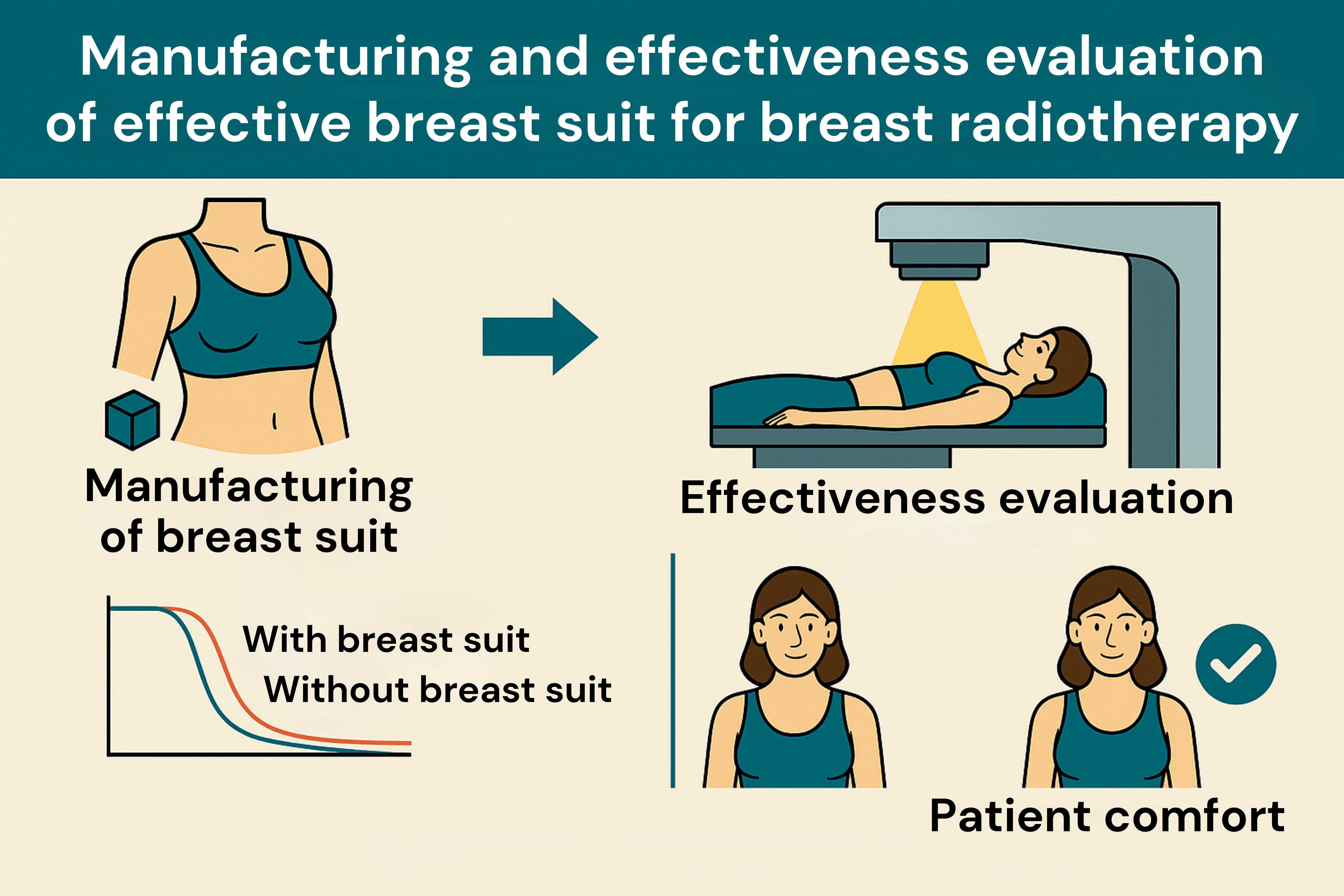
Manufacturing and effectiveness evaluation of effective breast suit for breast radiotherapy
Article Sidebar
Main Article Content
Abstract
Background: Various techniques and devices are used to immobilize the breast satisfactorily during radiation therapy for breast cancer, and they are adopted and utilized in treatment centers according to their preferences.
Objectives: In this study, a breast suit was manufactured using the advantages of thermoplastics used in breast cancer and thoracic radiotherapy, and the breast suit was validated by analyzing the reproducibility of setup errors.
Materials and methods: A computed tomography simulator and phantom were used to acquire reference images of a breast suit and a commercial bra, respectively. After acquiring the images in the CBCT system, the setup error reproducibility was analyzed using a Volume View™ 3D image acquisition tool. The image analysis method used automated mode and manual mode, and the validity was evaluated by analyzing the change of setup error reproducibility in the X, Y, and Z axis directions and pitch, roll, and yaw rotation directions of each matched image.
Results: The reproducibility of setup errors between the breast suit and the commercial bra ranged from 0.4 mm to 5.6 mm on the X-axis and from 0.3 mm to 5.8 mm on the Y-axis. In contrast, the Z-axis exhibited larger variations, ranging from 0.8 mm to 16.2 mm. Rotational setup errors were all less than 1°, indicating no significant differences. While the breast suit showed comparable setup errors to the commercial bra in the X and Y directions, it demonstrated improved reproducibility along the Z-axis (p = 0.09) and significantly lower rotational errors (p < 0.05).
Conclusions: The validity of the reproducibility change of setup errors was confirmed in the X, Y, and Z directions for the breast suit, and valid results were obtained for more stable reproducibility change in the Z-axis direction. Therefore, it is inferred that the breast suit can be used as a fixation device to reduce setup error reproducibility by limiting breast movement.
Article Details

This work is licensed under a Creative Commons Attribution-NonCommercial-NoDerivatives 4.0 International License.
Personal views expressed by the contributors in their articles are not necessarily those of the Journal of Associated Medical Sciences, Faculty of Associated Medical Sciences, Chiang Mai University.
References
Hong S, Lee YY, Lee J, Kim Y, Choi KS, Jae K, Jun IK et al. Trends in cancer screering rates among Korean men and women. Results of the Korean National Cancer Screening Survey 2004-2018. 2021;53(2): 330-38. doi: 10.4143/crt.2020.263.
Fonseca R, Hartmann LC, Petersen IA, Donohue JH, Crotty TB, Gisvold JJ. Ductal carcinoma in situ of the breast. Ann Intern Med. 1997; 127(11): 1013-22. doi: 10.7326/0003-4819-127-11-199712010-00013.
McDnonald ES, ClarkAS, Tchou J, Zhang P, Freedman GM. Clinical diagnosis and management of breast cancer. J Nucl Med. 2016; 57: 9S-16S. doi: 10.2967/jnumed.115.157834.
Arsene-Henry, Fourquet A, Kirova YM. Evolution of radiation techniques in the treatment of breast cancer (BC) patients: from 3D conformal radiotherapy (3D CRT) to intensity-modulated RT(IMRT) using Helical Tomotherapy(HT). Radiother Oncol. 2017; 124(2): 333-4. doi: 10.1016/j.radonc.2017.07.002.
Strydhorst JH, Caudrelier JM, Clark BG, Montgomery LA, Fox G, MacPherson MS. Evaluation of thermoplastic immobilization system for breast and chest wall radiation therapy. Med. Dosim. 2011; 36: 81-4. doi: 10.1016/j.meddos.2010.01.001.
Sakthivel V, Kadirampatti Mani G, Sunil M, Boopathy R, Selvaraj J. Estimating second malignancy risk in intensity-modulated radiotherapy and volumetricmodulated arc therapy using mechanistic radiobiological model in radiotherapy for carcinoma of left breast. J Med Phys 2017; 42(4): 234-240. doi: 10.4103/jmp.JMP_89_17.
Hall EJ. Intensity-modulated radiation therapy, protons, and the risk of second cancers. Int J Radiat Oncol Biol Phys. 2006; 65: 1-7. doi: 10.1016/j.ijrobp.2006.01.027.
Caudrelier JM, Morgan SC, Montgomery L., Lacelle M, Nyiri B, Macpherson M. Helical tomotherapy for locoregional irradiation including the internal mammary chain in left-sided breast cancer. Dosimetric evaluation. Radiother Oncol. 2009; 90: 99-105. doi: 10.1016/j.radonc.2008.09.028.
Jassal K, Bisht S, Kataria T, Sachdev K, Choughle A, Supe S. Comparison of geometrical uncertainties in breast radiation therapy with different immobilization methods. J Nucl Med Radiat Ther. 2013; 4: 140. doi: 10.4172/2155-9619.1000140.
Barrett-Lennard MJ, Thurstan SM. Comparing immobilization methods for the tangential treatment of large pendulous breasts. Radiographer. 2008; 55: 7-13. doi: 10.1016/j.meddos.2004.10.006. 190 Lee YS. and Kim JK. Journal of Associated Medical Sciences 2026; 59(1): 184-190
Kovacs A, Hadjiev J, Lakosi F, Vallyon M, Cselik Z, Bogner P, et al. Thermoplastic patient fixation: Influence on chest wall and target motion during radiotherapy of lung cancer. Strahlenther Onkol. 2007; 183: 271-8. doi: 10.1007/s00066-007-1681-6.
Xiugen FU, Xiong H, Zheng Z, Shen FU, Chao T, Liu K, et al. Analysis of setup errors during radiotherapy for breast cancer patients immobilized with neck and breast thermoplastic mask. Cancer Res Clinic. 2018; 30: 374-8.
Strydhorst JH, Caudrelier JM, Clark BG, Montgomery LA., Fox G, MacPherson MS. Evaluation of a thermoplastic immobilization system for breast and chest wall radiation Therapy. Med Dosim. 2011; 36(1): 81-4. doi: 10.1016/j.meddos.2010.01.001.
Kubo HD, Hill BC. Respiration gated radiotherapy treatment: a technical study. Phys Med Biol 1996; 41(1): 83-91. doi: 10.1088/0031-9155/41/1/007
Kataria T, Abhishek A, Chadha P, Nandigam J. Set-up uncertainties: online correction with X-ray volume imaging. J Cancer Res Ther. 2011; 7(1): 40-6. doi: 10.4103/0973-1482.80457.
Guckenberger M, Meyer J, Vordermark D, Baier K, Wilbert J, Flentje M. Magnitude and clinical relevance of translational and rotational patient setup errors: a cone-beam CT study. Int J Radiat Oncol Biol Phys. 2006; 65(3): 934-42. doi: 10.1016/j.ijrobp.2006.02.019.
