Association of aerobic and anaerobic capacities with body composition in basketball players aged 13-16 years in Chiang Mai Province
Article Sidebar
Main Article Content
Abstract
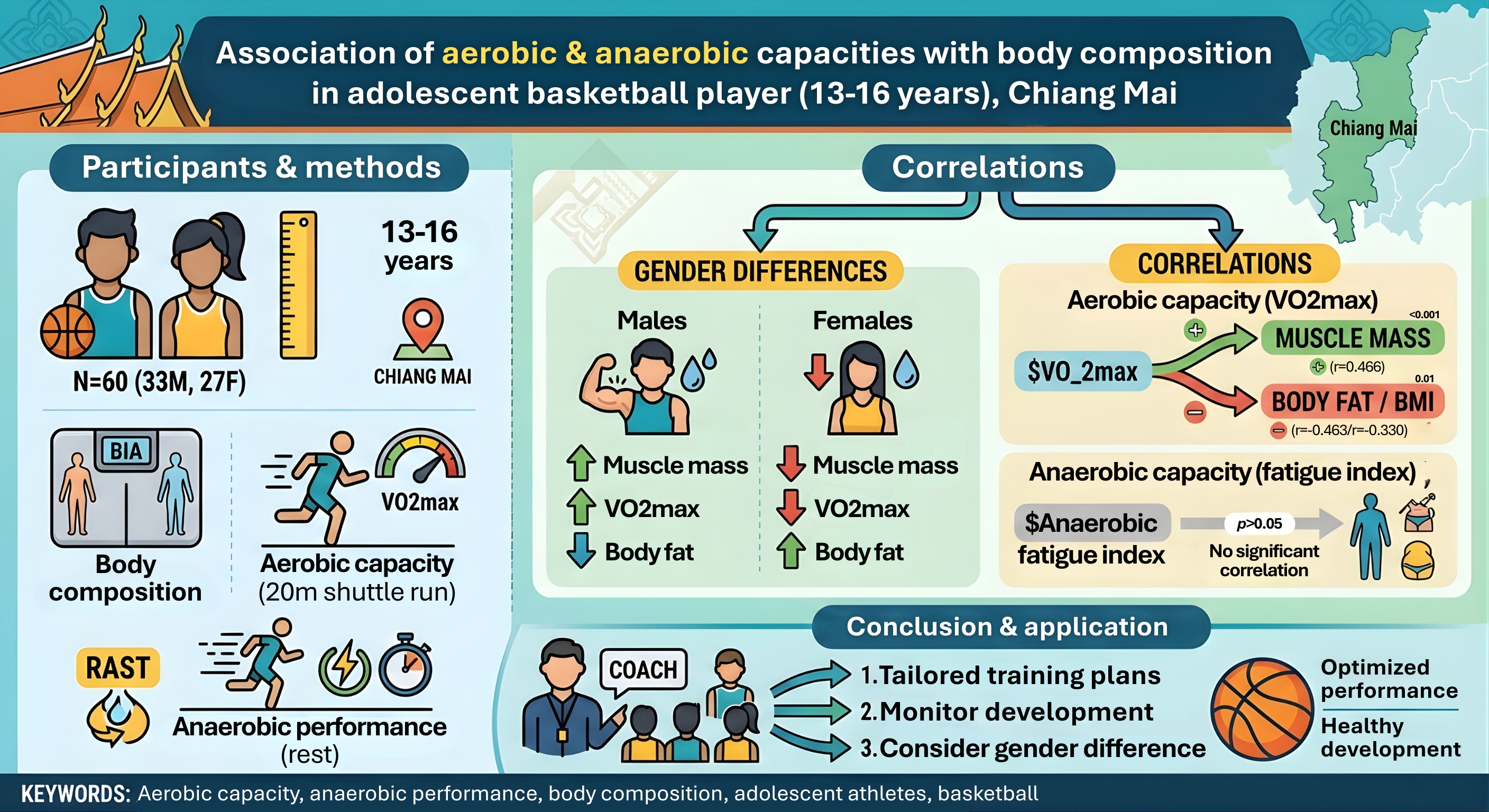
Background: Basketball demands both aerobic and anaerobic energy, with adolescent physiological development influencing performance capacities. While body composition impacts energy efficiency, its relationship to aerobic and anaerobic capacities in youth athletes remains underexplored.
Objectives: To examine associations between body composition and aerobic and anaerobic capacities in adolescent basketball players, and to compare these variables by gender.
Materials and methods: A cross-sectional study was conducted with 60 basketball players (33 males, 27 females) aged 13-16 years. Body composition was measured using bioelectrical impedance analysis. Aerobic capacity was assessed via the 20-meter shuttle run (VO₂max estimation), and anaerobic performance via the Running-based Anaerobic Sprint Test (RAST). Pearson’s Correlation Coefficient and Independent sample t-test were used for analysis.
Results: Males had significantly higher muscle mass and VO₂max, and lower body fat than females (p<0.05). VO₂max was positively correlated with muscle mass (r=0.466, p<0.001), and negatively with BMI (r=-0.330, p=0.01) and body fat (r=-0.463, p<0.001). No significant correlations were found between anaerobic fatigue index and body composition.
Conclusion: Aerobic capacity in youth basketball players is significantly influenced by body composition, with greater muscle mass and lower fat associated with better VO₂max. However, anaerobic capacity appears independent of these morphological factors. These findings support tailored training and monitoring strategies, especially considering sex-based developmental differences.
Article Details

This work is licensed under a Creative Commons Attribution-NonCommercial-NoDerivatives 4.0 International License.
Personal views expressed by the contributors in their articles are not necessarily those of the Journal of Associated Medical Sciences, Faculty of Associated Medical Sciences, Chiang Mai University.
References
FIBA, CIES. International Basketball Migration Report 2019. Neuchâtel: International Centre for Sports Studies; 2019.
Hoffman JR, Epstein S, Einbinder M, Weinstein Y. The influence of aerobic capacity on anaerobic performance and recovery indices in basketball players. J Strength Cond Res. 1999; 13(4): 407-11. doi: 10.1519/00124278-199911000-00018.
Gottlieb R, Eliakim A, Shalom A, Dello-Iacono A, Meckel Y. Improving anaerobic fitness in young basketball players: plyometric vs. specific sprint training. J Athl Enhancement. 2014; 3(3). doi: 10.4172/2324-9080.1000148.
Ben Abdelkrim N, El Fazaa S, El Ati J. Time-motion analysis and physiological data of elite under-19-year-old basketball players during competition. Br J Sports Med. 2007; 41(2): 69-75. doi: 10.1136/bjsm.2006.032318.
Castagna C, Impellizzeri FM, Rampinini E, D’Ottavio S, Manzi V. The Yo-Yo intermittent recovery test in basketball players. J Sci Med Sport. 2008; 11(2): 202-8. doi: 10.1016/j.jsams.2007.02.013.
Drinkwater EJ, Hopkins WG, McKenna MJ, Hunt PH, Pyne DB. Modelling age and secular differences in fitness between basketball players. J Sports Sci. 2007; 25(8): 869-78. doi: 10.1080/02640410600907870.
Siervogel RM, Demerath EW, Schubert C, Remsberg KE, Chumlea WC, Sun S, et al. Puberty and body composition. Horm Res. 2003; 60(Suppl 1): 36-45. doi: 10.1159/000071224.
Siervogel RM, Maynard LM, Wisemandle WA, Roche AF, Guo SS, Chumlea WC, et al. Annual changes in total body fat and fat-free mass in children from 8 to 18 years in relation to changes in body mass index. The Fels Longitudinal Study. Ann N Y Acad Sci. 2000; 904: 420-3. doi: 10.1111/j.1749-6632.2000.tb06494.x.
Robinson R. 20m multistage fitness test (beep test) instructions [Internet]. Topend Sports; [cited 2025 Jan 20]. Available from: https://www.topendsports.com/testing/tests/20mshuttle.htm
Léger LA, Lambert J. A maximal multistage 20-m shuttle run test to predict VO2 max. Eur J Appl Physiol Occup Physiol. 1982; 49(1): 1-12. doi: 10.1080/02640418808729800.
Gobatto CA, Torres RS, Moura FA, Cunha SA, Giometti CB, Araujo GG, et al. Corresponding assessment scenarios in laboratory and on-court tests: centrality measurements by complex networks analysis in young basketball players. Sci Rep. 2020; 10(1): 8620. doi: 10.1038/s41598-020-65420-3.
Cohen J. Statistical Power Analysis for the Behavioral Sciences. 2nd Ed. Hillsdale (NJ): Lawrence Erlbaum Associates; 1988.
Glaister M. Multiple sprint work: physiological responses, mechanisms of fatigue and the influence of aerobic fitness. Sports Med. 2005; 35(9): 757-77. doi: 10.2165/00007256-200535090-00003.
Meckel Y, Machnai O, Eliakim A. Relationship among repeated sprint tests, aerobic fitness, and anaerobic fitness in elite adolescent soccer players. J Strength Cond Res. 2009; 23(1): 163-9. doi: 10.1519/JSC.0b013e31818b9651.
França C, Martinho DV, Gouveia ÉR, Martins F, Marques A, Ribeiro T, et al. Changes in estimated body composition and physical fitness of adolescent boys after one year of soccer training. Children. 2023; 10(2): 391. doi:10.3390/children10020391.
Tsoukos A, Bogdanis GC. Physiological responses and fatigue during a repeated shuttle-sprint running test in adolescent schoolchildren: a comparison between sexes and fatigue calculation methods. Children. 2023; 10(6): 1041. doi:10.3390/children10061041.
Zając B, Mika A, Gaj PK, Ambroży T. Effects of anaerobic fatigue induced by sport-specific exercise on postural control in highly trained adolescent road cyclists. Appl Sci. 2023; 13(3): 1697. doi:10.3390/app13031697.
