A modifying respiratory muscle device: development and pilot testing
Article Sidebar
Main Article Content
Abstract
Background: A respiratory muscle device was designed in various forms and was available at different price ranging. However, financially disadvantaged users may find it difficult to afford the device.
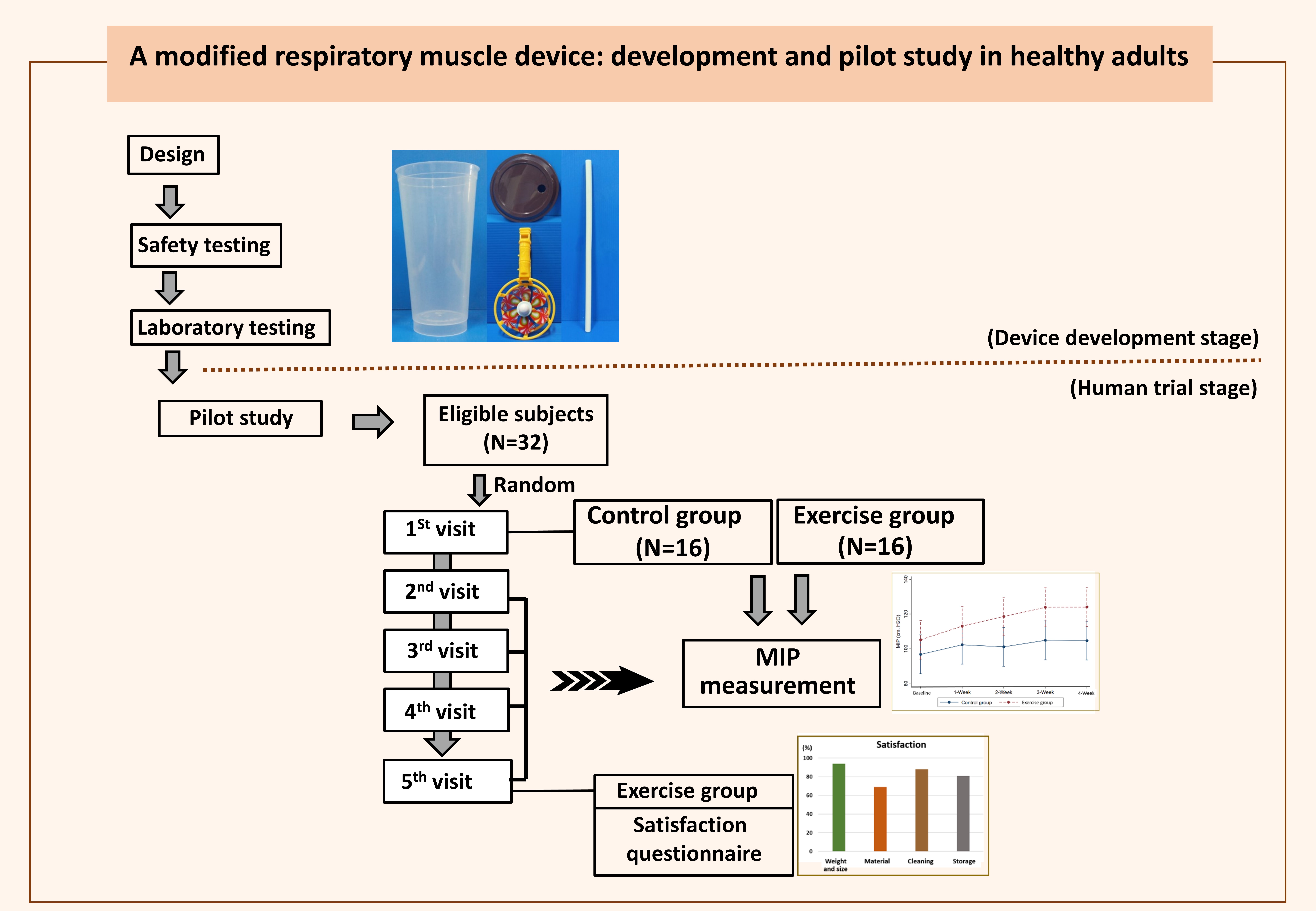
Objectives: The objective of the study was to develop a device utilizing readily available materials. Subsequently, a pilot study was conducted to evaluate maximal inspiratory pressure (MIP) among healthy adult subjects. Furthermore, feedback and suggestions regarding the device were collected using a questionnaire.
Materials and methods: The device’s components were evaluated to ensure safety. Subsequently, laboratory tests were conducted to assess device performance, including measurements of windmill blade rotation and airflow, to determine and prescribe the exercise intensity. Healthy subjects aged 18 to 25 years were then recruited and randomly assigned into either the control group or the exercise group (N=16 per group). Subjects in the exercise group were instructed to use the device daily for four weeks, while those in the control group were asked to continue their usual daily activities. MIP was measured in all participants on a weekly basis throughout the study. Then, subjects in the exercise group were given a questionnaire to evaluate their opinions regarding the device.
Results: The result revealed that all components of the device complied with safety standards. There was no significant difference in MIP between the exercise group and the control group. However, by the third and fourth weeks of the training period, the exercise group exhibited a significant improvement in MIP compared to their values in the first week. Furthermore, user feedback indicated that the device’s size, weight, and usability were very satisfactory.
Conclusion: The study concluded that the modified device did not have a significant effect on inspiratory muscle strength, as indicated by MIP, in healthy adult subjects. However, further research is warranted to more thoroughly evaluate the effectiveness of the device and in relevant clinical populations.
Article Details

This work is licensed under a Creative Commons Attribution-NonCommercial-NoDerivatives 4.0 International License.
Personal views expressed by the contributors in their articles are not necessarily those of the Journal of Associated Medical Sciences, Faculty of Associated Medical Sciences, Chiang Mai University.
References
Kadu D. Incentive spirometer and respiratory muscle training devices: What do physiotherapists need to know? J Pulm Respir Med. 2023; 13: 620. doi: 10.37421/2161-105X.2023.13.620.
Menezes KKP, do Nascimento LR, Avelino PR, Polese JC, Teixeira-Salmela LF. A review on respiratory muscle training devices. J Pulm Respir Med. 2018; 8: 451. doi: 10.4172/2161-105X.1000451.
Bharti A. A review on phases of clinical trials and types of clinical trials. Der Pharmacia Lettre. 2021; 13: 59-64.
Drug and medical supply medical center, Ministry of Public Health. Non-medical supplies. [serial online] 2019 [cited 2025 April 18].Available from: https://dmsic.moph.go.th/index/detail/7951 (in Thai)
Nepomuceno BRV Jr, Barreto MS, Almeida NC, Guerreiro CF, Xavier-Souza E, Neto MG. Safety and efficacy of inspiratory muscle training for preventing adverse outcomes in patients at risk of prolonged hospitalization. Trials. 2017; 18: 626. doi: 10.1186/s13063-017-2372-y.
Koo TK, Li MY. A guideline of selecting and reporting intraclass correlation coefficients for reliability research. J Chiropr Med. 2016; 15: 155-63. doi: 10.1016/j.jcm.2016.02.012.
Laveneziana P, Albuquerque A, Aliverti A, Babb T, Barreiro E, Dres M, et al. ERS statement on respiratory muscle testing at rest and during exercise. Eur Respir J. 2019; 53: 1801214. doi: 10.1183/13993003.01214-2018.
Food and drug administration. Re: Classes of medical devices or medical devices of which manufacturers or importers are required to declare specifications (No. 2), B.E. 2563 (2020) [serial online] 2020 [cited 2025 April 18]. Available from: https://shorturl.asia/cfNpX
Food and drug administration. Re: Risk classification of medical devices, B.E. 2562 (2019) [serial online] 2020 [cited 2025 April 18]. Available from: https://en.fda.moph.go.th/cat2-health-products?ppp=10&page=1&kw=risk+classification&cate_2=
Souza H, Rocha T, Pessoa M, Rattes C, Brandao D, Fregonezi G, et al. Effects of inspiratory muscle training in elderly women on respiratory muscle strength, diaphragm thickness and mobility. J Gerontol A Biol Sci Med Sci. 2014; 69: 1545-53. doi: 10.1093/gerona/glu182.
Downey AE, Chenoweth LM, Townsend DK, Ranum JD, Ferguson CS, Harms CA. Effects of inspiratory muscle training on exercise responses in normoxia and hypoxia. Respir Physiol Neurobiol. 2007; 156: 137-46. doi: 10.1016/j.resp.2006.08.006.
Romer LM, McConnell AK. Specificity and reversibility of inspiratory muscle training. Med Sci Sports Exerc. 2003; 35: 237-44. doi: 10.1249/01.MSS.0000048642.58419.1E.
Sheel AW. Respiratory muscle training in healthy individuals: physiological rationale and implications for exercise performance. Sports Med. 2002; 32: 567-81. doi: 10.2165/00007256-200232090-00003.
Enright SJ, Unnithan VB, Heward C, Withnall L, Davies DH. Effect of high-intensity inspiratory muscle training on lung volumes, diaphragm thickness, and exercise capacity in subjects who are healthy. Phys Ther. 2006; 86: 345-54. doi: 10.1093/ptj/86.3.345.
Das AK, Sharma A, Sondhi R, Goyal S. A simple incentive spirometry device for morale-boosting for geriatric patients. Eur Geriatr Med. 2022; 13: 1495-6. doi: 10.1007/s41999-022-00683-9.
Kluayhomthong S, Khrisanapant W, Chaisuksant S, Jones C. Effectiveness of a new breathing device “BreatheMAX®” to increase airway secretion clearance in patients with ventilatory dependence. J Med Tech Phy Ther. 2011; 23: 95-108. (in Thai)
Jones CU, Kluayhomthong S, Chaisuksant S, Khrisanapant W. Breathing exercise using a new breathing device increases airway secretion clearance in mechanically ventilated patients. Heart Lung. 2013; 42: 177-82. doi: 10.1016/j.hrtlng.2012.12.009.
Ubolsakka-Jones C, Tongdee P, Jones DA. The effects of slow loaded breathing training on exercise blood pressure in isolated systolic hypertension. Physiother Res Int. 2019; 24: e1785. doi: 10.1002/pri.1785.
Wongsawat C, Ubolsakka-Jones C, Panwong W, Phimphasak C, Domthong P, Kiatboonsri S. Effectiveness of inspiratory muscle training with a new breathing pattern in elderly patients with chronic obstructive pulmonary disease. Arch AHS. 2020; 31: 467-80. doi: https://he01.tci-thaijo.org/index.php/ams/article/view/235114.
Leelarungrayub J, Pinkaew D, Yankai A, Chautrakoon B, Kuntain R. Simple artificial training device for respiratory muscle strength and lung volumes in healthy young male and female subjects: A pilot study. J Bodyw Mov Ther. 2017; 21: 995-1002. doi: 10.1016/j.jbmt.2016.11.012.
