Frequencies of major blood group antigens and phenotypes among blood donors in Aljouf, Saudi Arabia
Article Sidebar
Main Article Content
Abstract
Background: Blood group antigens are a representation of some personal traits.
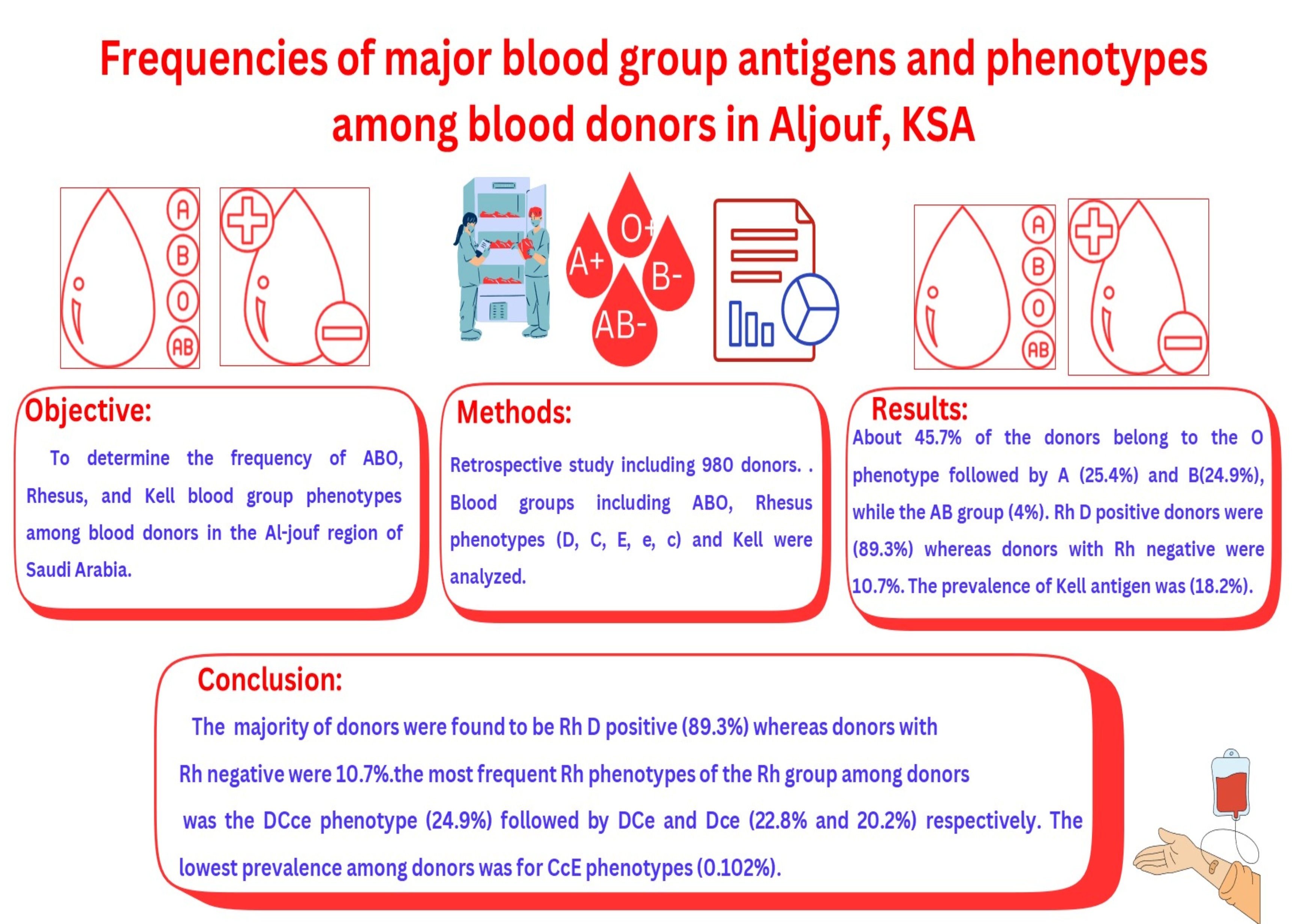
Objectives: To determine the frequency of ABO, Rhesus and Kell blood group phenotypes among blood donors in the Al-Jouf region, Saudi Arabia.
Materials and methods: 980 donors were included in retrospective study design. Data was collected from blood donor records from July 2022 to January 2023 at Al-Jouf Central Blood Bank. ABO, Rhesus phenotypes (D, C, E, e, c), and K antigen have been detected in the blood bank using the fully automated Bio-Rad IH-500.
Results: Regarding the ABO system, the O phenotype was the most common among the donors (approximately 45.7%), and followed by A (25.4%) and B (24.9%), while the AB group had the lowest number (4%). Analysis of Rhesus blood group phenotypes demonstrated that 89.3% of donors were Rh D positive and 10.7% were Rh D negative. Other Rhesus antigens were found in variable percentages; the e antigen was the most prevalent among donors (99.2%),followed by the c and C antigens (72.7% and 69.2%, respectively), and the E antigen was the least prevalent (22.8%). Only 0.3% of donors were positive for Cw. Accordingly, the DCce phenotype (24.9%) was the most common Rh phenotype among donors, followed by DCe and Dce (22.8% and 20.2%,respectively). CE and CEe phenotypes had the lowest prevalence among donors(0.1%). Out of 980 donors, 178 donor (18.2%) had the Kell antigen (K).
Conclusion: The most prevalent blood group among donors was O Rh D+ while the most prevalent Rhesus antigen was the e antigen. The most common Rhesus phenotype among donors was DCce. Reporting Rh phenotypes and Kell antigen (K) is extremely important from a clinical standpoint, especially during pregnancy and blood transfusions as it can improve maternal and fetal care and enhance safer blood transfusion.
Article Details

This work is licensed under a Creative Commons Attribution-NonCommercial-NoDerivatives 4.0 International License.
Personal views expressed by the contributors in their articles are not necessarily those of the Journal of Associated Medical Sciences, Faculty of Associated Medical Sciences, Chiang Mai University.
References
Rahadi I, Choodoung M, Choodoung A. Studies on red blood cells (rbcs) and white blood cells (WBCS) detection by image processing. Newest Phys Sci Res Updates. 2021; 7(2): 50-8. doi.org/10.9734/bpi/nupsr/v7/8996D.
Felimban R, Al-Ghamdi A, Elmissbah T, Almalki A, Alzoghaibi N, Hakami N, et al. ABO, Rh, and Kell blood group antigen frequencies in blood donors of Taif City, Saudi Arabia. Clin Lab. 2023; 69(7). doi: 10.7754/Clin.Lab.2023.230104.
Qanash H, Alcantara JC, Alshammari AM, Aljuhani A, Binsaleh NK, Almashjary MN, et al. The frequencies of ABO and Rh phenotypes among male blood donors in northwestern Saudi Arabia. Clin Lab. 2022; 68(11). doi: 10.7754/Clin.Lab.2022.220123.
Altayar MA, Jalal MM, Kabrah A, Qashqari FS, Jalal NA, Faidah H, et al. Prevalence and association of transfusion transmitted infections with ABO and Rh blood groups among blood donors in the western region of Saudi Arabia: A 7-year retrospective analysis. Medicina. 2022;58(7): 857. doi: 10.3390/medicina58070857.
Hamali HA, Madkhali MM, Dobie G, Madkhali AM, Madkhali B, Hummadi Y, et al. Prevalence of Rh and K phenotypes among blood donors from different ethnicities in Samtah (Southwestern Region) Saudi Arabia. Int J Immunogenet. 2022; 49(3): 202-8. doi: 10.1111/iji.12577.
Halawani AJ, Arjan AH. ABO, RH, and KEL1 antigens, phenotypes and haplotypes in Southwestern Saudi Arabia. Clin Lab. 2021; 67(2): 344-8. doi: 10.7754/Clin.Lab.2020.200633.
Alabdulmonem W, Shariq A, Alqossayir F, AbaAlkhail FM, Al-Musallam AY, Alzaaqi FO, et al. Sero-prevalence ABO and Rh blood groups and their associated transfusion-transmissible infections among blood donors in the Central Region of Saudi Arabia. J Infect Public Health. 2020; 13(2): 299-305. doi: 10.1016/j.jiph.2019.12.004.
Selleng K, Jenichen G, Denker K, Selleng S, Müllejans B, Greinacher A. Emergency transfusion of patients with unknown blood type with blood group O Rhesus D positive red blood cell concentrates: a prospective, single-centre, observational study. Lancet Haematol. 2017; 4(5): e218-24. doi: 10.1016/S2352-3026(17)30051-0.
Oladeinde BH, Olaniyan MF, Muhibi MA, Uwaifo F, Richard O, Omabe NO, et al. Association between ABO and RH blood groups and hepatitis B virus infection among young Nigerian adults. J Prev Med Hyg. 2022; 63(1): E109. doi 10.15167/2421-4248/jpmh2022.63.1.1967.
Harmening DM. Modern blood banking & transfusion practices. FA Davis; 2018.
Dean L, Dean L. Blood groups and red cell antigens. Bethesda: NCBI; 2005.
Avent ND, Reid ME. The Rh blood group system: a review. Blood, Blood. 2000; 95(2): 375-87. doi :10.1182/blood.V95.2.375.
Ristovska E, Bojadjieva ТM, Velkova Е, Dimceva АH, Todorovski B, Tashkovska M, et al. Rare blood groups in ABO, Rh, Kell systems–Biological and clinical significance. Prilozi. 2022; 2022: 0021. doi: 10.2478/prilozi-2022-0021.
Daniels G, Hadley A, Green CA. Causes of fetal anemia in hemolytic disease due to anti‐K. Transfusion. 2003; 43(1): 115-6. doi: 10.1046/j.1537-2995.2003.00327.x.
Daniels G. The molecular genetics of blood group polymorphism. Hum Genet. 2009; 126(6): 729-42. doi: 10.1007/s00439-009-0738-2.
Chown B, Lewis M, Kaita K. A new Kell blood-group phenotype. Nature. 1957; 180: 711. doi: 10.1038/180711a0.
Owaidah AY, Naffaa NM, Alumran A, Alzahrani F. Phenotype frequencies of major blood group systems (Rh, Kell, Kidd, Duffy, MNS, P, Lewis, and Lutheran) among blood donors in the Eastern Region of Saudi Arabia. J Blood Med. 2020; 11: 59-65. doi 10.2147/JBM.S236834.
Siransy Bogui L, Dembele B, Sekongo Y, Abisse S, Konaté S, Sombo M. Phenotypic profile of Rh and Kell blood group systems among blood donors in Cote d’Ivoire, West Africa. J Blood transfus. 2014; 2014(1): 309817. doi 10.1155/2014/309817.
Kahar MA, Patel RD. Phenotype frequencies of blood group systems (Rh, Kell, Kidd, Duffy, MNS, P, Lewis, and Lutheran) in blood donors of south Gujarat, India. Asian J Transfus Sci. 2014; 8(1): 51-5. doi: 10.4103/0973-6247.126693.
Makroo R, Gupta R, Bhatia A, Rosamma NL. Rh phenotype, allele and haplotype frequencies among 51,857 blood donors in North India. Blood Transfus. 2014; 12(1): 36-9. doi: 10.2450/2013.0300-12.
Adewoyin AS, Lee GM, Adeyemo TA, Awodu OA. Rh and Kell blood group antigen prevalence in a multi-ethnic cohort in Nigeria: implications for local transfusion service. Immunohematology. 2018; 34(2): 61-5. PMID: 29989421.
Westhoff CM, Reid ME. the Kell, Duffy, and Kidd blood group systems. Immunohematology. 2004; 20(1): 37-49. PMID: 15373667.
Pirenne F, Floch A, Diop S. Alloimmunisation against red blood cells in sickle cell disease: transfusion challenges in high-income and low-income countries. Lancet Haematol. 2023; 10(6): e468-76. doi: 10.1016/S2352-3026(23)00066-2.
Kambale‐Kombi P, Djang'eing'a RM, Alworong'a Opara JP, Minon JM, Sepulchre E, Bours V, Floch A, Pirenne F, Tshilumba CK, Batina‐Agasa S. Red blood cell alloimmunisation in sickle cell disease patients in the Democratic Republic of the Congo. Transfus Med. 2023; 33(2): 137-46.. doi: 10.1111/tme.12939.
Kuriri FA, Ahmed A, Alanazi F, Alhumud F, Ageeli Hakami M, et al. Red blood cell alloimmunization and autoimmunization in blood transfusion‐dependent sickle cell disease and β‐thalassemia patients in Al‐Ahsa Region, Saudi Arabia. Anemia. 2023; 2023(1): 3239960. doi 10.1155/2023/3239960.
Daniels G, Poole J, de Silva M, Callaghan T, MacLennan S, Smith N. The clinical significance of blood group antibodies. Transfus Med. 2002; 12(5): 287-95. doi: 10.1046/j.1365-3148.2002.00399.x. PMID: 12383334.
Klein HG, Anstee DJ. Mollison's Blood Transfusion in Clinical Medicine. John Wiley & Sons; 2014.
Alabdulmonem W, Shariq A, Alqossayir F, AbaAlkhail FM, Al-Musallam AY, Alzaaqi FO. et al. Sero-prevalence ABO and Rh blood groups and their associated transfusion-transmissible infections among blood donors in the Central Region of Saudi Arabia. J Infect Public Health. 2020; 13: 299-305. doi: 10.1016/j.jiph.2019.12.004.
Eweidah MH, Rahiman S, Ali MH, Al-Shamary AM. Distribution of ABO and Rhesus (RHD) Blood Groups in Al-Jouf Province of the Saudi Arabia. Anthropol. 2011; 13(2): 99-102. doi: 10.1080/09720073.2011.11891182.
Belali TM. Distribution of ABO and rhesus types in the Northern Asir Region in Saudi Arabia. J Blood Med. 2022: 13: 643-8. doi: 10.2147/JBM.S383151. eCollection 2022.
Saboor M, Zehra A, Hamali HA, Halawani AJ, Mobarki AA, Madkhali AM, Abdullah S. Prevalence of A2 and A2B subgroups and anti-A1 antibody in blood donors in Jazan, Saudi Arabia. Int J Gen Med. 2020: 13: 787-90. doi: 10.2147/IJGM.S272698. eCollection 2020.
Sarhan MA, Saleh KA, Bin-Dajem SM. Distribution of ABO blood groups and rhesus factor in Southwest Saudi Arabia. Saudi Med J. 2009; 30(1): 116-9. PMID: 19139784.
Reid ME, Lomas-Francis C. Ii blood group collection, The Blood Group Antigen, Facts Book Series, 471-7.
Alcantara JC, Alcantara TY, Al Shaghdali KF, Al Shammari FD, Al Shammari FG. Rh alleles and phenotypes among Saudi women in Hail Region, Saudi Arabia. Adv Life Sci. 2021; 8(2): 114-118.:13. doi doi.org/10.62940/als. v8i2.1001.
Elsayid M, Al Qahtani FS, Al Qarni AM, Almajed F, Al Saqri F, Qureshi S. Determination of the frequency of the most immunogenic Rhesus antigens among Saudi donors in King Abdulaziz Medical City–Riyadh. J Nat Sci Biol Med. 2017; 8(1): 56. doi 10.4103/0976-9668.198361.
Alalshaikh M, Almalki Y, Hasanato R, Almomen A, Alsughayir A, Alabdullateef A, et al. Frequency of Rh and K antigens in blood donors in Riyadh. Hematol Transfus Cell. 2022; 44(4): 555-9. doi: 10.1016/j.htct.2021.03.003.
Elsayid m, alfaifi am, almutairi ak, almajed f, al saqri f, qureshi s. phenotypic profile of kell blood group system among saudi donors at king abdulaziz medical city-riyadh. J Med Sci Clin Res. 2017; 5(1): 15654-7. doi.org/10.18535/jmscr/v5i1.75.
Felimban RI, Sumeda SM. Distribution of Kell antigens K, k, Kpa and Kpb among blood donors in Jeddah city of Western Saudi Arabia. Asian J Transfus Sci. 2021; 15(1): 75-81. doi: 10.4103/ajts.AJTS_109_19.
