Normative nasalance in Indians speaking Malayalam and Kannada: Influence of native language, gender, and vowels
Article Sidebar
Main Article Content
Abstract
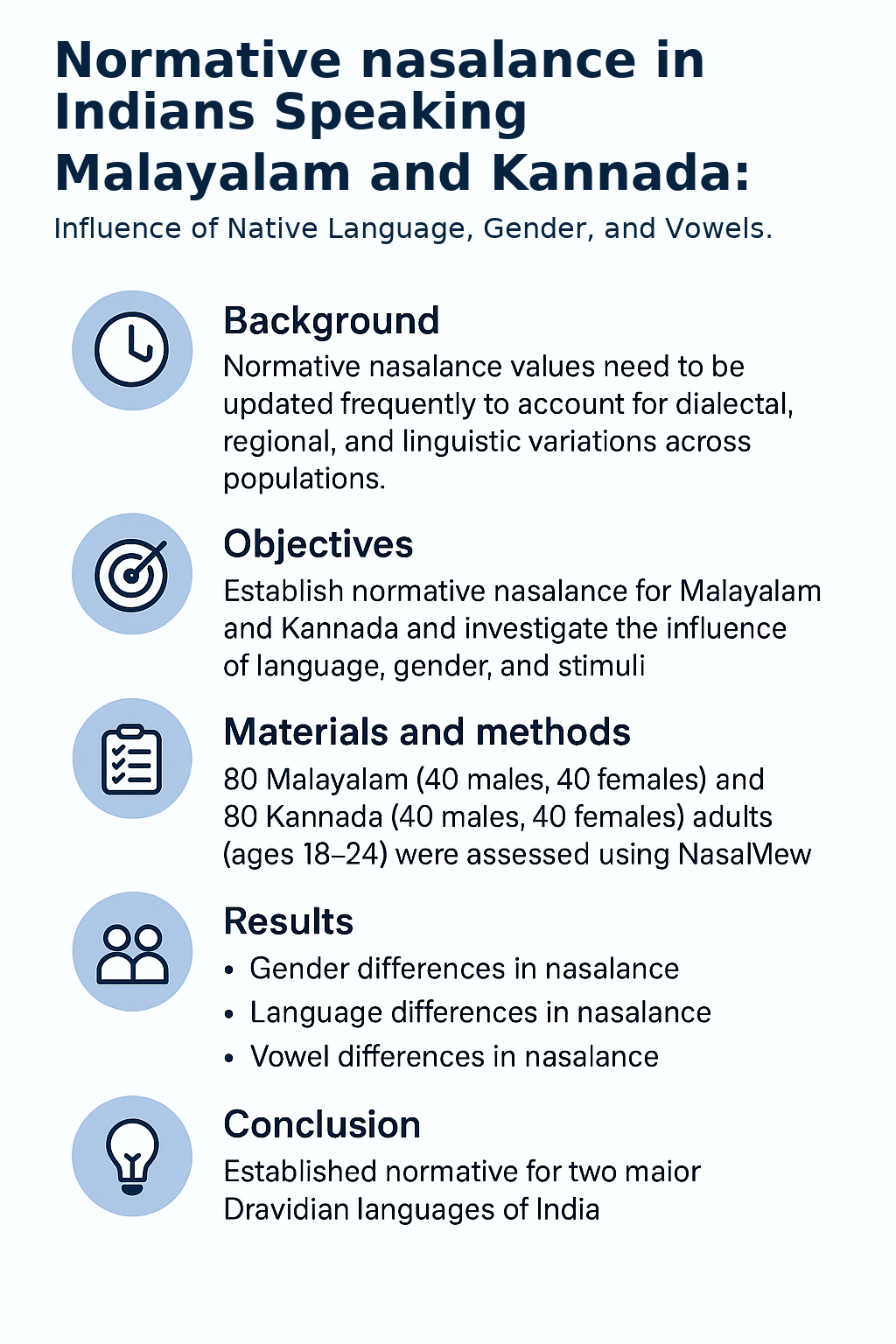
Background: Normative nasalance values need to be updated frequently to account for dialectal, regional, and linguistic variations across populations. Regular updates ensure the data remains relevant and accurate for clinical assessment and diagnosis.
Objectives: The primary objective of the current study was to establish normative nasalance for adults who are native speakers of Malayalam and Kannada using the NasalView system. Furthermore, this study aimed to investigate the influence of language, gender, and stimuli on the nasalance scores.
Materials and methods: The study recruited 80 native Malayalam-speaking adults (40 males and 40 females) and 80 native Kannada-speaking adults (40 males and 40 females) between 18 to 24 years of age. The nasalance score were obtained with the NasalView system while the participants phonated vowels /a/, /i/, and /u/. Three trials were conducted for each vowel. The obtained data were tabulated for further analysis.
Results: The study revealed significant differences in nasalance values for the vowels /i/ and / u/ between genders and across languages, but not for / a/. The results further revealed that / i/ had the highest nasalance, followed by by/u/ and / a/. Nasalance was significantly different between /i/ and /a/ and between /i/ and /u/ but not between /u/ and /a/.
Conclusion: The study has been able to establish nasalance normative for two major Dravidian languages of India that can be used for the clinical diagnosis and management of resonance disorders. Further, it sheds light on the impact of nasalance in geographically diverse multilingual situations.
Article Details

This work is licensed under a Creative Commons Attribution-NonCommercial-NoDerivatives 4.0 International License.
Personal views expressed by the contributors in their articles are not necessarily those of the Journal of Associated Medical Sciences, Faculty of Associated Medical Sciences, Chiang Mai University.
References
Henningsson G, Kuehn DP, Sell D, Sweeney T, TrostCardamone JE, Whitehill TL. Universal parameters for reporting speech outcomes in individuals with cleft palate. Cleft Palate Craniofac J. 2008; 45(1) :1-17. doi: 10.1597/06-086.1
Fletcher SG, Frost M, Druecke P. Measurement of nasality with the Nasometer. Cleft Palate J. 1989; 26: 1-5.
Awan SN, Ziegler W, Deger K. Analysis of nasalance: NasalView. In: Clinical Phonetics and Linguistics. London, Whurr: 1997; pp 518-25.
Fletcher SG. Theory and instrumentation for quantitative measurement for nasality. Cleft Palate J. 1970; 7(2): 601-9.
Fletcher SG. “Nasalance” vs. listener judgements of nasality. Cleft Palate J. 1976; 13(1): 31-44.
Sudarshan Reddy BM, Sheela S, Kishore Pebbili G. Comparison of nasalance values obtained from nasality visualization system and Nasometer II. J All India Inst Speech Hear. 2012; 31: 30-3.
Deepthi KJ, Pushpavathi M. The effect of vowels on the nasalance values in Kannada-speaking preschoolers with repaired cleft of lip and palate. Int J Interdiscip Res Innov. 2018; 6(3): 383-8. Available from: www.researchpublish.com
Girish KS, Pushpavathi M, Satish HV. Influence of native language on nasalance values in Kannada and Malayalam speakers. J Cleft Lip Palate Craniofac Anomal. 2021; 8(2): 111-8.
Jayakumar T, Pushpavathi M. Normative score for Nasometer in Kannada. Student Res AIISH. 2005; 7: 44-53.
Arya P, Pushpavathi M. Normative nasalance value in Hindi language [Master’s dissertation]. Mysore: University of Mysore; 2009. (Unpublished, personal communication).
Sunitha, Roopa N, Prakash B. Proceedings of 4th Annual Congress of Indian Society of Cleft Lip, Palate & Craniofacial Anomalies (Abstract). Proc 4th Annu Congr Indian Soc Cleft Lip Palate Craniofac Anomal. 1994.
Pokharel A, Naina P, Sebastian S, Syed K, John M, Varghese A. Normative nasalance scores in Tamilspeaking Indian children. Logoped Phoniatr Vocol. 2020; 47: 1-6. doi: 10.1080/14015439.2020.1849391
Jayakumar T, Soonan VV, Thankamany VR, Benoy JJ. Nasalance, nasal airflow and perceived nasality in carnatic singers and non-singers. Indian J Otolaryngol Head Neck Surg. 2024; 76(1): 5-18. doi: 10.1007/ s12070-023-03994-w.
Kuppusamy G, Sankar G, Mariswamy P. Normative nasalance values across stimuli and gender in Malayalam-speaking individuals. Otolaryngol Online J. 2013; 3: 85-98.
Bressmann T, Sader R, Whitehill TL, Samman N, Marciniak C. Comparison of nasalance scores obtained with the Nasometer, the NasalView, and the OroNasal System. Cleft Palate Craniofac J. 2005; 42(4): 423-9. doi: 10.1597/03-159.1
IBM Corp. IBM SPSS Statistics for Windows, Version 25.0. Armonk (NY): IBM Corp; 2017.
Mallikarjun B. Patterns of Indian multilingualism. Lang India [Internet]. 2010 Jun;10(6). Available from: http://www.languageinindia.com
Mishima K, Mori Y, Sugahara T, Minami K. Gender and dialectal differences in nasalance scores in a Japanese population. J Craniomaxillofac Surg. 2008; 36(3): 146-9. doi: 10.1016/j.jcms.2007.09.005
Kim HK, Park IS, Yoon HY. Dialectal and gender differences in nasalance for a Mandarin population. Clin Linguist Phon. 2016; 30(6): 451-64. doi: 10.3109/ 02699206.2016.1142591
Ibrahim HM, Hamzah HS, Nordin NAM, Ahmad R, Abdul Wahab N. Speech stimuli and nasalance scores among Mandarin-speaking Malaysian children. Clin Linguist Phon. 2020; 34(12): 1063-74. doi: 10.1080/ 02699206.2020.1793815
Zajac DJ, Mayo R. Aerodynamic and acoustic measures of velopharyngeal function in normal speakers. Cleft Palate Craniofac J. 1996; 33(3): 235-41. doi: 10.1597/ 1545-1569_1996_033_0235_aaamov_2.3. co_2
Office of the Registrar General & Census Commissioner, India. Census 2001 data online [Internet]. India.Gov. in National Portal of India; 2001 [cited 2025 Aug 20]. Available from: https://www.india.gov.in/census2001-data-online
Kroll JF, Dussias PE. The benefits of multilingualism to the personal and professional development of residents of the US. Foreign Lang Ann. 2017; 50(2): 248-59.
Han Q, Tian JX, Chen HC. L3 prosody: Crosslinguistic influence of prosodic features in Mandarin and English by Cantonese multilinguals. In: L3 Development After the Initial State. Amsterdam: John Benjamins Publishing Company; 2023. pp 96120.
