
Understanding occupation-based practice among Thai occupational therapy students: A mixed-methods study
Article Sidebar
Main Article Content
Abstract
Background: In Thailand, Occupation-based practice (OBP) has been emphasized in the curriculum of outcome-based education for Chiang Mai occupational therapy students towards the revised bachelor curriculum year 2021; however, it was essential in how they comprehensively understand and skills implementation in recent years.
Objective: The aim of this study was to explore an understanding of OBP among Thai occupational therapy students towards their clinical fieldwork and classroom experience.
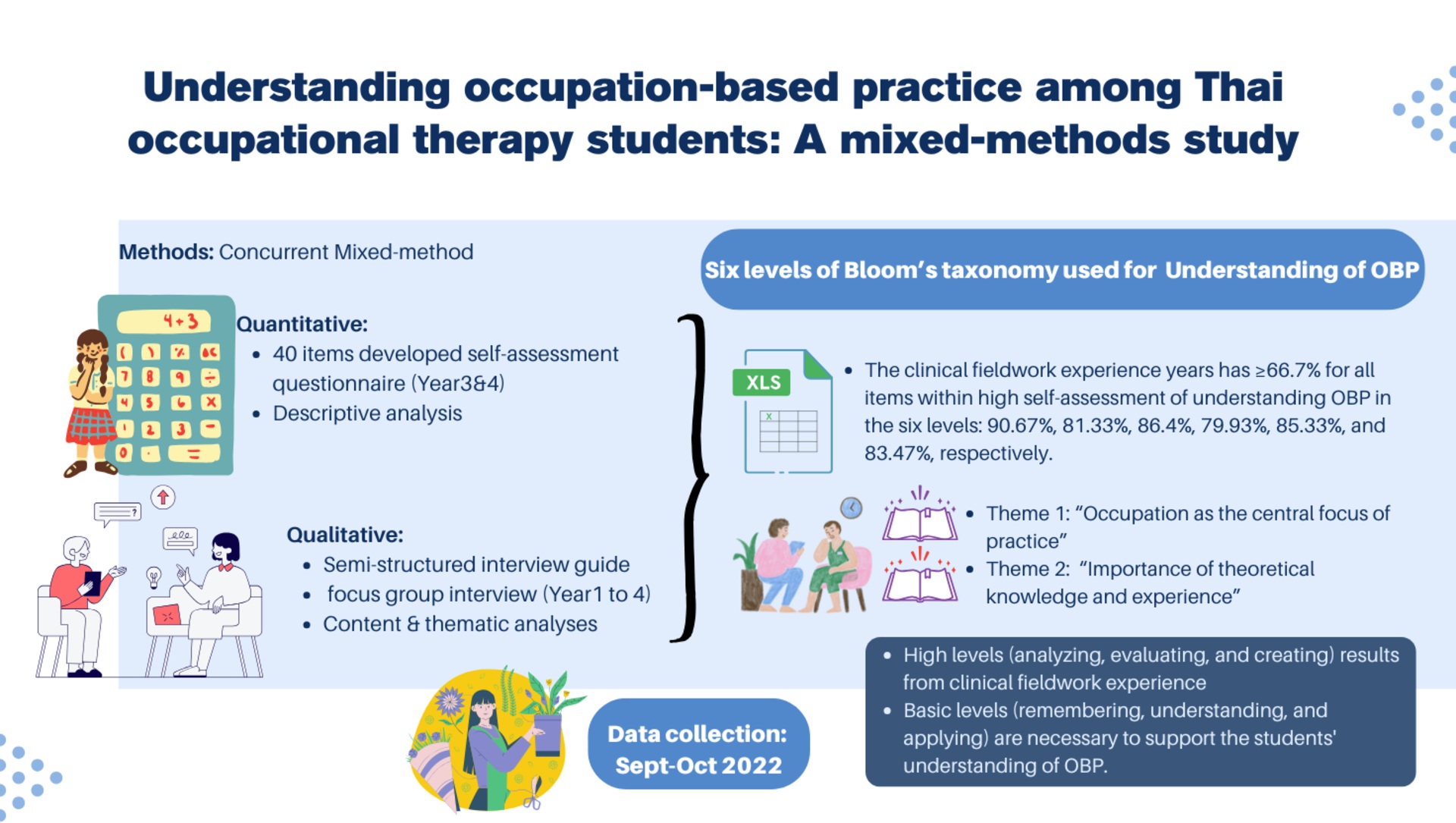
Materials and methods: This study used a convergent mixed method by collecting data with a forty-item developed self-assessment questionnaire of the clinical fieldwork experience from third- and fourth-year students and employing focus group interviews with first- to fourth-year students between September and October 2022. Descriptive statistics were analyzed for seventy-five return questionnaires. Thirty-eight participants participated in a total of nine focus group interviews, and the qualitative data were analyzed by content and thematic analyses. Both sets of data were merged. An interpretation with six levels (remembering, understanding, applying, analyzing, evaluating, and creating) of cognitive domains of Bloom’s revised taxonomy was used.
Results: The understanding of OBP in the clinical fieldwork experience years has ≥66.7% for all items within high self-assessment of understanding OBP in the six levels: 90.67%, 81.33%, 86.4%, 79.93%, 85.33%, and 83.47%, respectively. Two main themes, firstly, Occupation as the central focus of practice, and secondly, Importance of theoretical knowledge and experience, are presented. Analyzing, evaluating, and
creating levels of a high cognitive domain were revealed in fourth-year students, while remembering, understanding, and applying levels were basic cognitive domains that support the students’ understanding of OBP.
Conclusion: The results indicate an average comprehension of OBP in a high percentage, over 75% for overall levels with the supportive two themes, which is further useful in improving outcome-based learning and teaching of the occupational therapy curriculum.
Article Details

This work is licensed under a Creative Commons Attribution-NonCommercial-NoDerivatives 4.0 International License.
Personal views expressed by the contributors in their articles are not necessarily those of the Journal of Associated Medical Sciences, Faculty of Associated Medical Sciences, Chiang Mai University.
References
Trombly CA. Occupation: Purposefulness and meaningfulness as therapeutic mechanism (Eleanor Clarke Slagle Lecture). Am J Occup Ther. 1995; 49(10): 690-72. doi: 10.5014/ajot.49.10.960.
Fisher AG. Occupation-centered, occupation-based, occupation-focused: Same, same or different? Scand J Occup Ther. 2014; 20(3): 162-73. doi:10.3109/11038128.2012.754492.
O’Brien JC, Hussey SM. Introduction to occupational therapy. 5th Ed. Missouri: Elsevier; 2018.
American Occupational Therapy Association (AOTA). Occupational therapy practice framework: Domain and process (4th Edition). Am J Occup Ther. 2020; 74(Suppl 2): 7412410010p1-p87. doi: 10.5014/ajot.2020.74S2001.
Wolf TJ, Chuh A, Floyd T, McInnis K, Williams E. Effectiveness of occupation-based interventions to improve areas of occupation and social participation after stroke: An evidence-based review. Am J Occup Ther. 2015; 69(1): 6901180060p1-6901180060p11. doi: 10.5014/ajot.2015.012195.
Shea CK, Jackson N. Client perception of a client-centered and occupation-based intervention for at-risk youth. Scand J Occup Ther. 2015; 22(3): 173-80. doi: 10.3109/11038128.2014.958873.
Hess-April L, Dennis L, Ganas N, Phiri L, Phoshoko P. Occupation-based practice in a tertiary hospital setting: Occupational therapists’ perceptions and experiences. S Afr J Occup Ther. 2017; 47(3): 25-31. doi: 10.17159/2310-3833/2017/v47n3a5.
Aas MH, Bonsaksen T. Exploring occupation-based practice among occupational therapists in hospitals and rehabilitation institutions. Scand J Occup Ther. 2022; 1-11. doi: 10.1080/11038128.2022.2059564.
Tommaso AD, Wicks A, Scarvell J, Isbel S. Experiences of occupation based practice: An Australian phenomenological study of recently graduated occupational therapists. Br J Occup Ther. 2019; 82(7): 412-21. doi: 10.1177/0308022618823656.
Coleman K, Senger N. Collaboration to impact occupation-based practice during level II fieldwork [master’s thesis]. Department of Occupational Therapy, University of North Dakota; 2014: 43. Available from https://commons.und.edu/ot-grad/43.
Keener AS, Hayden CL, Howell DM. Impacting occupational therapy assistant student knowledge about occupation and occupation-based practice. Open J Occup Ther. 2021; 9(2): 1-14. doi: 10.15453/2168-6408.1741.
Jackson L, Bye K, Drumm D, Elizondo M, Murphy J. Student perspective on using evidence and occupation-based practice level II fieldwork. Am J Occup Ther. 2019; 73(4_Suppl_1): 7311505104p1. doi: 10.5014/ajot.2019.73S1-PO2031.
Kaunnil A, Khemthong S, Sriphetcharawut S, Thicanpiang P, Sansri V, Thongchoomsin S, Permpoonputtana K, Smith CR. Occupational therapists’ experiences and perspectives towards occupation-based practice in Thailand: A mixed-methods study. Br J Occup Ther. 2020; 84(1): 54-64. doi:10.1177/0308022620910402.
Anderson LW, Krathwohl DR, editors. A taxonomy for learning, teaching, and assessing: A revision of Bloom’s Taxonomy of Educational Objectives. New York: Longman; 2001. Available from: https://www.quincycollege.edu/wp-content/uploadsAnderson-and Krathwohl_Revised-Blooms-Taxonomy.pdf
Mernar TJ, Herzberger L. Understanding accreditation requirement trends of teaching occupation in occupational therapy curricula. Am J Occup Ther. 2024 ; 78(1): 7801347020. doi: 10.5014/ajot.2024.050342.
Akalu Y, Ayelign B, Molla MD. Knowledge, attitude and practice towards COVID-19 among chronic disease patients at Addis Zemen Hospital, Northwest Ethiopia. Infect Drug Resist. 2020; 13: 1949. doi: 10.2147/IDR.S258736.
Feleke BT, Wale MZ, Yirsaw MT. Knowledge, attitude and preventive practice towards COVID-19 and associated factors among outpatient service visitors at Debre Markos compressive specialized hospital, North-West Ethiopia, 2020. PLoS ONE. 2021; 16: e0251708. doi: 10.1371/journal.pone.0251708.
Neuendorf KA. Content analysis and thematic analysis. In: Brough P, Editor. Advanced research methods for applied psychology: Design, analysis, and reporting. New York: Routledge Taylor & Francis; 2019: 211-23.
Vaismoradi M, Jones J, Turunen H, Snelgrove S. Theme development in qualitative content analysis and thematic analysis. J Nurs Educ Pract. 2016; 6(5): 100-10. doi: 10.5430/jnep.v6n5p100.
Vaismoradi M, Snelgrove S. Theme in qualitative content analysis and thematic analysis. Forum: Quali Soc Res. 2019; 20(3): 1-14. doi: 10.17169/fqs-20.3.3376.
Braun V, Clarke V. Using thematic analysis in psychology. Qual Res Psychol. 2006; 3(2): 77-101. doi: 10.1191/1478088706qp063oa.
Raiz A. Service learning in an occupation-based curriculum: Student commentary. Occup Ther Health Care. 2009; 21(1-2): 61-9. doi: 10.1080/J003v21n01_05.
McLaughlin M, Bracciano AG. An exploration into effective pedagogies in occupational therapy education for the safe and effective use of physical agents. J Occup Ther Educ. 2023; 7(3). doi:10.26681/jote.2023.070303.
Tyminski QP, Nguyen TM, McFadden K, Edwards D, Le V. Proposing a metacurriculum for occupational therapy education in 2025 and beyond. J Occup Ther Educ. 2019; 3(4). doi:10.26681/jote.2019.030404.
Knecht-Sabres LJ. Experiential learning in occupational therapy: Can it enhance readiness for clinical practice? J Exp Educ. 2013; 36(1): 22-36. doi: 10.1177/1053825913481584.
