Impact of self reflection training using Kawa model on quality of life and Academic performance among occupational therapy students
Article Sidebar
Main Article Content
Abstract
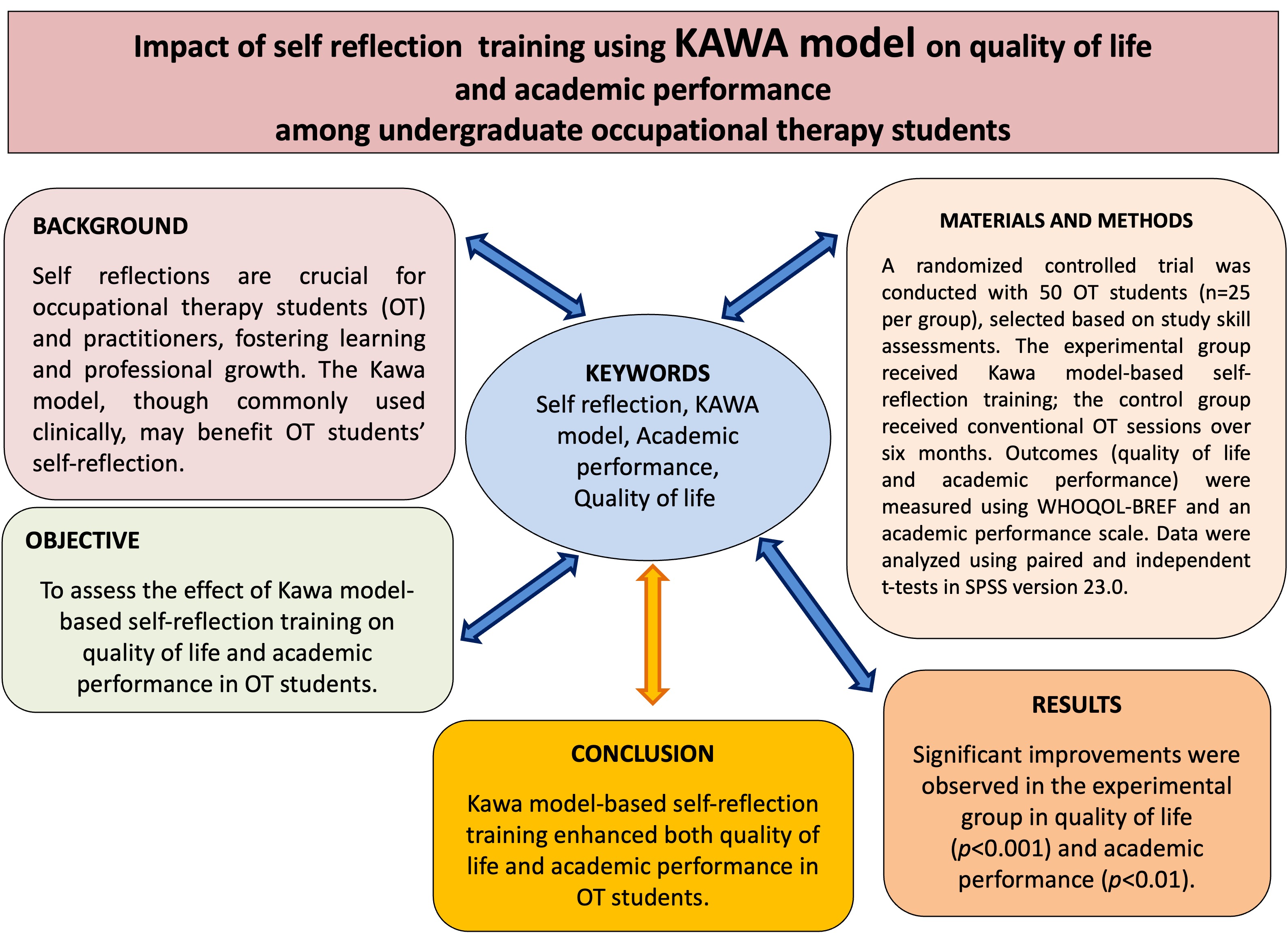
Background: Self-appraisal and reflection are crucial for occupational therapy students (OT) and practitioners, fostering learning and professional growth. The Kawa model, typically used clinically, may aid self-reflection by helping students recognize their strengths and challenges. However, while the model has been extensively studied in clinical settings, research on its application as a self-reflection tool for OT students remains limited.
Objectives: This study aimed to evaluate the impact of self-reflection training using the Kawa model on the quality of life and academic performance of undergraduate occupational therapy students.
Materials and methods: A randomized controlled trial was conducted. A total of 183 occupational therapy students were initially screened using the Study Skills Assessment Questionnaire. Based on poor and moderate study skill levels, along with teacher reports, 77 students met the inclusion criteria. Through simple randomization using the lottery method, 50 students were selected and assigned to either the experimental group (N=25) or the control group (N=25).The quality of life and academic performance were assessed using the WHOQOL-BREF and an academic performance scale. The experimental group received self-reflection training based on the Kawa model, while the control group underwent conventional occupational therapy for six months. Data analysis was performed using SPSS version 23.0, with paired and independent t-tests applied.
Results: Post-test scores showed statistically significant improvements in the experimental group in both quality of life (p<0.001) and academic performance (p<0.01). The results of this study showed that self-reflection training using the Kawa model was effective in enhancing both quality of life and academic performance among occupational therapy students.
Conclusion: The results suggested that self-reflection training with the Kawa model was beneficial for the experimental group, it improved quality of life and better academic performance of occupational therapy students after the intervention.
Article Details

This work is licensed under a Creative Commons Attribution-NonCommercial-NoDerivatives 4.0 International License.
Personal views expressed by the contributors in their articles are not necessarily those of the Journal of Associated Medical Sciences, Faculty of Associated Medical Sciences, Chiang Mai University.
References
Mishra B, Pathak R, Dwivedi A, Mishra HB, Gupta SS. Study of correlation between academic performance and quality of life among occupational therapy students. Int J Adv Res Ideas Innov Technol. 2018; 4(6): 497-501. Available from: https://www.ijariit.com/manuscripts/v4i6/V4I6-1322.pdf.
Shareef MA, AlAmodi AA, Al-Khateeb AA, et al. The interplay between academic performance and quality of life among preclinical students. BMC Med Educ. 2015; 15(1): 193. doi: 10.1186/s12909-015-0476-1.
Chattu VK, Sahu PK, Seedial N, et al. An exploratory study of quality of life and its relationship with academic performance among students in medical and other health professions. Med Sci (Basel). 2020; 8(2): 23. doi: 10.3390/medsci8020023.
Blakely T, Potvin MC, Iwama M. The Kawa model’s value for level II occupational therapy fieldwork students. J Occup Ther Educ. 2021; 5(4): 14. doi: 10.26681/jote.2021.050414.
Iliff S, Tool G, Bowyer P, Parham L, Fletcher T, Freysteinson W. Self-reflection and its relationship to occupational competence and clinical performance in level II fieldwork. Internet J Allied Health Sci Pract. 2021; 19(3): Article 8. doi: 10.46743/1540-580x/2021.1988
Foo KS, Kueh YC, Leong KJ, et al. Kawa model on mental health, sports and physical performance: A mini review. Asian J Sport Exerc Psychol. 2023; 3(2): 89-97. doi: 10.1016/j.ajsep.2023.08.002.
Naidoo O, Christopher C, Lingah T, Moran M. The Kawa Model: A self-reflection tool for occupational therapy student development in practice placements in Australia. Occup Ther Int. 2023; 2023: 2768898. doi: 10.1155/2023/2768898.
Ilić I, Šipetić S, Grujičić J, Mačužić IŽ, Kocić S, Ilić M. Psychometric properties of the World Health Organization’s quality of life (WHOQOL-BREF) questionnaire in medical students. Medicina (Kaunas). 2019; 55(12):772. doi: 10.3390/medicina55120772.
Hadning I, Ainii NQ. An analysis of health workers’ quality of life in Indonesia during COVID-19 pandemic. In: Proceedings of the 4th International Conference on Sustainable Innovation 2020–Health Science and Nursing (ICoSIHSN 2020). Atlantis Press; 2021. doi: 10.2991/ahsr.k.210115.085.
Keerthana DMM. Exploring the relationship between hope, academic performance among college students. Punitha and S. Williams. Journal of Associated Medical Sciences 2025; 58(3): 156-162162 Int J Multidiscip Res. 2024; 6(4): 1-7. doi: 10.36948/ijfmr.2024.v06i04.24592
Pizzi MA, Richards LG. Promoting health, well-being, and quality of life in occupational therapy: A commitment to a paradigm shift for the next 100 years. Am J Occup Ther. 2017; 71(4): 7104170010p1-5. doi: 10.5014/ajot.2017.028456.
Espiritu EW. Assessing the effectiveness of an occupation-based intervention in promoting OT student well-being. Am J Occup Ther. 2023; 77 (Suppl 2): 7711510288p1. doi: 10.5014/ajot.2023.77S2-PO288.
Galof K. Improve quality of life client with visual impairment. Fam Med Prim Care Open Access. 2022; 6(2): 188. doi: 10.29011/2688-7460.100088.
Hsiao HY. The effects of Kawa model therapeutic group for ketamine users [master’s thesis]. Tainan (TW): National Cheng Kung University; 2016. Available from: https://ndltd.ncl.edu.tw/cgi-bin/gs32/gsweb.cgi?o=dnclcdr&s=id=%22104NCKU5738007%22. &searchmode=basic.
Zolotnitsky LK, Beach C, Potvin MC, Ryan MA. Outcomes of OT-led coaching to support the success of students with disabilities in higher education. Am J Occup Ther. 2022; 76(Suppl 1): 7610510177p1. doi: 10.5014/ajot.2022.76s1-po177.
Nagata R, Forry S, Lannigan EG. Occupational therapy interventions for college students with learning differences. Am J Occup Ther. 2022; 76(6): 7606390010. doi: 10.5014/ajot.2022.050057.
