
The effects of motor-cognitive training on balance and working memory in young adult women with low physical activity: A randomized controlled trial
Article Sidebar
Main Article Content
Abstract
Background: Young adult women with low physical activity levels often experience a decline in muscle mass and balance, which can negatively impact both physical and mental health. Cognitive functions, particularly working memory, play a crucial role in maintaining balance during various activities. A reduction in working memory capacity may impair the ability to manage dual-task activities, increasing the risk of instability and falls.
Objectives: To investigate the effects of motor-cognitive training combining balance exercises with working memory tasks on balance performance and working memory skills in women aged 18-25 years with low physical activity levels.
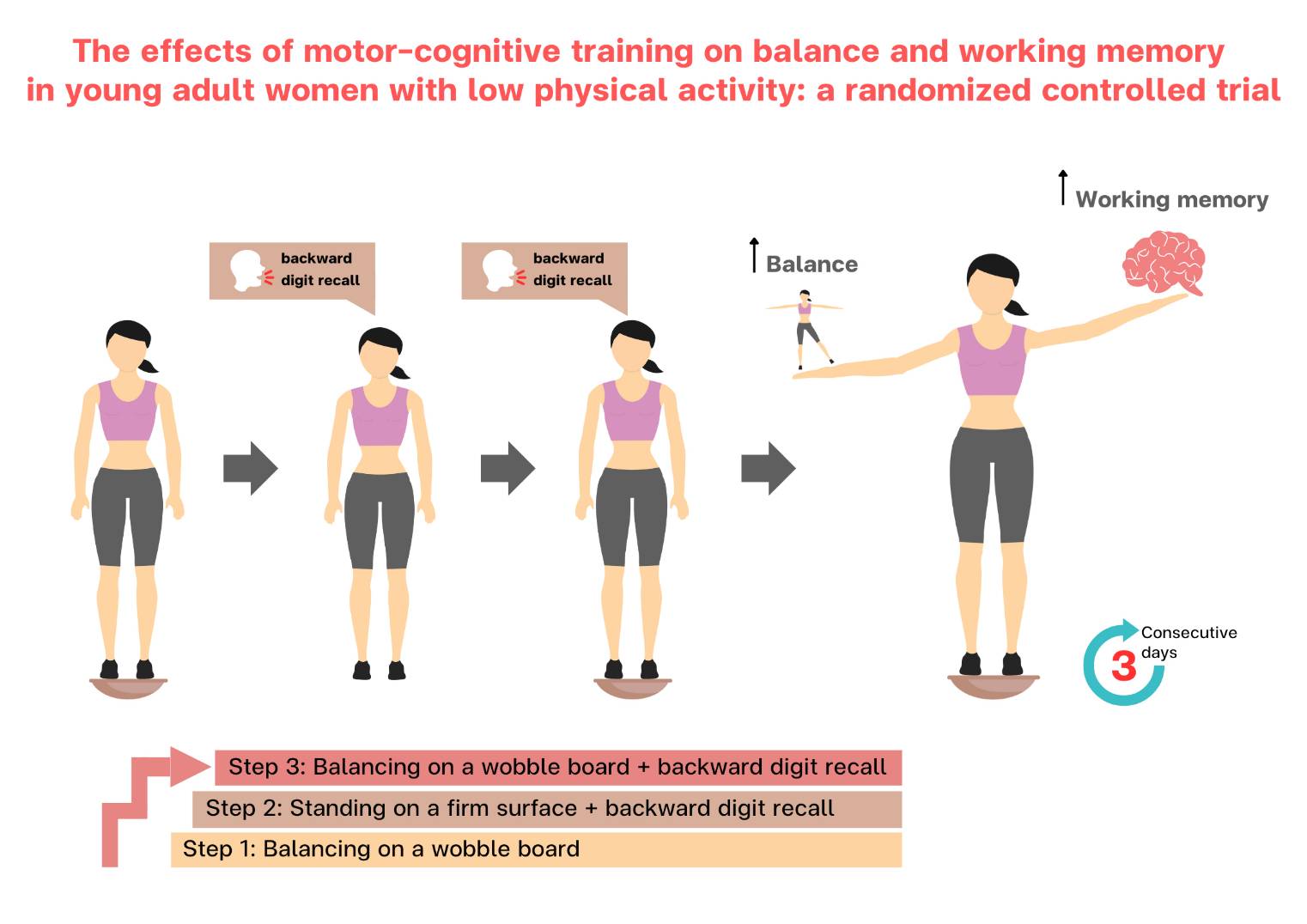
Materials and methods: A randomized controlled trial was conducted with 46 female participants aged 18-25 years who had low physical activity levels. Participants were randomly assigned to either an experimental group (N=23) or a control group (N=23). The experimental group underwent motor-cognitive training, which integrated balance training with working memory tasks, for three consecutive days. The control group received general information on improving balance and working memory. Pre- and post-training assessments were conducted using the Biodex Balance System to measure static balance (sway index values from the Balance Error Scoring System), dynamic balance (limit of stability), and working memory were assessed using the digit span test. Data were analyzed statistically, with significance set at p<0.05.
Results: Following the training, the experimental group exhibited significantly greater improvements in working memory skills compared to the control group. Additionally, the experimental group demonstrated enhanced dynamic balance performance, particularly in the forward/right and backward/left directions, compared to the control group.
Conclusion: Motor-cognitive training enhances balance and working memory in young adult women with low physical activity over the short period. This dual-task training approach presents a promising strategy for promoting balance and cognitive function in this population.
Article Details

This work is licensed under a Creative Commons Attribution-NonCommercial-NoDerivatives 4.0 International License.
Personal views expressed by the contributors in their articles are not necessarily those of the Journal of Associated Medical Sciences, Faculty of Associated Medical Sciences, Chiang Mai University.
References
Corder K, Winpenny E, Love R, Brown HE, White M, van Sluijs E. Change in physical activity from adolescence to early adulthood: a systematic review and meta-analysis of longitudinal cohort studies. Br J Sports Med. 2019; 53(8): 496-503. doi.org/10.1136/bjsports-2016-097330.
Guthold R, Stevens GA, Riley LM, Bull FC. Worldwide trends in insufficient physical activity from 2001 to 2016: a pooled analysis of 358 population-based surveys with 1·9 million participants. Lancet Glob Health. 2018; 6(10): e1077-86. doi.org/10.1016/S2214-109X(18)30357-7.
Liu R, Menhas R, Saqib ZA. Does physical activity influence health behavior, mental health, and psychological resilience under the moderating role of quality of life? Front Psychol. 2024; 15: 1349880. doi.org/10.3389/fpsyg.2024.1349880.
Bowden Davies KA, Pickles S, Sprung VS, Kemp GJ, Alam U, Moore DR, et al. Reduced physical activity in young and older adults: metabolic and musculoskeletal implications. Ther Adv Endocrinol Metab. 2019; 10: 1-15. doi.org/10.1177/2042018819888824.
Cox EP, O’Dwyer N, Cook R, Vetter M, Cheng HL, Rooney K, et al. Relationship between physical activity and cognitive function in apparently healthy young to middle-aged adults: A systematic review. J Sci Med Sport. 2016; 19(8): 616-28.doi.org/10.1016/j.jsams.2015.09.003.
Onofrei RR, Amaricai E. Postural balance in relation with vision and physical activity in healthy young adults. Int J Environ Res Public Health. 2022; 19(9): 5021. doi.org/10.3390/ijerph19095021.
Petroman R, Rata AL. Balance performance in sedentary and active healthy young individualsa cross-sectional study. Phys Educ Stud. 2020; 24(2): 115-9. doi.org/10.15561/20755279.2020.0207.
Susan B O’sullivan, Thomas J Schmitz, George Fulk. Physical rehabilitation. 7th Ed. Philadelphia: F.A. Davis; 2019.
Woollacott MH, Shumway-Cook A. Changes in posture control across the life span-a systems approach. Phys Ther. 1990; 70(12): 799-807. doi.org/10.1093/ptj/70.12.799.
Lajoie Y, Teasdale N, Bard C, Fleury M. Attentional demands for static and dynamic equilibrium. Exp Brain Res. 1993; 97(1): 139-44. doi.org/10.1007/bf00228824.
Welsh M, Schmitt-Wilson S. Executive function, identity, and career decision-making in college students. SAGE Open. 2013; 3(4): 215824401350575. doi.org/10.1177/2158244013505755.
Divandari N, Bird M-L, Vakili M, Jaberzadeh S. The association between cognitive domains and postural balance among healthy older adults: A systematic review of literature and meta-analysis. Curr Neurol Neurosci Rep. 2023; 23(11): 681-93. doi.org/10.1007/s11910-023-01305-y.
Baddeley A. Working memory. Science. 1992; 255 (5044): 556-9. doi.org/10.1126/science.1736359.
Andre J, Picchioni M, Zhang R, Toulopoulou T. Working memory circuit as a function of increasing age in healthy adolescence: A systematic review and meta-analyses. NeuroImage Clin. 2016; 12: 940-8. doi.org/10.1016/j.nicl.2015.12.002.
Doumas M, Rapp MA, Krampe RT. Working memory and postural control: adult age differences in potential for improvement, task priority, and dual tasking. J Gerontol B Psychol Sci Soc Sci. 2009; 64(2): 193-201. doi.org/10.1093/geronb/gbp009.
Calderón-Garcidueñas L, Torres-Solorio AK, Kulesza RJ, Torres-Jardón R, González-González LO, García-Arreola B, et al. Gait and balance disturbances are common in young urbanites and associated with cognitive impairment. Air pollution and the historical development of Alzheimer’s disease in the young. Environ Res. 2020; 191(110087): 110087. doi.org/10.1016/j.envres.2020.110087.
Peng B, Ng JYY, Ha AS. Barriers and facilitators to physical activity for young adult women: a systematic review and thematic synthesis of qualitative literature. Int J Behav Nutr Phys Act. 2023; 20(1): 23. doi.org/10.1186/s12966-023-01411-7.
Yalnaz U, Sarwar U, Quresh S, Saeed HS, Manzoor I, Rasheed N. Effectiveness of wobble board exercises on dynamic balance among Undergraduate students. J Univ Med Dent Coll. 2022; 13(2): 391-5. doi.org/10.37723/jumdc.v13i2.737.
Rogge A-K, Röder B, Zech A, Nagel V, Hollander K, Braumann K-M, et al. Balance training improves memory and spatial cognition in healthy adults. Sci Rep. 2017; 7(1): 5661. doi.org/10.1038/s41598-017-06071-9.
Ludyga S, Held S, Rappelt L, Donath L, Klatt S. A network meta-analysis comparing the effects of exercise and cognitive training on executive function in young and middle-aged adults. Eur J Sport Sci. 2023; 23(7): 1415-25. doi.org/10.1080/17461391.2022.2099765.
Kiss R, Brueckner D, Muehlbauer T. Effects of single compared to dual task practice on learning a dynamic balance task in young adults. Front Psychol. 2018; 9: 311. doi.org/10.3389/fpsyg.2018.00311.
Pescatello LS, Arena R, Riebe D, Thompson PD. ACSM’s guidelines for exercise testing and prescription. 9th ed. Philadelphia (PA): American College of Sports Medicine; 2014.
Arnett JJ. Emerging adulthood: A theory of development from the late teens through the twenties. Am Psychol. 2000; 55(5): 469-80. doi.org/10.1037/0003-066x.55.5.469.
Rattanawiwatpong P, Khunphasee A, Pongurgsorn C, Intarakamhang P. Validity and reliability of the Thai version of short format international physical activity questionnaire (IPAQ). J Thai Rehabil. 2006; (16): 147-60.
Turner M, Ridsdale J. The digit memory test. Dyslexia Int. 2004.
Zhang W, Liu H, Zhang T. Immediate and short-term effects of single-task and motorcognitive dual-task on executive function. PLoS One. 2023; 18(8): e0290171. doi.org/10.1371/journal.pone.0290171.
Beurskens R, Brueckner D, Muehlbauer T. Effects of motor versus cognitive task prioritization during dual-task practice on dual-task performance in young adults. Front Psychol. 2020; 11: 581225. doi.org/10.3389/fpsyg.2020.581225.
Schubert T, Kübler S, Strobach T. A mechanism underlying improved dual-task performance after practice: Reviewing evidence for the memory hypothesis. Psychon Bull Rev. 2024; 31(5): 2005-21. doi.org/10.3758/s13423-024-02498-0.
Hocking DR, Fritsche S, Farhat H, Atkinson A, Bendak H, Menant J. Working memory is a core executive function supporting dual-task locomotor performance across childhood and adolescence. J Exp Child Psychol. 2020; 197: 104869. doi. org/10.1016/j.jecp.2020.104869.
Li Y, Fu W, Zhang Q, Chen X, Li X, Du B, et al. Effects of forward and backward span trainings on working memory: Evidence from a randomized controlled trial. Psychophysiology. 2023; 60(1): e14154. Available from: doi.org/10.1111/psyp.14154.
Koziol LF, Budding D, Andreasen N, D’Arrigo S, Bulgheroni S, Imamizu H, et al. Consensus paper: the cerebellum’s role in movement and cognition. Cerebellum. 2014; 13(1): 151-77. doi.org/10.1007/s12311-013-0511-x.
Ito M. Control of mental activities by internal models in the cerebellum. Nat Rev Neurosci. 2008; 9(4): 304-13. doi.org/10.1038/nrn2332.
Diamond A. Executive functions. Annu Rev Psychol. 2013; 64(1): 135-68. doi.org/10.1146/annurev-psych-113011-143750.
Taghavi Asl A, Shojaedin SS, Hadadnezhad M. Comparison of effect of wobble board training with and without cognitive intervention on balance, ankle proprioception and jump landing kinetic parameters of men with chronic ankle instability: a randomized control trial. BMC Musculoskelet Disord. 2022; 23(1): 888. doi.org/10.1186/s12891-022-05706-x.
Bakker, L.B.M., Lamoth, C.J.C., Vetrovsky, T. et al. Neural correlates of balance skill learning in young and older individuals: A systematic review and meta-analysis. Sports Med Open. 2024; 10(1): 3. doi.org/10.1186/s40798-023-00668-3.
Haith AM, Krakauer JW. The multiple effects of practice: skill, habit and reduced cognitive load. Curr Opin Behav Sci. 2018; 20: 196-201. doi. org/10.1016/j.cobeha.2018.01.015.
Taubert M, Draganski B, Anwander A, Müller K, Horstmann A, Villringer A, et al. Dynamic properties of human brain structure: learning-related changes in cortical areas and associated fiber connections. J Neurosci. 2010; 30(35): 11670-7. doi.org/10.1523/JNEUROSCI.2567-10.2010.
Patel JK, Patel VG, Desai NR, Patel NR, Mukkhi MS, Ribadiya PK. Effect of 4 weeks balance training program in healthy young adults: A randomized clinical trial study. Indian J Physiother Occup Ther. 2020; 14(2): 74-9. doi.org/10.37506/ijpot.v14i2.2611.
Lüder B, Kiss R, Granacher U. Single- and dual-task balance training are equally effective in youth. Front Psychol. 2018; 9: 912. doi.org/10.3389/fpsyg.2018.00912.
Petró B, Papachatzopoulou A, Kiss RM. Devices and tasks involved in the objective assessment of standing dynamic balancing - A systematic literature review. PLoS ONE. 2017; 12(9): E0185188. doi.org/10.1371/journal.pone.0185188.
