
Speech therapy for children with cleft lip and palate: Telepractice combined with face-to-face via Application for Articulation Therapy-Thai (AAT-T) in the pandemic of Covid-19
Article Sidebar
Main Article Content
Abstract
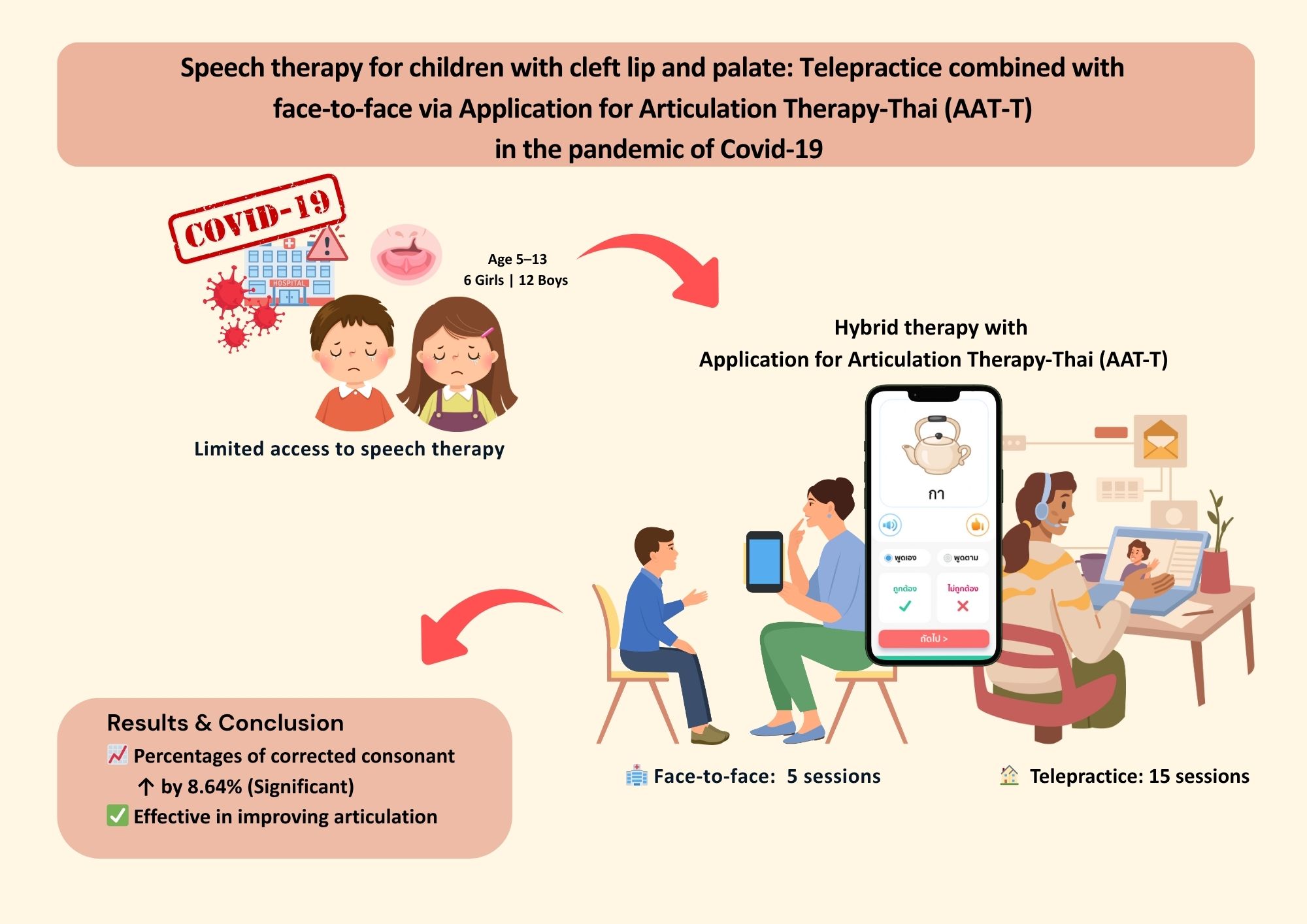
Background: In developing countries, access to speech therapy is restricted due to limited resources, lack of trained professionals, and geographical barriers. The COVID-19 pandemic further exacerbated these issues, making in-person therapy sessions difficult or impossible for many patients. In response, combining telepractice and mobile applications can help bridge this gap in accessibility to speech therapy services for children with cleft lip and palate.
Objective: To compare the percentage of correct consonants (PCC) before and after implementing telepractice combined with face-to-face speech therapy using the Application for Articulation Therapy-Thai (AAT-T) for children with cleft lip and palate and to evaluate the effectiveness of implementing the combination of AAT-T with telepractice regarding improvement in pronunciation.
Materials and methods: A one-group pretest-posttest design was employed to evaluate a cohort of 18 children aged 5 to 13 years who have undergone surgery for cleft lip and palate, including 12 boys and 6 girls. During pre- and post-implementation of telepractice and face-to-face speech therapy using the Application for Articulation Therapy-Thai (AAT-T), the percentage of correct consonants (PCC) for each individual was elicited via the Thai Connected Speech Standard Test by qualified speech and language pathologists. The speech therapy program consisted of five 45-minute face-to-face training sessions using AAT-T held once a month, along with 15 weekly telepractice sessions, each lasting 30 minutes, conducted over a period of five months.
Results: After telepractice and face-to-face speech therapy with AAT-T, the numbers of PCC scores significantly increased (mean difference=8.64, SD=8.89; 95% confidence interval=4.22-13.06).
Conclusion: Telepractice combined with face-to-face speech therapy using AAT-T effectively corrected the articulation disorders in patients with cleft lip and cleft palate. This strategy can be applied in any areas that have limited resources, geographical barriers, or a pandemic situation that requires social distancing in Thailand. The application can also be developed in any language for use in enhancing speech accessibility in other developing countries.
Article Details

This work is licensed under a Creative Commons Attribution-NonCommercial-NoDerivatives 4.0 International License.
Personal views expressed by the contributors in their articles are not necessarily those of the Journal of Associated Medical Sciences, Faculty of Associated Medical Sciences, Chiang Mai University.
References
Panamonta V, Pradubwong S, Panamonta M, Chowchuen B. Global birth prevalence of orofacial clefts: A systematic review. J Med Assoc Thai. 2015; 98(Suppl 7): S11-21.
Fuangtharnthip P, Chonnapasatid W, Thiradilok S, Manopatanakul S, Jaruratanasirikul S. Registry-based study of prevalence of cleft lip/palate in Thailand from 2012 to 2015. Cleft Palate Craniofac J. 2021; 58(11): 1430-7. doi:10.1177/1055665620987677.
Scherer NJ, D’Antonio LL, McGahey H. Early intervention for speech impairment in children with cleft palate. Cleft Palate Craniofac J. 2008; 45(1): 18-31. doi: 10.1597/06-085.1.
Rezaei P, Poorjavad M, Abdali H. Speech outcomes after palatal closure in 3-7-year-old children. Braz J Otorhinolaryngol. 2022; 88(4): 594-601. doi: 10.1016/j.bjorl.2020.08.005.
Albustanji YM, Albustanji MM, Hegazi MM, Amayreh MM. Prevalence and types of articulation errors in Saudi Arabic-speaking children with repaired cleft lip and palate. Int J Pediatr Otorhinolaryngol. 2014; 78(10): 1707-15. doi: 10.1016/j.ijporl.2014.07.025.
Prandini EL, Pegoraro-Krook MI, Dutka Jde C, Marino VC. Occurrence of consonant production errors in liquid phonemes in children with operated cleft lip and palate. J Appl Oral Sci. 2011; 19(6): 579-85. doi: 10.1590/s1678-77572011000600007.
Prathanee B, Thanawirattananit P, Thanaviratananich S. Speech, language, voice, resonance and hearing disorders in patients with cleft lip and palate. J Med Assoc Thai. 2013; 96 (Suppl. 4): S71-80.
Kuehn DP, Moller KT. Speech and language issues in the cleft palate population: the state of the art. Cleft Palate-Craniofac J. 2000; 37 (348): 1-35. doi: 10.1597/1545-1569_2000_037_0348_saliit_2.3.co_2.
Prathanee B, Lorwatanapongsa P, Makarabhirom K, Suphawatjariyakul R, Wattanawongsawang W, Prohmtong S, et al. Speech camp for children with cleft lip and/or palate in Thailand. Asian Biomed. 2011; 5(1): 111-8. doi:10.5372/1905-7415.0501.013.
Suphawatjariyakul R, Lorwatanapongsa P, Makarabhirom K, Prathanee B, Manochiopinig S, Wattanawongsawang W. Speech camp: community-based speech therapy model for Thai children with cleft lip/palate in Amnatchareon Province. Saraburi Hosp Med J. 2007; 33(2): 118-25.
Pamplona C, Ysunza A, Patiño C, Ramírez E, Drucker M, Mazón JJ. Speech summer camp for treating articulation disorders in cleft palate patients. Int J Pediatr Otorhinolaryngol. 2005; 69(3): 351-9. doi: 10.1016/j.ijporl.2004.10.012.
Prathanee B, Thanawirattananit P, Surit P, Mitkitti R, Makarabhirom K. Speech task force and quality of life after surgery in children with cleft lip and palate: Limitation of professionals. Arch Plast Surg. 2024; 51(3): 275-83. doi: 10.1055/s-0043-1776738.
Pamplona MC, Ysunza A, Jimenez-Murat Y. Mothers of children with cleft palate undergoing speech intervention change communicative interaction. Int J Pediatr Otorhinolaryngol. 2001; 59(3): 173-9. doi: 10.1016/s0165-5876(01)00476-1.
Sweeney T, Hegarty F, Powell K, Deasy L, Regan MO, Sell D. Randomized controlled trial comparing parent led therapist supervised articulation therapy (PLAT) with routine intervention for children with speech disorders associated with cleft palate. Int J Lang Commun Disord. 2020; 55(5): 639-60. doi: 10.1111/1460-6984.12542.
Pushpavathi M, Kavya V, Akshatha V. Efficacy of focused stimulation in early language intervention program for toddlers with repaired cleft palate. Glob J Oto. 2017; 9: 5-12. doi: 10.19080/GJO.2017.09.555752.
Prathanee B, Dechongkit S, Manochiopinig S. Development of community-based speech therapy model: for children with cleft lip/palate in northeast Thailand. J Med Assoc Thai. 2006; 89(4): 500-8.
Prathanee B, Makarabhirom K, Jaiyong P, Pradubwong S. Khon Kaen: a community-based speech therapy model for an area lacking in speech services for clefts. The Southeast Asian journal of tropical medicine and public health. 2014; 45(5): 1182-95.
ASHA. Telepractice 2025 [cited 2025 18 April 2025]. Available from: https://www.asha.org/practice-portal/professional-issues/telepractice/.
Palomares-Aguilera M, Inostroza-Allende F, Solar LR. Speech pathology telepractice intervention during the COVID-19 pandemic for Spanish-speaking children with cleft palate: A systematic review. Int J Pediatr Otorhinolaryngol. 2021; 144: 110700. doi: 10.1016/j.ijporl.2021.110700.
Pamplona MDC, Ysunza PA. Speech pathology telepractice for children with cleft palate in the times of COVID-19 pandemic. Int J Pediatr Otorhinolaryngol. 2020; 138: 110318. doi: 10.1016/j.ijporl.2020.110318.
Philp J, Ellis PK, Scherer NJ, Lien KM. Enhanced milieu teaching with phonological emphasis: A pilot telepractice parent training study for toddlers with clefts. Children (Basel). 2021; 8(9). doi: 10.3390/children8090736.
Nakarmi KK, Mehta K, Shakya P, Rai SK, Bhattarai Gurung K, Koirala R, et al. Online speech therapy for cleft palate patients in rural Nepal: Innovations in providing essential care during COVID-19 Pandemic. J Nepal Health Res Counc. 2022; 20(1): 154-9. doi: 10.33314/jnhrc.v20i01.3781.
Dhillon H, Chaudhari PK, Dhingra K, Kuo RF, Sokhi RK, Alam MK, et al. Current applications of artificial intelligence in cleft care: A scoping review. Front Med (Lausanne). 2021; 8: 676490. doi: 10.3389/fmed.2021.676490.
Prathanee B. Application for Articulation Therapy-Thai: AAT-T. Thailand, 2023.
Prathanee B, Pumnum T, Yoodee P, Makarabhirom K. Speech therapy model for patients with cleft palate in Lao People’s Democratic Republic: Lack of speech services. Int J Pediatr Otorhinolaryngol. 2020; 138: 110366. doi: 10.1016/j.ijporl.2020.110366.
Interacoustics. AC40 2025 [cited 2025 11 May]. Available from: https://www.interacoustics.com/audiometers/ac40.
Prathanee B. Assessment and intervention of articulation disorders in children with cleft lip and palate. In: Prathanee B, editor. Cleft lip and palate: speech problem and interdisciplinary approaches Vol II. Khon Kaen: Khon Kaen University Printing; 2014. p. 393-442.
Ooppanasak N, Makarabhirom K, Chowchuen B, Prathanee B. Speech outcomes in children with cleft and palate: Srinagarind Hospital, Khon Kaen University, Thailand. J Med Assoc Thai. 2019; 102(6): 10-8.
Makarabhirom K, Prathanee B, Suphawatjariyakul R, Yoodee P. Speech therapy for children with cleft Lip and palate using a community-based speech therapy model with speech assistants. J Med Assoc Thai. 2015; 98 (Suppl. 7): S140-50.
Prathanee B. Record book of speech therapy for children with cleft lip and palate. KhonKaen: Klangnanawittaya Press; 2010.
Prathanee B, Lorwatanapongsa P, Anantapong D, Buakanok N. Thai speech parameters for patients with cleft palate in a universal reporting system. Asia Pac J Speech Lang Hear. 2011; 14(1): 31-49. doi: 10.1179/136132811805334902.
Henningsson G, Kuehn DP, Sell D, Sweeney T, Trost-Cardamone JE, Whitehill TL. Universal parameters for reporting speech outcomes in individuals with cleft palate. Cleft Palate Craniofac J. 2008; 45(1): 1-17. doi: 10.1597/06-086.1.
IBM. IBM SPSS Statistics Desktop 28.0.1.0 2025 [cited 2025 11 May]. Available from: https://www.ibm.com/software/reports/compatibility/clarity/product.html?id=0B6294300A3F11ECADF816E2FD273C71.
Burke BL, Jr., Hall RW. Telemedicine: Pediatric applications. Pediatrics. 2015; 136(1): e293-308. doi: 10.1542/peds.2015-1517.
Hayakawa T, Imura H, Inoue C, Mori T, Aihara Y, Tsujiuchi S, et al. Efficacy of telepractice, an alternative therapy tool during the coronavirus disease 2019 pandemic, for speech disorders related to congenital anomalies. Congenit Anom (Kyoto). 2023; 63(6): 206-10. doi: 10.1111/cga.12543.
Rangarathnam B, McCullough GH, Pickett H, Zraick RI, Tulunay-Ugur O, McCullough KC. Telepractice versus in-person delivery of voice therapy for primary muscle tension dysphonia. Am J Speech Lang Pathol. 2015; 24(3): 386-99. doi: 10.1044/2015_ajslp-14-0017.
