
Effects of distal robot-assisted therapy combining with task-oriented training on paretic upper extremity functions in clients with sub-acute stroke: A preliminary study
Article Sidebar
Main Article Content
Abstract
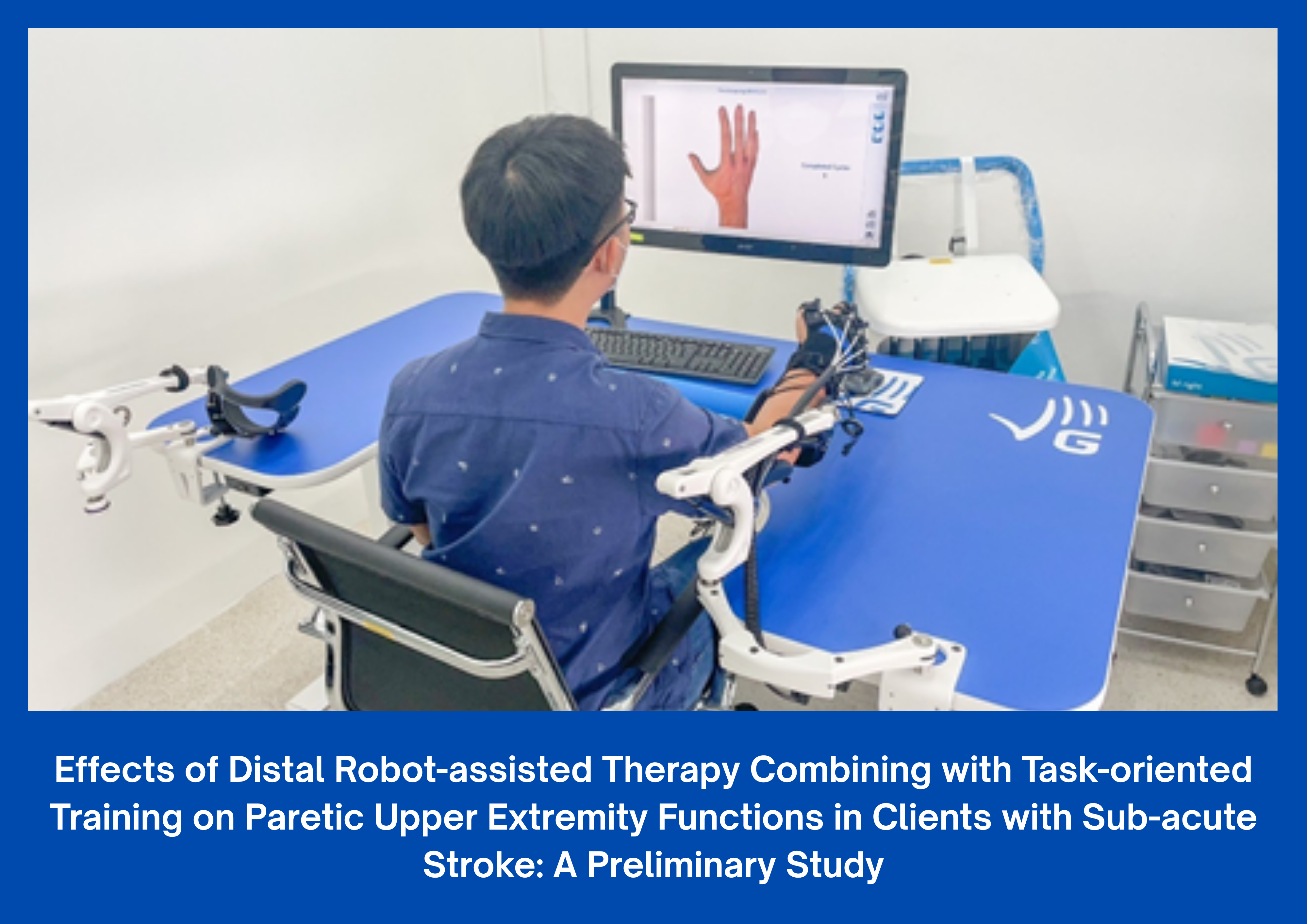
Background: Robot-assisted therapy (RT) is revolutionizing stroke rehabilitation, offering new hope for improving upper extremity function. When integrated with task-oriented training (TOT), RT has the potential to enhance recovery by promoting more meaningful, functional outcomes for stroke survivors. Despite its promise, evidence on the effectiveness of distal RT combined with TOT remains limited, leaving clinicians and researchers searching for clearer evidence on the best rehabilitation strategies.
Objective: This study aimed to investigate the feasibility of distal RT combined with TOT on the function of the paretic upper extremity in sub-acute stroke patients.
Materials and methods: This preliminary randomized controlled, assessor-blinded study recruited 15 sub-acute stroke patients. Participants were randomly assigned to either the experimental group (EG; enrolled, N=8; completed, N=7) or the control group (CG; enrolled, N=7; completed, N=7). Both groups received conventional occupational therapy. The EG additionally underwent one hour of distal robot-assisted task-oriented training twice a week for six weeks. Paretic upper extremity function was assessed at baseline and post-rehabilitation using the Fugl-Meyer Assessment for Upper Extremity (FMA-UE) and the Functional Test for Hemiplegic Upper Extremity Thai Version (FTHUE-Thai version).
Results: Fourteen patients completed the program. No significant differences in post-intervention mean scores were found between groups. However, change scores were significantly higher in the EG for distal FMA-UE (p=0.002), total FMA-UE (p=0.004), and FTHUE-Thai Version (p=0.026). Additionally, effect size analysis also indicated high effects in the EG for proximal FMA-UE (d=0.94), distal FMA-UE (d=2.28), total FMA-UE (d=1.66), and FTHUE-Thai version scores (d=1.89), suggesting clinically meaningful improvements.
Conclusion: Combining distal RT with TOT has the potential to enhance upper extremity function in sub- acute stroke patients. Although further research is needed to confirm these findings, the results are promising for developing more effective rehabilitation strategies.
Article Details

This work is licensed under a Creative Commons Attribution-NonCommercial-NoDerivatives 4.0 International License.
Personal views expressed by the contributors in their articles are not necessarily those of the Journal of Associated Medical Sciences, Faculty of Associated Medical Sciences, Chiang Mai University.
References
Feigin VL, Stark BA, Johnson CO, Roth GA, Bisignano C, Abady GG, et al. Global, regional, and national burden of stroke and its risk factors, 1990-2019: a systematic analysis for the Global Burden of Disease Study 2019. Lancet Neurol. 2021; 20(10): 795-820. doi: 10.1016/s1474-4422(21)00252-0.
Tiamkao S, Ienghong K, Cheung LW, Celebi I, Suzuki T, Apiratwarakul K. Stroke incidence, rate of thrombolytic therapy, mortality in Thailand from 2009 to 2021. OAMJMS. 2022; 10(E): 110-5. doi: 10.3889/oamjms.2022.8051.
Borschmann KN, Hayward KS. Recovery of upper limb function is greatest early after stroke but does continue to improve during the chronic phase: A two-year, observational study. Physiotherapy. 2020; 107: 216-23. doi: 10.1016/j.physio.2019.10.001.
Nakayama H, Stig Jørgensen H, Otto Raaschou H, Skyhøj Olsen T. Recovery of upper extremity function in stroke patients: The Copenhagen stroke study. ACRM. 1994; 75(4): 394-8. doi: 10.1016/0003-9993(94)90161-9.
Kainz A, Meisinger C, Linseisen J, Kirchberger I, Zickler P, Naumann M, et al. Changes of health-related quality of life within the 1st year after stroke–Results from a prospective sroke chort study. Front Neurol. 2021; 12. doi: 10.3389/fneur.2021.71531.
Tiwari S, Joshi A, Rai N, Satpathy P. Impact of stroke on quality of life of stroke survivors and their caregivers: A qualitative study from India. J Neurosci Rural Pract. 2021; 12(4): 680-8. doi: 10.1055/s-0041-1735323.
Huang HC, Chung KC, Lai DC, Sung SF. The impact of timing and dose of rehabilitation delivery on functional recovery of stroke patients. J Chin Med Assoc. 2009; 72(5): 257-64. doi: 10.1016/s1726-4901(09)70066-8.
Bath PM, Lees KR. Acute stroke. West J Med. 2000; 173(3): 209-12. doi: 10.1136/ewjm.173.3.209.
Stinear C, Ackerley S, Byblow W. Rehabilitation is initiated early after stroke, but most motor rehabilitation trials are not: A systematic review. Stroke. 2013; 44(7): 2039-45. doi: 10.1161/strokeaha.113.000968.
Teasell R, Bayona N, Bitensky J. Background concepts in stroke rehabilitation. EBRSR. 2008; 1. Available from: http://www.ebrsr.com/evidence-review/3-background-concepts-stroke-rehabilitation
Pollock A, St George B, Fenton M, Firkins L. Top ten research priorities relating to life after stroke. Lancet Neurol. 2012; 11(3): 209. doi: 10.1016/s1474-4422(12)70029-7.
Iruthayarajah J, Mirkowski M, Reg M, Iliescu A, Caughlin S, Harris J, et al. Upper extremity motor rehabilitation interventions. EBRSR. 2016. Available from: http://www.ebrsr.com/sites/default/files/Ch.%2010%20Upper%20Extremity%20Motor%20Interventions_v20.pdf.
Hatem SM, Saussez G, Della Faille M, Prist V, Zhang X, Dispa D, et al. Rehabilitation of motor function after stroke: A multiple systematic review focused on techniques to stimulate upper extremity recovery. Front Hum Neurosci. 2016; 10: 442. doi: 10.3389/fnhum.2016.00442.
Weber LM, Stein J. The use of robots in stroke rehabilitation: A narrative review. Neurorehab. 2018; 43(1): 99-110. doi: 10.3233/nre-172408.
Bertani R, Melegari C, De Cola MC, Bramanti A, Bramanti P, Calabrò RS. Effects of robot-assisted upper limb rehabilitation in stroke patients: A systematic review with meta-analysis. Neurol Sci. 2017; 38(9): 1561-9. doi: 10.1007/s10072-017-2995-5.
Lee H-C, Kuo F-L, Lin Y-N, Liou T-H, Lin J-C, Huang S-W. Effects of robot-assisted rehabilitation on hand function of people with stroke: A randomized, crossover-controlled, assessor-blinded study. AJOT. 2020; 75(1): 7501205020p1-p11. doi: 10.5014/ajot.2021.038232.
Milia P, Peccini M, De Salvo F, Sfaldaroli A, Grelli C, Lucchesi G, et al. Rehabilitation with robotic glove (Gloreha) in poststroke patients. Digit Med. 2019; 5(2): 62-7. doi: 10.4103/digm.digm_3_19.
Vanoglio F, Bernocchi P, Mulè C, Garofali F, Mora C, Taveggia G, et al. Feasibility and efficacy of a robotic device for hand rehabilitation in hemiplegic stroke patients: A randomized pilot controlled study. Clin Rehabil. 2017; 31(3): 351-60. doi: 10.1177/0269215516642606.
Veerbeek JM, Langbroek-Amersfoort AC, van Wegen EEH, Meskers CGM, Kwakkel G. Effects of robot-assisted therapy for the upper limb after stroke: A systematic review and meta-analysis. Neurorehabil Neural Repair. 2017; 31(2): 107-21. doi: 10.1177/1545968316666957.
Villafañe JH, Taveggia G, Galeri S, Bissolotti L, Mullè C, Imperio G, et al. Efficacy of short-term robot-assisted rehabilitation in patients with hand paralysis after stroke: A randomized clinical trial. Hand. 2018; 13(1): 95-102. doi: 10.1177/1558944717692096.
Idrogenet. Gloreha Sinfonia Italy: Idrogenet coporation; 2021. Available from: https://www.gloreha.com/sinfonia/.
Chang PH, Lee S-H, Koo K-M, Lee S-H, Jin S-H, Yeo SS, et al. The cortical activation pattern by a rehabilitation robotic hand: A functional NIRS study. Front Hum Neurosci. 2014; 8: article 49. doi: 10.3389/fnhum.2014.00049.
Sobinov AR, Bensmaia SJ. The neural mechanisms of manual dexterity. Nat Rev Neurosci. 2021; 22(12): 741-57. doi: 10.1038/s41583-021-00528-7.
Teasell R, Hussein N, Mirkowski M, Vanderlaan D, Saikaley M, Iruthayarajah MLJ. Hemiplegic upper extremity rehabilitation. In: Teasell R, Hussein N, Iruthayarajah J, Saikaley M, Longval M, Viana R, editors. The Stroke Rehabilitation Clinician’s Handbook. London, Ontario, Canada: Heart & Stroke Foundation Canadian Partnership for Stroke Recovery; 2020: pp 1-60.
Winstein CJ, Stein J, Arena R, Bates B, Cherney LR, Cramer SC, et al. Guidelines for adult stroke rehabilitation and recovery. Stroke. 2016; 47(6): e98-e169. doi: 10.1161/STR.0000000000000098.
Wu C-y, Wong M-k, Lin K-c, Chen H-c. Effects of task goal and personal preference on seated reaching kinematics after stroke. Stroke. 2001; 32(1): 70-6. doi: 10.1161/01.STR.32.1.70.
Pongtham P, Chingchit W, Dhippayom JP. Improving upper extremity function in chronic stroke using occupational therapy task-oriented approach. J Assoc Med Sci. 2021; 55(1): 52-9. Available from: https://he01.tci-thaijo.org/index.php/bulletinAMS/article/view/252539.
Thant AA, Wanpen S, Nualnetr N, Puntumetakul R, Chatchawan U, Hla KM, et al. Effects of task-oriented training on upper extremity functional performance in patients with sub-acute stroke: A randomized controlled trial. J Phys Ther Sci. 2019; 31(1): 82-7. doi: 10.1589/jpts.31.82 .
Winstein CJ, Rose DK, Tan SM, Lewthwaite R, Chui HC, Azen SP. A randomized controlled comparison of upper-extremity rehabilitation strategies in acute stroke: A pilot study of immediate and long-term outcomes. Arch Phys Med Rehabil. 2004; 85(4): 620-8. doi: 10.1016/j.apmr.2003.06.027.
Borboni A, Mor M, Faglia R. Gloreha—hand robotic rehabilitation: Design, mechanical model, and experiments. J Dyn Sys Meas Control. 2016; 138(11). doi: 10.1115/1.4033831.
Thichanpiang P, Kaunnil A, Sansri V, Thongchoomsin S, Permpoonputtana K. Reliability and internal consistency of Thai activity card sort for stroke survivors in occupational therapy units. J Assoc Med Sci. 2020; 53(3). Available from: https://he01.tci-thaijo.org/index.php/bulletinAMS/article/view/241386.
Platz T, Pinkowski C, van Wijck F, Kim I-H, di Bella P, Johnson G. Reliability and validity of arm function assessment with standardized guidelines for the
Fugl-Meyer Test, Action Research Arm Test and Box and Block Test: A multicentre study. Clin Rehabil. 2005; 19(4): 404-11. doi: 10.1191/0269215505cr832oa.
Fong K, Ng B, Chan D, Chan E, Ma D, Au B, et al. Development of the Hong Kong version of the functional test for the hemiplegic upper extremity (FTHUE-HK). Hong Kong J Occup Ther. 2004; 14(1): 21-9. doi: 10.1016/S1569-1861(09)70025-7.
Pingmuang P, Chinchai P, Dhippayom JP. Internal consistency and inter-rater reliability of the functional test for hemiplegic upper extremity in persons with hemiplegia-Thai version. ASEAN J Rehabil Med. 2016; 26(2): 36-46. doi: 10.14456/jtrm.2016.9.
Cohen J. The Effect Size Index: d. Statistical power analysis for the behavioral sciences. 2nd Ed. New York: Lawrence Erlbaum Associates; 1988: pp 20-7
Harikrishnan H, Abd halim N, Arjunan S. Exploring the digital game-based elements in mathematics education: A meta-analysis review. Univ J Educ. 2019; 7: 106-16. doi: 10.13189/ujer.2019.071613.
Arya KN, Verma R, Garg RK. Estimating the minimal clinically important difference of an upper extremity recovery measure in subacute stroke patients. TSR. 2011; 18(Suppl 1): 599-610. doi: 10.1310/tsr18s01-599.
Timmermans AA, Spooren AI, Kingma H, Seelen HA. Influence of task-oriented training content on skilled arm-hand performance in stroke:
A systematic review. NNR. 2010; 24(9): 858-70. doi: 10.1177/1545968310368963.
Lee CY, Howe TH. Effectiveness of activity-based task-oriented training on upper extremity recovery for adults with stroke: A systematic review. AJOT. 2024; 78(2): 7802180070. doi: 10.5014/ajot.2024.050391.
Shi X, Yang C, Lee PC, Xie D, Ye Z, Li Z, et al. An interactive soft robotic hand-task training system with wireless task boards and daily objects on post-stroke rehabilitation. Wearable Technologies. 2025; 6: e4. doi: 10.1017/wtc.2024.10.
Zhao M, Wang G, Wang A, Cheng LJ, Lau Y. Robot-assisted distal training improves upper limb dexterity and function after stroke: A systematic review and meta-regression. Neurol Sci. 2022; 43(3): 1641-57. doi: 10.1007/s10072-022-05913-3.
