Extended verbal fluency in older adults: Results of a 2-minute test across animal, object, and food categories with frequently listed words
Article Sidebar
Main Article Content
Abstract
Background: Verbal fluency tests are widely used to assess cognitive function in dementia and evaluate word retrieval in stroke, typically within one minute. Although extending the test duration improves sensitivity to cognitive decline, 2-minute data in older Thai adults remain limited.
Objectives: This study aimed to evaluate the performance of older adults in Nonthaburi on a 2-minute verbal fluency test across animal, object, and food categories, reporting frequently listed words and exploring influential factors such as age, gender, and education.
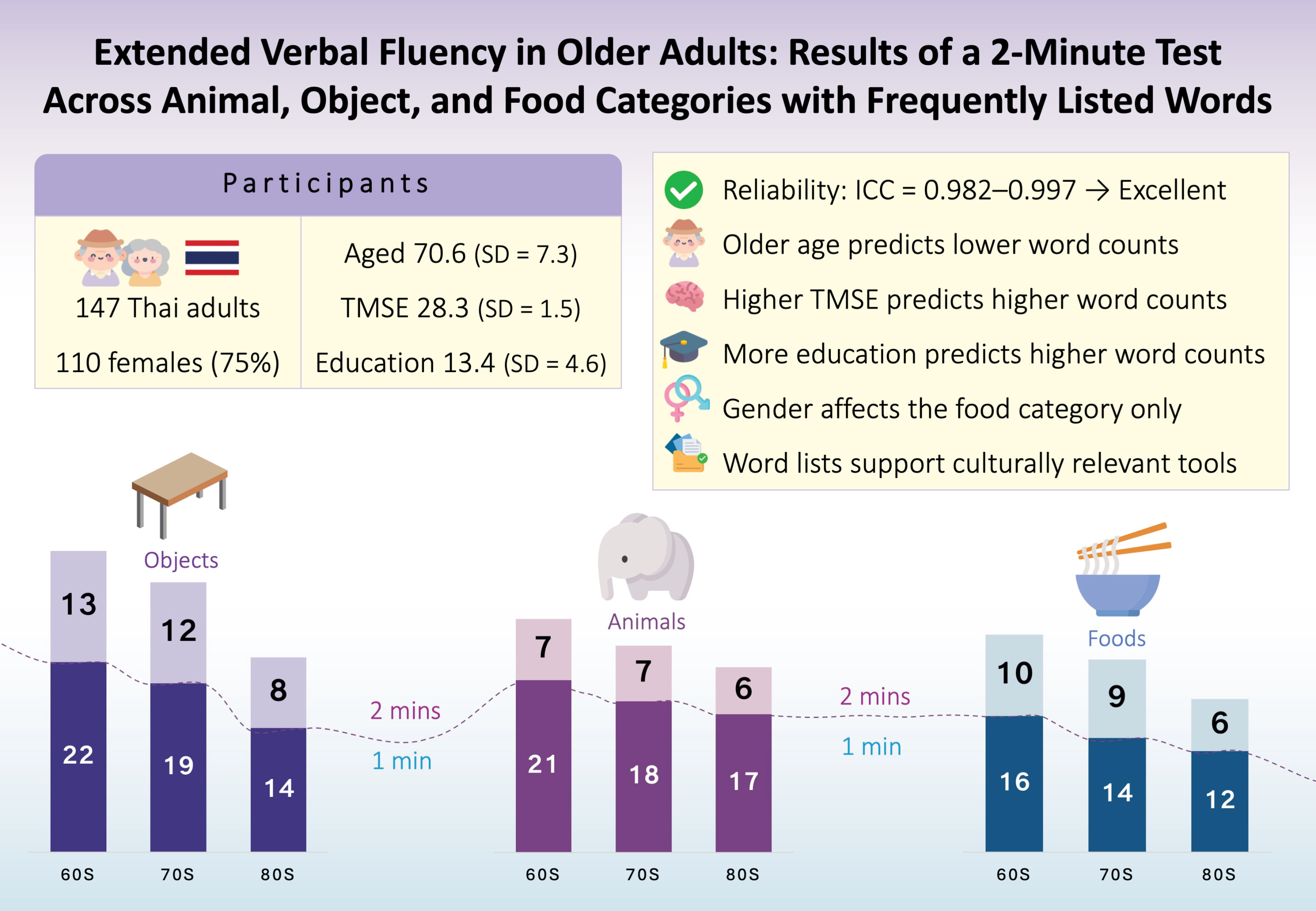
Materials and Methods: This cross-sectional study recruited 147 healthy adults aged 60-89, categorized into three age groups: 60-69, 70-79, and 80-89. All participants were Central Thai speakers, had no history of neurological disorders, scored above 23 on the Thai Mental State Examination (TMSE), and underwent an oral reading of the Noo Jaew Passage and an oral motor examination by speech-language pathologists. Participants completed a 2-minute verbal fluency task in three categories: animal, object, and food. Responses were transcribed and analyzed using one-way ANOVA, independent t-tests, and regression analysis to examine the relationships between verbal fluency performance and relevant variables. Inter-rater reliability was assessed using the Intraclass Correlation Coefficient (ICC).
Results: Participants had an average age of 70.6 (SD=7.3) years, and 75% were females. The average TMSE score was 28.3 (SD=1.5), and the average years of education was 13.4 (SD=4.6). The 2-minute test yielded an average of 26.3 (SD=7.0) animals, 32.0 (SD=10.2) objects, and 24.2 (SD=7.3) foods. Significant differences were found across age groups (p≤0.001), with the 60-69 group outperforming older groups in the animal category. Gender influenced performance only in the food category. ICC values ranged from 0.982 to 0.997, indicating excellent inter-rater reliability.
Conclusion: This study reported the performance of older Thai adults on a 2-minute verbal fluency test, highlighting the effects of age, education, gender, and language-specific scoring. Frequently listed words may inform culturally relevant assessments and training materials. Future research should investigate alternative measures beyond word count to enhance cognitive assessments in clinical settings.
Article Details

This work is licensed under a Creative Commons Attribution-NonCommercial-NoDerivatives 4.0 International License.
Personal views expressed by the contributors in their articles are not necessarily those of the Journal of Associated Medical Sciences, Faculty of Associated Medical Sciences, Chiang Mai University.
References
Whiteside DM, Kealey T, Semla M, Luu H, Rice L, Basso MR, et al. Verbal Fluency: Language or Executive Function Measure? Appl Neuropsychol Adult. 2016; 23(1): 29-34. doi: 10.1080/23279095.2015.1004574.
Charernboon T. Verbal fluency in the Thai elderly with mild cognitive impairment and elderly with dementia. J Ment Health Thai. 2018; 26(2): 91-102.
Muangpaisan W, Intalapaporn S, Assantachai P. Digit span and verbal fluency tests in patients with mild cognitive impairment and normal subjects in Thai-community. J Med Assoc Thai. 2010; 93(2): 224-30. PMID: 20302005.
Suttichujit I, Kripanan N, Ruamsuk S. The Study on Verbal Fluency in Older Adults in Nonthaburi Province. J Assoc Med Sci. 2024; 57(3): 230-6. doi: 10.12982JAMS.2024.065.
Teerapong W. The comparison of language abilities of Thai aphasic patients and Thai normal subjects by using Thai Adaptation of Western Aphasia Battery [Thesis]. Nakhon Pathom: Mahidol University; 2000.
Foundation of Thai Gerontology Research and Development Institute (TGRI). Situation of the Thai Older Persons 2022. Nakhon Pathom: Institute for Population and Social Research, Mahidol University; 2022.
Wangtongkum S, Sucharitkul P, Silprasert N, Inthrachak R. Prevalence of dementia among population age over 45 years in Chiang Mai, Thailand. J Med Assoc Thai. 2008; 91(11): 1685-90. PMID: 19127790.
Jitapunkul S, Kunanusont C, Phoolcharoen W, Suriyawongpaisal P. Prevalence estimation of dementia among Thai elderly: a national survey. J Med Assoc Thai. 2001; 84(4): 461-7. PMID: 11460954.
Senanarong V, Poungvarin N, Sukhatunga K, Prayoonwiwat N, Chaisewikul R, Petchurai R, et al. Cognitive status in the community dwelling Thai elderly. J Med Assoc Thai. 2001; 84(3): 408-16. PMID: 11460944.
Holtzer R, Goldin Y, Donovick PJ. Extending the administration time of the letter fluency testincreases sensitivity to cognitive status in aging. Exp Aging Res. 2009; 35(3): 317-26. doi: 10.1080/03610730902922119. PMID: 19449244; PMCID: PMC2832286.
Perez M, Amayra I, Lazaro E, García M, Martínez O, Caballero P, Berrocoso S, López-Paz JF, Al-Rashaida M, Rodríguez AA, Luna P, Varona L. Intrusion errors during verbal fluency task in amyotrophic lateral sclerosis. PLoS One. 2020; 15(5): e0233349. doi: 10.1371/journal.pone.0233349.
Ngamjarus C. n4Studies: Sample size calculation for an epidemiological study on a smart device. Siriraj Med J. 2016; 68(3): 160-70.
Statistics of Elderly Person in Thailand 2019 [Internet]. 2019. Available from: www.dop.go.th/download/knowledge/th1580099938-275_1.pdf.
Department of Older Persons. Situation of The Thai Elderly 2019. Nakhon Pathom: Institute for Population and Social Research, Mahidol University, and Foundation of Thai Gerontology Research and Development Institute (TGRI); 2019. Available from: https://ipsr.mahidol.ac.th/wp-content/uploads/2022/03/Report-File-613.pdf.
Train the Brain Forum Committee. Thai mental state examination (TMSE). Siriraj Hosp Gaz. 1993; 45: 661-74.
Sindermsuk D. The survey of speech defects among Prathom 4 students in Mitsampan school group [Thesis]. Nakhon Pathom: Mahidol University; 1986.
Torres-Russotto D, Landau WM, Harding GW, Bohne BA, Sun K, Sinatra PM. Calibrated finger rubs auditory screening test (CALFRAST). Neurology. 2009; 72(18): 1595-600. doi: 10.1212/WNL.0b013e3181a41280.
Ngamjarus C, Pattanittum P. n4Studies Plus: application for sample size calculation in health science research. App Store; 2024. Available from: https://he02.tci-thaijo.org/index.php/sirirajmedj/article/view/58342.
Zou GY. Sample size formulas for estimating intraclass correlation coefficients with precision and assurance. Stat Med. 2012; 31(29): 3972-81. doi: 10.1002/sim.5466. Epub 2012 Jul 4. PMID: 22764084.
Koo TK, Li MY. A Guideline of Selecting and Reporting Intraclass Correlation Coefficients for Reliability Research. J Chiropr Med. 2016; 15(2): 155-63. doi: 10.1016/j.jcm.2017.10.001.
Cohen J. Statistical Power Analysis for the Behavioral Science. 2nd Ed. New York: Routledge; 1988.
[ Barois E, Sagawa Y, Yilmaz S, Magnin E, Decavel P. What (more) can verbal fluency tell us about multiple sclerosis? Ann Phys Rehabil Med. 2021; 64(2): 101394. doi: 10.1016/j.rehab.2020.05.002.
Scholtissen B, Dijkstra J, Reithler J, Leentjens AF. Verbal fluency in Parkinson’s disease: results of a 2-min fluency test. Acta Neuropsychiatr. 2006; 18(1): 38-41. doi: 10.1111/j.0924-2708.2006.00122.x.
Carnero-Pardo C, Gurpegui M, Sánchez-Cantalejo E, Camello AG, Santervás PG, Ríos MT. [Reliability assessment of the EUROTEST]. Neurologia. 2007; 22(3): 153-8. doi: 10.1016/j.nrl.2010.09.021.
Woods DL, Wyma JM, Herron TJ, Yund EW. Computerized Analysis of Verbal Fluency: Normative Data and the Effects of Repeated Testing, Simulated Malingering, and Traumatic Brain Injury. PLoS One. 2016; 11(12): e0166439. doi: 10.1371/journal.pone.0166439.
Ardila A. A cross-linguistic comparison of category verbal fluency test (ANIMALS): a systematic review. Arch Clin Neuropsychol. 2020;35(2):213-25. doi: 10.1093/arclin/acz060.
Villalobos D, Torres-Simón L, Pacios J, Paúl N, Del Río D. A Systematic Review of Normative Data for Verbal Fluency Test in Different Languages. Neuropsychol Rev. 2023; 33(4): 733-64. doi: 10.1007/s11065-022-09549-0.
Chandrangam K. The relationship between gender and women’s self-value in Bangkok metropolis [Thesis]. Bangkok: Chulalongkorn University; 2005.
Olabarrieta-Landa L, Torre EL, López-Mugartza JC, Bialystok E, Arango-Lasprilla JC. Verbal fluency tests: developing a new model of administration and scoring for Spanish language. NeuroRehabilitation. 2017; 41(2): 539-565. doi: 10.3233/NRE-162102.
Troyer AK, Moscovitch M, Winocur G, Alexander MP, Stuss D. Clustering and switching on verbal fluency: the effects of focal frontal- and temporal-lobe lesions. Neuropsychologia. 1998; 36(6): 499-504. doi: 10.1016/s0028-3932(97)00152-8.
Tombaugh TN, Kozak J, Rees L. Normative data stratified by age and education for two measures of verbal fluency: FAS and animal naming. Arch Clin Neuropsychol. 1999; 14(2): 167-77. PMID: 14590600.
Machado TH, Fichman HC, Santos EL, Carvalho VA, Fialho PP, Koenig AM, et al. Normative data for healthy elderly on the phonemic verbal fluency task - FAS. Dement Neuropsychol. 2009; 3(1): 55-60. doi: 10.1590/S1980-57642009DN30100011.
Metarugcheep S, Punyabukkana P, Wanvarie D, Hemrungrojn S, Chunharas C, Pratanwanich PN. Selecting the most important features for predicting mild cognitive impairment from Thai Verbal Fluency Assessments. Sensors. 2022; 22(15): 5813. doi: 10.3390/s22155813.
