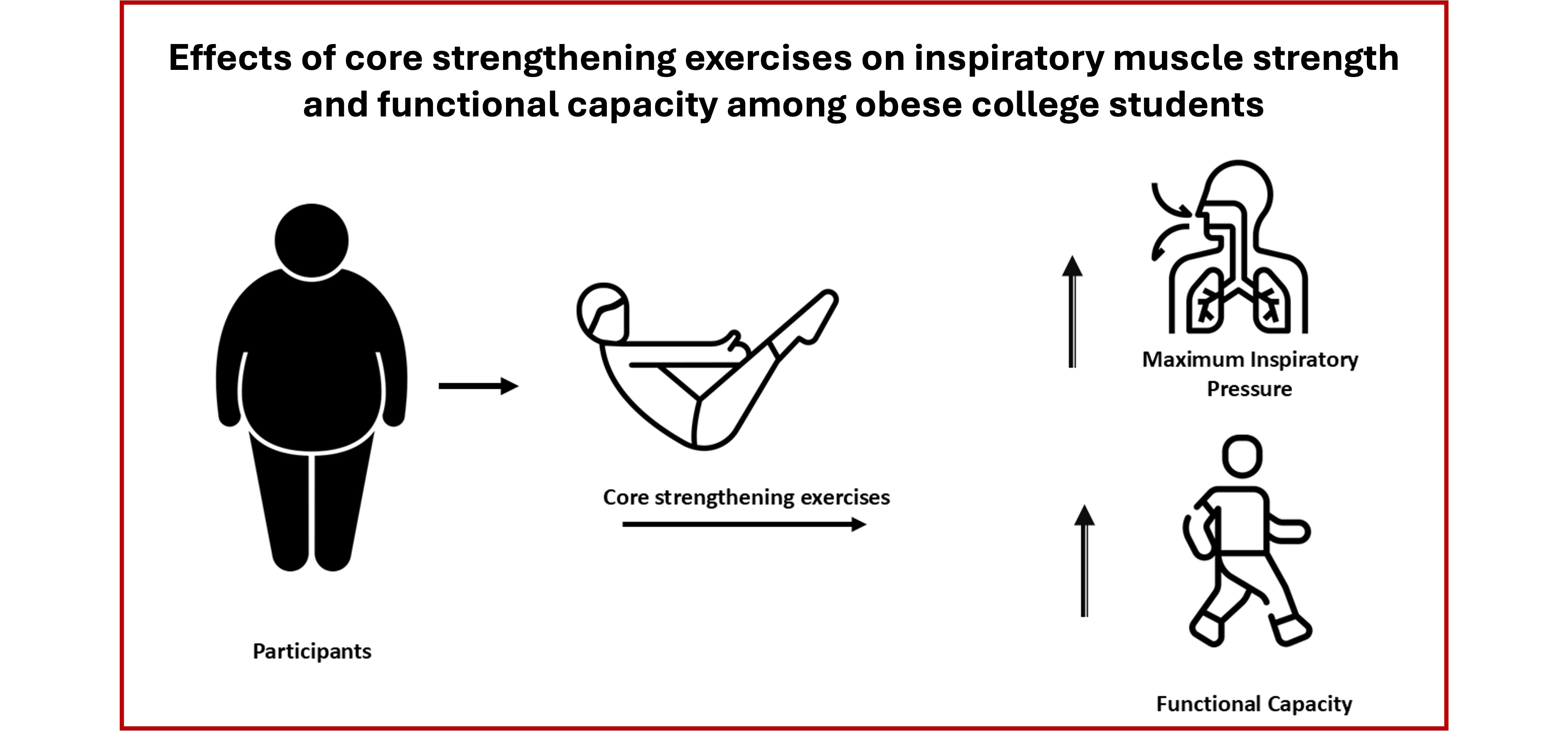
Effects of core strengthening exercises on inspiratory muscle strength and functional capacity among obese college students
Article Sidebar
Main Article Content
Abstract
Background: Obesity weakens core muscles, impacting posture, balance, and respiratory function. Central obesity is particularly harmful due to its effect on visceral organs. Exercises targeting the core and respiratory muscles, such as inspiratory muscle training, are essential for managing obesity and enhancing functional capacity.
Objectives: To investigate the impact of core strengthening exercises on the strength of inspiratory muscles and overall functional capacity among obese college students.
Materials and methods: A 6-week experimental study was carried out involving 34 participants selected using convenience sampling methods. Individuals aged 18-25 years, regardless of gender, with a BMI exceeding 25 kg/m² were included in the study. Maximal inspiratory pressure was measured using a respiratory pressure meter, and the 6-minute walk test was used to measure functional capacity.
Results: The mean age of subjects was 20.85±1.63. The mean value of maximal inspiratory pressure (cmH₂O) pre-test was 95.09±9.58 and post-test was 95.85±9.39. The mean six-minute walk distance (metres) pre-test was 399.15±38.62 and post-test was 412.18±35.25. Both improvements were statistically significant (p=0.003 for MIP and p<0.001 for 6-MWTD)
Conclusion: A six-week core strengthening exercise programmme significantly increases the strength of inspiratory muscles and overall functional capacity among obese college students. These results support the clinical use of core exercises in obesity rehabilitation to enhance respiratory strength and physical function.
Article Details

This work is licensed under a Creative Commons Attribution-NonCommercial-NoDerivatives 4.0 International License.
Personal views expressed by the contributors in their articles are not necessarily those of the Journal of Associated Medical Sciences, Faculty of Associated Medical Sciences, Chiang Mai University.
References
World Health Organization. Obesity and overweight [Internet]. WHO; 2021. Available from: https://www.who.int/news-room/fact-sheets/detail/obesity-and-overweight.
GBD 2019 risk factors collaborators. Global burden of 87 risk factors in 204 countries and territories, 1990–2019: a systematic analysis for the global burden of disease study 2019. Lancet. 2020; 396(10258): 1223-49. doi:10.1016/S0140-6736(20)30752-2.
Després JP. Body fat distribution and risk of cardiovascular disease: an update. Circulation. 2012; 126(10): 1301-13. doi:10.1161/CIRCULATIONAHA.111.067264.
McGill SM. Core training: evidence translating to better performance and injury prevention. Strength Cond J. 2010; 32(3): 33-46. doi:10.1519/SSC.0b013e3181df4521.
Caicedo-Trujillo S, Torres-Castro R, Vasconcello-Castillo L, Solis-Navarro L, Sanchez-Ramirez D, Núñez-Cortés R, et al. Inspiratory muscle training in patients with obesity: a systematic review and meta-analysis. Front Med (Lausanne). 2023; 10: 1284689.doi:10.3389/fmed.2023.1284689.
Torun E, Cakir E, Ozgüç F, Ozgen IT. The effect of obesity degree on childhood pulmonary function tests. Balkan Med J. 2014; 31(3): 235-8. doi: 10.5152/balkanmedj.2014.13101.
Vincent HK, Vincent KR, Lamb KM. Obesity and mobility disability in the older adult. Obes Rev. 2010; 11(8): 568-79. doi: 10.1111/j.1467-789X.2009.00703.x.
WHO Expert Consultation. Appropriate body-mass index for Asian populations and its implications for policy and intervention strategies. Lancet. 2004; 363(9403): 157-63. doi:10.1016/S0140-6736(03)15268-3.
Black LF, Hyatt RE. Maximal respiratory pressures: normal values and relationship to age and sex. Am Rev Respir Dis. 1969; 99(5): 696-702. doi:10.1164/arrd.1969.99.5.696.
Evans JA, Whitelaw WA. The assessment of maximal respiratory mouth pressures in adults. Respir Care. 2009; 54(10): 1348-59.
Vaish H, Gupta S, Sharma S. Six minute walk distance and six minute walk work in young adults aged 18-25 years. Int J Pharm Med Res. 2017;5(3):464-8. https://www.researchgate.net/publication/328274875.
Kibler WB, Press J, Sciascia A. The role of core stability in athletic function. Sports Med. 2006; 36(3): 189-98. doi:10.2165/00007256-200636030-00001.
Parameswaran K, Todd DC, Soth M. Altered respiratory physiology in obesity. Can Respir J. 2006; 13(4): 203-10. doi: 10.1155/2006/834786.
Lai PP, Leung AK, Li AN, Zhang M. Threedimensional gait analysis of obese adults. Clin Biomech (Bristol). 2008; 23(Suppl 1): S2-6. doi: 10.1016/j.clinbiomech.2008.02.004.
Mustafaoglu R, Demir R, Demirci AC, Yigit Z. Effects of core stabilization exercises on pulmonary function, respiratory muscle strength, and functional capacity in adolescents with substance use disorder: randomized controlled trial. Pediatr Pulmonol. 2019; 54(7): 100211. doi:10.1002/ppul.24330.
Vardar-Yagli N, Saglam M, Caik-Kutukcu E, Inal-Ince D, Arikan H, Kiper N. Effects of core stabilization training on balance, functional capacity, and respiratory muscle strength in children with bronchiectasis. Eur Respir J. 2014; 44(Suppl 58): P4279. doi:10.1183/13993003/erj.44.Suppl_58.P4279.
Özgen İT, Çakır E, Torun E, Güleş A, Hepokur MN, Cesur Y. Relationship Between Functional Exercise Capacity and Lung Functions in Obese Chidren. J Clin Res Pediatr Endocrinol. 2015;7(3):217–21. doi:10.4274/jcrpe.1990.
O'Donnell DE, Laveneziana P. The clinical importance of dynamic lung hyperinflation in COPD. COPD. 2006;3(4):219-32. doi:10.1080/15412550600977478.
Waghmare PD, Das AK, Diwate AD. Effect of six-week core strengthening exercises on inspiratory patients with chronic kidney disease undergoing haemodialysis. Int J Community Med Public Health. 2025; 11(3): 1311-3. doi.org/10.18203/2394-6040.ijcmph20240637.
Develi E, Subasi F, Aslan GK, Bingol Z. The effects of core stabilization training on dynamic balance and pulmonary parameters in patients with asthma. J Back Musculoskelet Rehabil. 2021; 34(4): 639-48. doi:10.3233/BMR-191803.
