The impact of parents’ subjective happiness on children’s executive functions: A longitudinal study
Article Sidebar
Main Article Content
Abstract
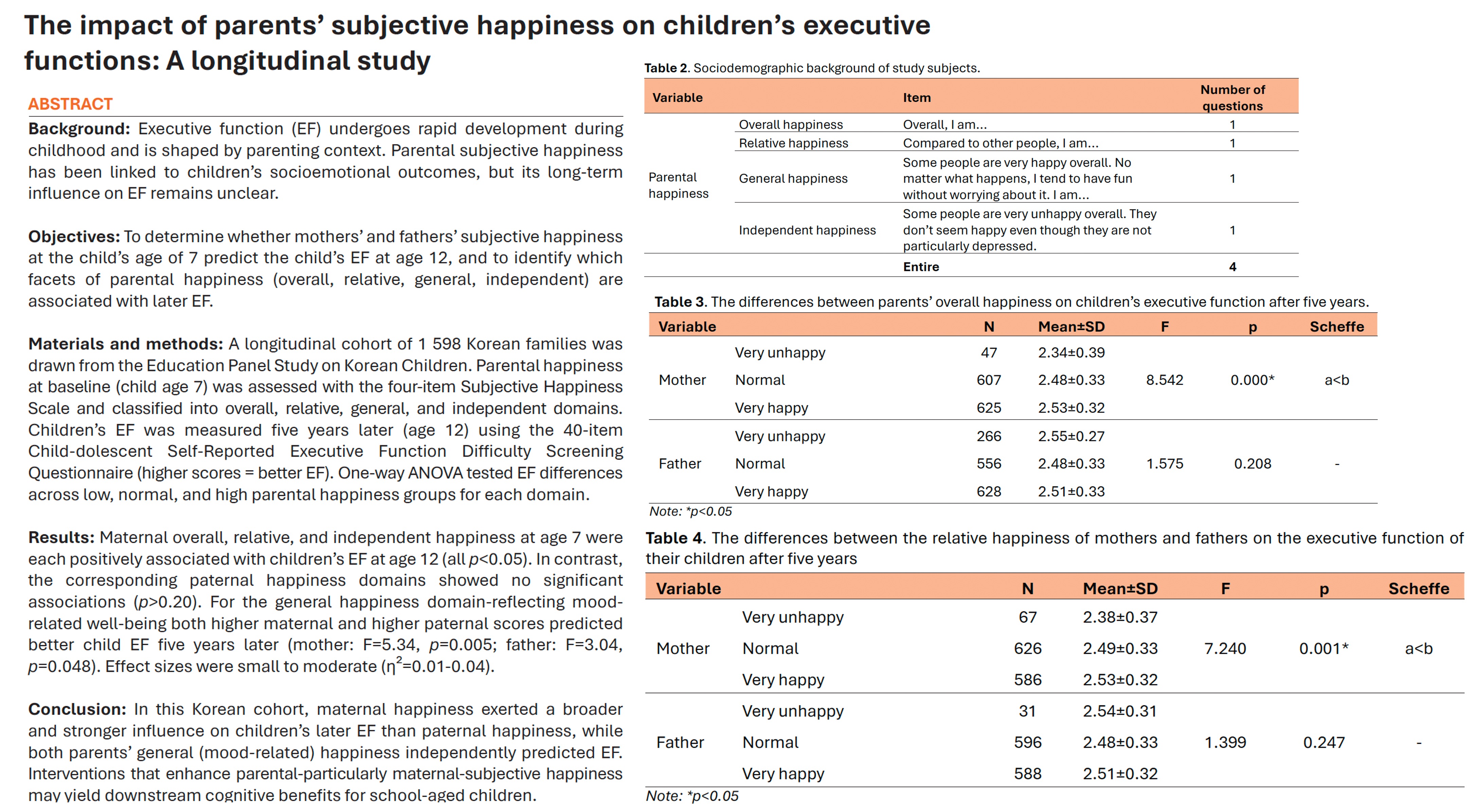
Background: Executive function (EF) undergoes rapid development during childhood and is shaped by parenting context. Parental subjective happiness has been linked to children’s socioemotional outcomes, but its long-term influence on EF remains unclear.
Objectives: To determine whether mothers’ and fathers’ subjective happiness at the child’s age of 7 predict the child’s EF at age 12, and to identify which facets of parental happiness (overall, relative, general, independent) are associated with later EF.
Materials and methods: A longitudinal cohort of 1 598 Korean families was drawn from the Education Panel Study on Korean Children. Parental happiness at baseline (child age 7) was assessed with the four-item Subjective Happiness Scale and classified into overall, relative, general, and independent domains. Children’s EF was measured five years later (age 12) using the 40-item Child-dolescent Self-Reported Executive Function Difficulty Screening Questionnaire (higher scores = better EF). One-way ANOVA tested EF differences across low, normal, and high parental happiness groups for each domain.
Results: Maternal overall, relative, and independent happiness at age 7 were each positively associated with children’s EF at age 12 (all p<0.05). In contrast, the corresponding paternal happiness domains showed no significant associations (p>0.20). For the general happiness domain-reflecting moodrelated well-being both higher maternal and higher paternal scores predicted better child EF five years later (mother: F=5.34, p=0.005; father: F=3.04, p=0.048). Effect sizes were small to moderate (η²=0.01-0.04).
Conclusion: In this Korean cohort, maternal happiness exerted a broader and stronger influence on children’s later EF than paternal happiness, while both parents’ general (mood-related) happiness independently predicted EF. Interventions that enhance parental-particularly maternal-subjective happiness may yield downstream cognitive benefits for school-aged children.
Article Details

This work is licensed under a Creative Commons Attribution-NonCommercial-NoDerivatives 4.0 International License.
Personal views expressed by the contributors in their articles are not necessarily those of the Journal of Associated Medical Sciences, Faculty of Associated Medical Sciences, Chiang Mai University.
References
Baggetta P, Alexander PA. Conceptualization and operationalization of executive function. Mind Brain Educ. 2016;10(1):10-33. doi:10.1111/mbe.12100.
Kim HO, Park JH, Kim KH. Comparison of income polarity groups of community factors control effects on mothers' parenting stress on children's executive functions. Korea J Child Care Educ. 2020;121: 91-124. doi:10.37918/kce.2020.03.121.91.
Doebel S. Rethinking executive function and its development. Perspect Psychol Sci. 2020;15(4): 942–56. doi:10.1177/1745691620904771.
Gilbert SJ, Burgess PW. Executive function. Curr Biol. 2008; 18(3): R110-4. doi:10.1016/j.cub.2007.12.014.
Hofmann W, Schmeichel BJ, Baddeley AD. Executive functions and self-regulation. Trends Cogn Sci. 2012; 16(3): 174-80. doi:10.1016/j.tics.2012.01.006.
Fiske A, Holmboe K. Neural substrates of early executive function development. Dev Rev. 2019; 52: 42-62. doi:10.1016/j.dr.2019.100866.
Lund JI, Toombs E, Radford A, Boles K, Mushquash C. Adverse childhood experiences and executive function difficulties in children: A systematic review. Child Abuse Negl. 2020; 106: 104485. doi:10.1016/j.chiabu.2020.104485.
Luna B, Sweeney JA. The emergence of collaborative brain function: fMRI studies of the development of response inhibition. Ann N Y Acad Sci. 2004; 1021: 296-309. doi:10.1196/annals.1308.035.
Kim CI. A study of factors influencing school adjustment of the first grade elementary school student: Focusing on characteristics of children, parents, and teachers. Korean J Child Educ. 2019; 28(4): 171-87. doi:10.17643/KJCE.2019.28.4.10.
Lee HM, Han YJ. The sequential mediation effect of children’s happiness and media device addiction on the relationship between mothers’ happiness and children’s executive function difficulty. Korean J Child Stud. 2020; 41(5): 85-98. doi:10.5723/kjcs.2020.41.5.85.
Jeong JE, Shin N. Executive function and school adjustment in upper elementary school students: Mediating effect of self-efficacy. Korean J Child Stud. 2019; 40(4): 123-35. doi:10.5723/kjcs.2019.40.4.123.
Zelazo PD. Executive function and psychopathology: A neurodevelopmental perspective. Annu Rev Clin Psychol. 2020; 16: 431-54. doi:10.1146/annurev-clinpsy-072319-024242.
Caro-Morente C. The impact of child-parent relationship quality on neurodevelopmental problems in adoptees [dissertation]. Southampton (UK): University of Southampton; 2021.
Hong G, Moon SR. The mediating effects of parenting stress on the relationship between parents’ psychological variables, children’s problem behavior, and executive function. J Korean Council Child Rights. 2019; 23(3): 497-519. doi:10.21459/kccr.2019.23.3.497.
Molitor SJ, Dvorsky MR. Ethical considerations for assessing parent mental health during child assessment services. Ethics Behav. 2019; 29(2): 87-100. doi:10.1080/10508422.2018.1482746.
Kim JI. Study of the relationship between the child’s feeling of happiness, mother’s feeling of happiness, parenting behaviors, and the elements of familial environment. Korea J Child Care Educ. 2018; 109: 53-77. doi:10.37918/kce.2018.03.109.53.
Lyubomirsky S, Lepper HS. A measure of subjective happiness: Preliminary reliability and construct validation. Soc Indic Res. 1999; 46(2): 137-55. doi:10.1023/A:1006824100041.
Song H. Validity of child-adolescent self-reported executive function difficulty screening questionnaire. Korean J Clin Psychol. 2014; 33(1): 121-37. doi:10.15842/kjcp.2014.33.1.008.
Cho HS, Yoon EM. The relationship among parental subjective happiness, parent-child interaction, and self-esteem of children: Application of the actor-partner interdependence model (APIM). J Korea Acad Ind Coop Soc. 2022; 23(3): 183-93. doi:10.5762/KAIS.2022.23.3.183.
An SY, Park SM. Longitudinal study of mothers’ and fathers’ parenting stress with early childhood children. J Humanit Soc Sci. 2022; 13(4): 295-310. doi:10.22143/HSS21.13.4.21.
Murdock KW, Pittman LD, Fagundes CP. Maternal and paternal predictors of child depressive symptoms: An actor-partner interdependence framework. J Child Fam Stud. 2018; 27(2): 559-68. doi:10.1007/s10826-017-0910-6.
Newland LA. Family well-being, parenting, and child well-being: Pathways to healthy adjustment. Clin Psychol. 2015; 19(1):3-14. doi:10.1111/cp.12059.
Suh GW. The influence of fathers’ and mothers’ depression and drinking behavior on children’s development: The mediated role of family functioning and the moderated role of child sex. J Fam Relat. 2018; 23(2): 3-28. doi:10.21321/jfr.23.2.3.
Yang JH, Kim YC. Actor and partner effect of young children-parents’ family interaction, child care activities, and parenting stress. Asian J Educ. 2016; 17(3): 81-106. doi:10.15753/aje.2016.09.17.3.81.
Wang J, Mansfield AK, Zhao X, Keitner G. Family functioning in depressed and non-clinical control families. Int J Soc Psychiatry. 2013; 59(6): 561-9. doi:10.1177/0020764012445260.
Meyer S, Raikes HA, Virmani EA, Waters S, Thompson RA. Parent emotion representations and the socialization of emotion regulation in the family. Int J Behav Dev. 2014; 38(2): 164-73. doi:10.1177/0165025413519014.
Han JW, Lee H. The effect of parental self-esteem on children's emotional responsiveness and attention: Through the child's self-esteem. J Korea Acad Ind Coop Soc. 2017; 18(11): 628-36. doi:10.5762/KAIS.2017.18.11.628.
