
A survey of foodborne bacterial contamination in Chiang Mai Province, Thailand: A pilot study focused on Aeromonas and Vibrio
Article Sidebar
Main Article Content
Abstract
Background: The consumption of raw or undercooked food contaminated with microbial pathogens is a major cause of foodborne illness. Vibrio and Aeromonas are significant pathogenic bacteria found in raw seafood. Currently, the consumption of raw and undercooked seafood, including salmon, is becoming popular in Thailand. Nevertheless, studies focusing on the prevalence of human pathogenic Vibrio and Aeromonas in seafood and salmon in Thailand are scarce.
Objective: This study aimed to detect Vibrio and Aeromonas in undercooked foods from Chiang Mai Province, Thailand.
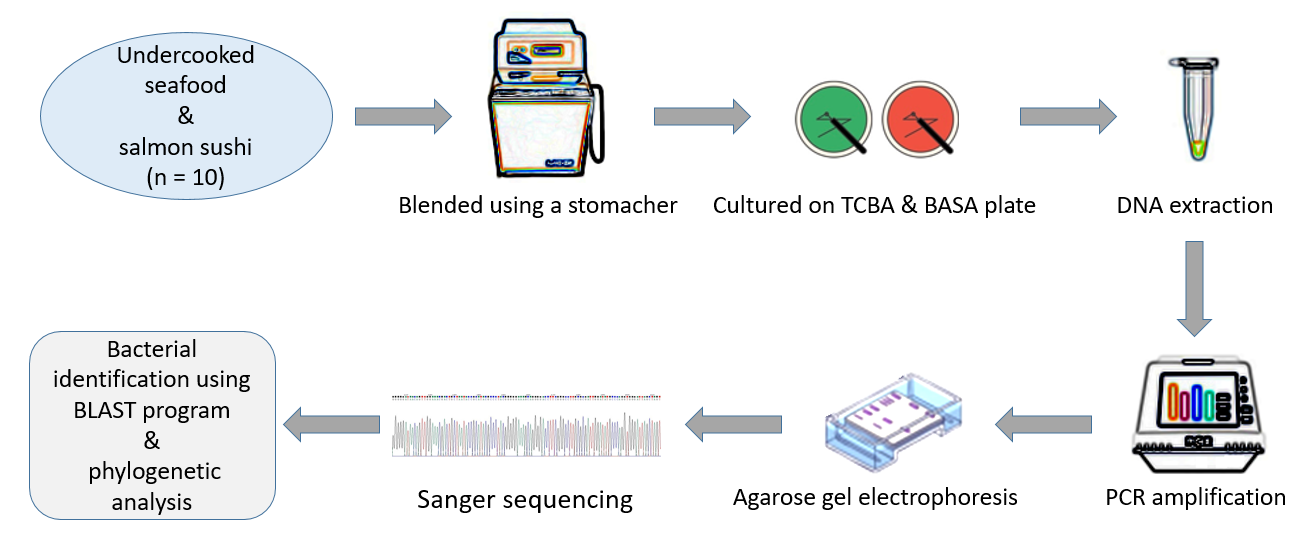
Materials and methods: Ten food samples (five spicy mixed seafood salads and five salmon sushi) individually collected in Chiang Mai, Thailand, from August to October 2024. Samples were processed as previously described and bacteria were identified by 16S rRNA gene amplification by PCR and Sanger sequencing.
Results: The results indicated that three of ten (30%) were contaminated with human pathogenic Vibrio, V. parahaemolyticus, V. cholerae, and V. vulnificus. Moreover, Aeromonas species regarded as potential human pathogens, A. caviae, A. dhakensis, A. veronii, and A. hydrophila, were isolated from eight food samples (80%).
Conclusion: Our findings suggest that undercooked seafood in Chiang Mai, Northern Thailand, frequently contains pathogenic bacteria, posing significant food safety risks.
Article Details

This work is licensed under a Creative Commons Attribution-NonCommercial-NoDerivatives 4.0 International License.
Personal views expressed by the contributors in their articles are not necessarily those of the Journal of Associated Medical Sciences, Faculty of Associated Medical Sciences, Chiang Mai University.
References
World Health Organization (WHO). WHO estimates of the global burden of foodborne diseases: foodborne disease burden epidemiology reference group 2007-2015. Geneva: WHO; 2015. Available from: https://apps.who.int/iris/handle/10665/199350 [Accessed 5 Oct 2024].
Sampaio A, Silva V, Poeta P, Aonofriesei F. Vibrio spp.: life strategies, ecology, and risks in a changing environment. Diversity. 2022; 14(2): 97. doi: 10.3390/d14020097.
Woodring J, Srijan A, Puripunyakom P, Oransathid W, Wongstitwilairoong B, Mason C. Prevalence and antimicrobial susceptibilities of Vibrio, Salmonella, and Aeromonas isolates from various uncooked seafoods in Thailand. J Food Prot. 2012; 75(1): 41-7. doi: 10.4315/0362-028X.JFP-11-291.
Fernandez-Bravo A, Figueras MJ. An update on the genus Aeromonas: taxonomy, epidemiology, and pathogenicity. Microorganisms. 2020; 8(1): 129. doi: 10.3390/microorganisms8010129.
Department of Medical Sciences, Thailand. Standard methods for food analysis, Volume II; 2014. Available from: http://dmsc2.dmsc.moph.go.th/webroot/BQSF/index.htm [Accessed 2 Feb 2024].
Gobat PF, Jemmi T. Comparison of seven selective media for the isolation of mesophilic Aeromonas species in fish and meat. Int J Food Microbiol. 1995; 24(3): 375-84. doi: 10.1016/0168-1605(94)00112-M.
Klindworth A, Pruesse E, Schweer T, Peplies J, Quast C, Horn M, et al. Evaluation of general 16S ribosomal RNA gene PCR primers for classical and next-generation sequencing-based diversity studies. Nucleic Acids Res. 2013; 41(1): e1. doi: 10.1093/nar/gks808.
Ward L, Bej A. Detection of Vibrio parahaemolyticus in shellfish by use of multiplexed real-time PCR with TaqMan fluorescent probes. Appl Environ Microbiol. 2006; 72(3): 2031-42. doi: 10.1128/AEM.72.3.2031-2042.2006.
Ceccarelli D, Hasan NA, Huq A, Colwell RR. Distribution and dynamics of epidemic and pandemic Vibrio parahaemolyticus virulence factors. Front Cell Infect Microbiol. 2013; 3: 97. doi: 10.3389/fcimb.2013.00097.
Yuwono C, Wehrhahn MC, Liu F, Zhang L. Enteric Aeromonas infection: a common enteric bacterial infection with a novel infection pattern detected in an Australian population with gastroenteritis. Microbiol Spectr. 2023; 11(4): e00286-23. doi: 10.1128/spectrum.00286-23.
Zhou Y, Yu L, Nan Z, Zhang P, Kan B, Yan D, et al. Taxonomy, virulence genes, and antimicrobial resistance of Aeromonas isolated from extraintestinal and intestinal infections. BMC Infect Dis. 2019; 19(1): 158. doi: 10.1186/s12879-019-3766-0.
Lobatón T, Hoffman I, Vermeire S, Ferrante M, Verhaegen J, Van Assche G. Aeromonas species: an opportunistic enteropathogen in patients with inflammatory bowel diseases? A single-center cohort study. Inflamm Bowel Dis. 2015; 21(1): 71-8. doi: 10.1097/MIB.0000000000000247.
Janda JM, Duffey S. Mesophilic Aeromonads in human disease: current taxonomy, laboratory identification, and infectious disease spectrum. Rev Infect Dis. 1988; 10(5): 980-97. doi: 10.1093/clinids/10.5.980.
Chen P-L, Lamy B, Ko WC. Aeromonas dhakensis, an increasing recognized human pathogen. Front Microbiol. 2016; 7: 793. doi: 10.3389/fmicb.2016.00793.
Siriphap A, Prapasawat W, Borthong J, Tanomsirdachchai W, Muangnapoh C, Suthienkul O, et al. Prevalence, virulence characteristics, and antimicrobial resistance of Vibrio parahaemolyticus isolates from raw seafood in a province in Northern Thailand. FEMS Microbiol Lett. 2024; 371: 1-9. doi: 10.1093/femsle/fnad134.
Preeprem S, Aksornkird T, Nuidate T, Hajimasalaeh W, Hajiwangoh Z, Mittraparp-arthorn P. Characterization and genetic relationships of Vibrio spp. isolated from seafood in retail markets, Yala, Thailand. Trends Sci. 2023; 20(10): 5962. doi: 10.48048/tis.2023.5962.
Zago V, Zambon M, Civettini M, Zaltum O, Manfrin A. Virulence-associated factors in Vibrio cholerae non-01/non-O139 and V. mimicus strains isolated in ornamental fish species. J Fish Dis. 2017; 40: 1857- 68. doi: 10.1111/jfd.12659.
Chitov T, Kirikaew P, Yongyune P, Ruengprapan N, Sontikun K. An incidence of large foodborne outbreak associated with Vibrio mimicus. Eur J Clin Microbiol Infect Dis. 2009; 28: 421-4. doi: 10.1007/s10096-008-0639-7.
Xie T, Wu G, He X, Lai Z, Xhang H, Zhao J. Prevalence and genetic diversity of Vibrio parahaemolyticus strains from salmon in Chinese markets. FEMS Microbiol Lett. 2019; 366(9): fnz103. doi: 10.1093/femsle/fnz103.
Dallaire-Dufresne S, Tanaka KH, Trudel MV, Lafaille A, Charette SJ. Virulence, genomic features, and plasticity of Aeromonas salmonicida subsp. salmonicida, the causative agent of fish furunculosis. Vet Microbiol. 2014; 169: 1-7. doi: 10.1016/j.vetmic.2013.06.025.
Tewari R, Dudeja M, Nandy S, Kumar Das A. Isolation of Aeromonas salmonicida from human blood sample: a case report. J Clin Diag Res. 2014; 8: 139-40. doi: 10.7860/JCDR/2014/6883.4032.
Kamble R. Aeromonas salmonicida furunculosis in an adult male. Int J Curr Microbiol App Sci. 2015; 4: 59-63.
Vashney A, Das M, Chaudhary P, Kumari R, Yadav K. Aeromonas salmonicida as a causative agent for postoperative endophthalmitis. Middle East Afr J Ophthalmol. 2017; 24: 213-5. doi: 10.4103/meajo. MEAJO_238_17.
Vincent AT, Fernandez-Bravo A, Sanchis M, Mayayo E, Figueras MJ, Charette SJ. Investigation of the virulence and genomics of Aeromonas salmonicida strains isolated from human patients. Infect Genet Evol. 2019; 68: 1-9. doi: 10.1016/j.meegid.2018.11.019.
Kitagawa D, Suzuki Y, Abe N, Ui K, Suzuki K, Yamashita T, et al. Comparison of MALDI-TOF mass spectrometry and rpoB gene sequencing for the identification of clinical isolates of Aeromonas spp. Heliyon. 2022; 8: e11585. doi: 10.1016/j.heliyon.2022.e11585.
Kupfer M, Kuhnert P, Korczak BM, Peduzzi R, Demarta A. Genetic relationships of Aeromonas strains inferred from 16S rRNA, gyrB and rpoB gene sequences. Int J Syst Evol Microbial. 2006; 56: 2743-51. doi: 10.1099/ijs.0.63650-0.
