
The performance evaluation of the Dirui MUS3600 and FUS3000Plus automated urine analyzers utilized in the AMS CMU EQA unit's urinalysis proficiency testing program
Article Sidebar
Main Article Content
Abstract
Background: Urinalysis is one of the essential laboratory tests for health checks, which requires highly skilled personnel. In medical laboratories, automated urine analyzers are crucial for reducing workloads compared to human methods. However, quality control is necessary to ensure their accuracy and precision. The Dirui MUS3600 and FUS3000Plus automated urinalysis analyzer models are also interested in taking part in the proficiency testing program, and the AMS CMU EQA unit has developed urine control materials for the Thai medical laboratory's urinalysis EQA program.
Objective: The goal of this study was to evaluate the performance of the Dirui 3600 and FUS3000Plus urine analyzer models for usage in the AMS CMU EQA unit laboratory using method validation items.
Materials and methods: Total of 724 urine samples were collected, and three in-house urine control levels were prepared. Imprecision, accuracy, comparison, and diagnostic performance tests were determined by using MUS3600 and FUS3000Plus compared with the microscopic examination as the standard method.
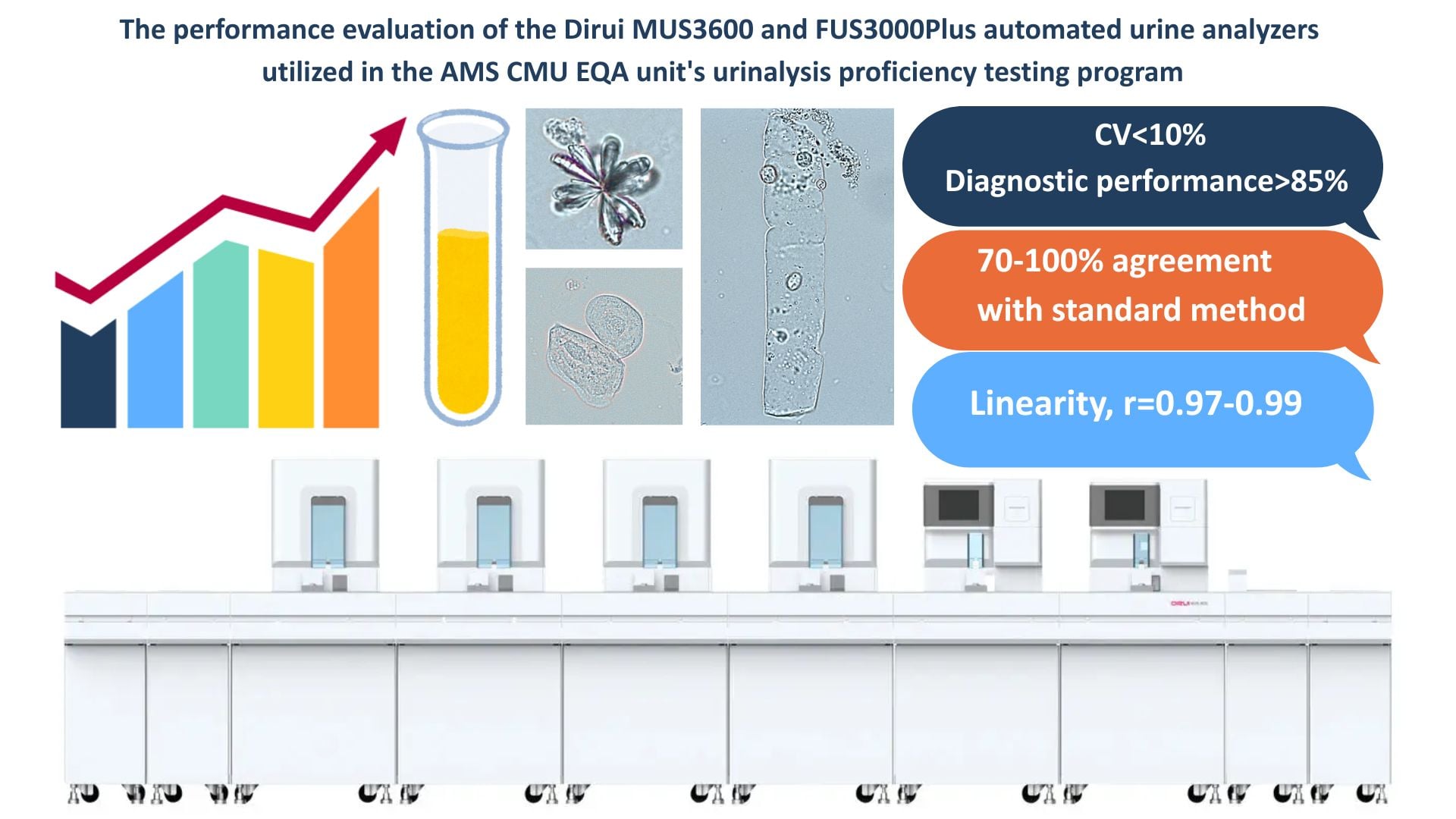
Results: Both automated models provided excellent results of %CV of within day and between day running shows less than 10%. The agreement between automation and standard methods in physical, chemical, and sediment evaluation was 70-100%. The correlation coefficient for the RBC and WBC parameters compared with the manual microscope method ranged from r=0.88 to 0.93. Linearity results of both models show r=0.99 for RBCs and WBCs, respectively. Results of carry-over also show good reliability results below 0.005%. Moreover, the results of sensitivity and specificity in important urinary diseases indicate sediment for example RBC and WBC show more than 83% of overall results.
Conclusion:The Dirui MUS3600 and FUS3000Plus models of urinalysis analyzers yielded good results, indicating that they are suitable for use in the future for the collection and preparation of specimens for QC material used in the proficiency program that should follow the standard procedure for EQA participants. In addition, both models can produce good urinalysis results in clinical laboratories.
Article Details

This work is licensed under a Creative Commons Attribution-NonCommercial-NoDerivatives 4.0 International License.
Personal views expressed by the contributors in their articles are not necessarily those of the Journal of Associated Medical Sciences, Faculty of Associated Medical Sciences, Chiang Mai University.
References
Oyaert M, Delanghe JR. Semiquantitative, fully automated urine test strip analysis. J Clin Lab Anal. 2019; 33(5): e22870. doi: 10.1002/jcla.22870.
Tantisaranon P, Dumkengkhachornwong K, Aiadsakun P, Hnoonual A. A comparison of automated urine analyzers cobas 6500, UN 3000-111b and iRICELL 3000 with manual microscopic urinalysis. Pract Lab Med. 2021; 24: e00203. doi: 10.1016/j.plabm.2021.e00203.
Hannemann-Pohl K. Automation of urine sediment examination: a comparison of the Sysmex UF-100 automated flow cytometer with routine manual diagnosis (microscopy, test strips, and bacterial culture) Clin Chem Lab Med. 1999; 37: 753-64. doi: 10.1515/CCLM.1999.116.
Sterry-Blunt RE, Randall KS, Doughton MJ, Aliyu SH, Enoch DA. Screening urine samples for the absence of urinary tract infection using the sediMAX automated microscopy analyser. J Med Microbiol. 2015; 64(6): 605-9. doi: 10.1099/jmm.0.000064.
Shayanfar N, Tobler U, von Eckardstein A, Bestmann L. Automated urinalysis: first experiences and a comparison between the Iris iQ200 urine microscopy system, the Sysmex UF-100 flow cytometer and manual microscopic particle counting. Clin Chem Lab Med. 2007; 45(9): 1251-6. doi: 10.1515/CCLM.2007.503.
Oyaert M, Delanghe J. Progress in automated urinalysis. Ann Lab Med. 2019; 39 (1): 15-22. Available from: https://doi: 10.3343/alm.2019.39.1.15.
Larkey NE, Obiorah IE. Advances and progress in automated urine analyzers. Clin Lab Med. 2024; 44(3): 409-21. doi: 10.1016/j.cll.2024.04.003.
Lamchiagdhase P, Preechaborisutkul K, Lomsomboon P, Srisuchart P, Tantiniti P, Khan-u-Ra N, Preechaborisutkul B. Urine sediment examination: a comparison between the manual method and the iQ200 automated urine microscopy analyzer. Clin Chim Acta. 2005; 358(1-2): 167-74. doi: 10.1016/j.cccn.2005.02.021.
Anderlini R, Manieri G, Lucchi C, Raisi O, Soliera AR, Torricelli F, Varani M, Trenti T. Automated urinalysis with expert review for incidental identification of atypical urothelial cells: An anticipated bladder carcinoma diagnosis. Clin Chim Acta. 2015; 451:252-6. doi: 10.1016/j.cca.2015.10.005.
Zaman Z, Fogazzi GB, Garigali G, Croci MD, Bayer G, Kránicz T. Urine sediment analysis: Analytical and diagnostic performance of sediMAX - a new automated microscopy image-based urine sediment analyser. Clin Chim Acta. 2010; 411(3-4): 147-54. doi: 10.1016/j.cca.2009.10.018.
Cho EJ, Ko DH, Lee W, Chun S, Lee HK, Min WK. The efficient workflow to decrease the manual microscopic examination of urine sediment using on-screen review of images. Clin Biochem. 2018; 56: 70-4. doi: 10.1016/j.clinbiochem.2018.04.008.
Cho J, Oh KJ, Jeon BC, Lee SG, Kim JH. Comparison of five automated urine sediment analyzers with manual microscopy for accurate identification of urine sediment. Clin Chem Lab Med. 2019; 57(11): 1744-53. doi: 10.1515/cclm-2019-0211.
Yalcinkaya E, Erman H, Kirac E, Serifoglu A, Aksoy A, Isman FK. Comparative performance analysis of Urised 3 and DIRUI FUS-200 automated urine sediment analyzers and manual microscopic method. Medeni Med J. 2019;34(3):244-51. doi: 10.5222/MMJ.2019.23169.
Benovska M, Wiewiorka O, Pinkavova J. Evaluation of FUS-2000 urine analyzer: analytical properties and particle recognition. Scand J Clin Lab Invest. 2018; 78(1-2): 143-8. doi: 10.1080/ 00365513. 2017.1423108.
Dirui MUS3600 product brochure. [cited 2024 Dec 5]. Available from: http://en.dirui.com.cn/list-20-1.html.
ICH Q2(R2) Guideline on validation of analytical procedures [cited 2024 Dec 20]. Available from: https://www.ema.europa.eu/en/documents/scientific-guideline/ich-q2r2-guideline-validation-an-alytical-procedures-step-5-revision-1_en.pdf.
Yang WS. Automated urine sediment analyzers underestimate the severity of hematuria in glomerular diseases. Sci Rep. 2021; 11(1): 20981. doi: 10.1038/s41598-021-00457-6.
Kucukgergin C, Ademoglu E, Omer B, Genc S. Performance of automated urine analyzers using flow cytometric and digital image-based technology in routine urinalysis. Scand J Clin Lab Invest. 2019; 79(7): 468-74. doi: 10.1080/00365513.2019.1658894.
Yuksel H, Kiliç E, Ekinci A, Evliyaoglu O. Comparison of fully automated urine sediment analyzers H800-FUS100 and LabUMat-UriSed with manual microscopy. J Clin Lab Anal. 2013; 27(4): 312-6. doi: 10.1002/jcla.21604.
Kocer D, Sarıguzel FM, Karakukcu C. Cutoff values for bacteria and leukocytes for urine sediment analyzer FUS200 in culture-positive urinary-tract infections. Scand J Clin Lab Invest. 2014; 74(5): 414-7. doi: 10.3109/00365513.2014.900189.
Bartosova K, Kubicek Z, Franekova J, Louzensky G, Lavrikova P, Jabor A. Analysis of Four Automated Urinalysis Systems Compared to Reference Methods. Clin Lab. 2016; 62(11): 2115-23. doi: 10.7754/Clin. Lab.2016.160316.
