
Effect of task-oriented approach based activities to improve balance among children with cochlear implant
Article Sidebar
Main Article Content
Abstract
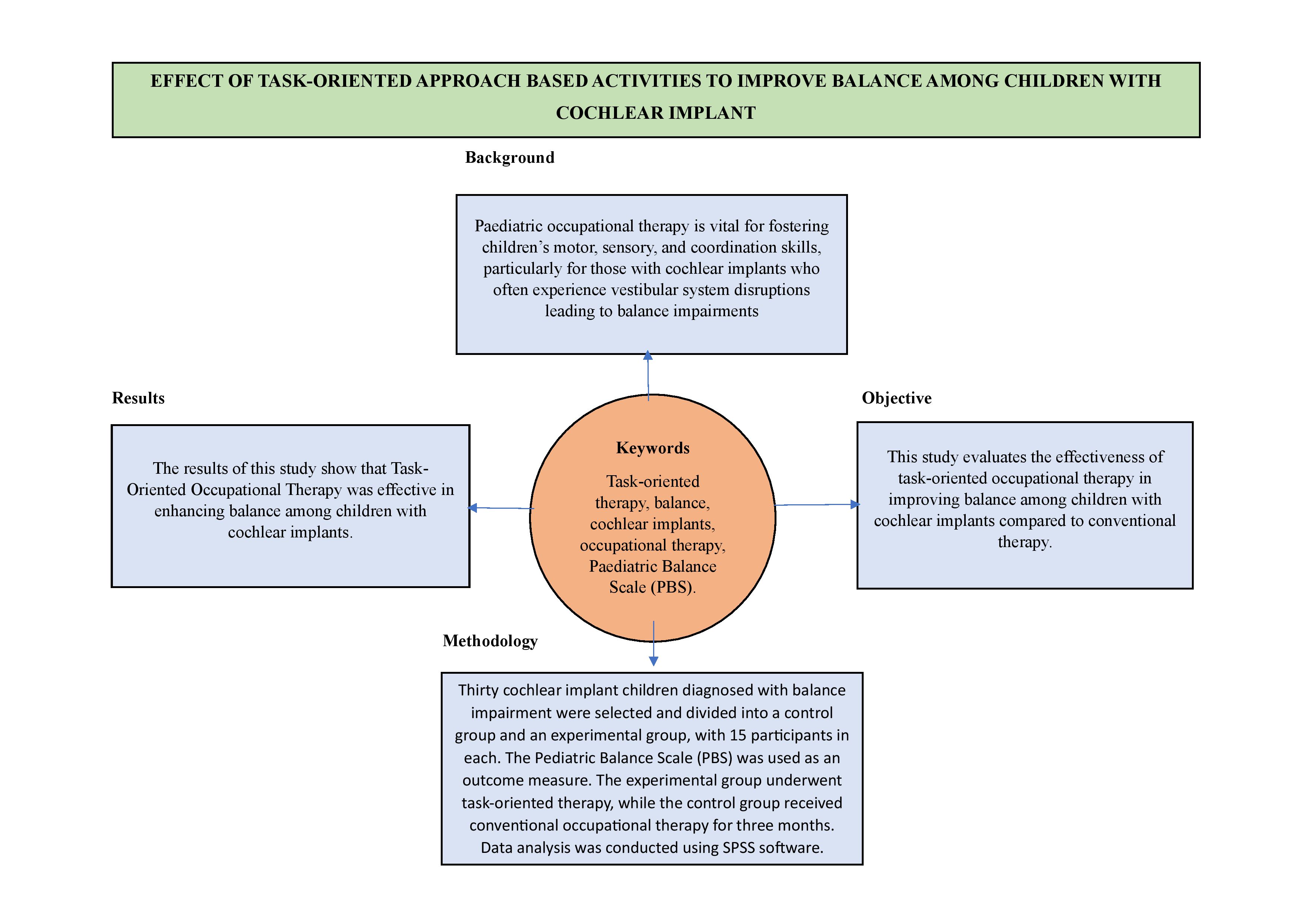
Background: Paediatric occupational therapy is vital for fostering children’s motor, sensory, and coordination skills, particularly for those with cochlear implants who often experience vestibular system disruptions leading to balance impairments. This study evaluates the effectiveness of task-oriented occupational therapy in improving balance among children with cochlear implants compared to conventional therapy.
Methodology: A quasi-experimental design was conducted with 30 participants aged 4–8 years, recruited using convenience sampling and divided into two groups: experimental (task-oriented therapy) and control (conventional therapy). Both interventions were delivered over 12 weeks with 30 sessions. Balance was assessed pre- and post-intervention using the Paediatric Balance Scale (PBS). Statistical analysis was performed to compare pre- and post-test scores within and between groups.
Results: The experimental group (N=15) had a mean pre-test PBS score of 33.2 (SD=2.88) and post-test score of 38.87 (SD=3.66), showing a statistically
significant improvement (Z=-3.429, p=0.001). The control group (N=15) had a mean pre-test score of 34.67 (SD=3.79) and post-test score of 36.07 (SD=3.37), also showing significant improvement (Z=-2.829, p=0.005). Post-test scores between the groups revealed a significantly greater improvement in the experimental group compared to the control group (Z=-2.032, p=0.042).
Conclusion: Task-oriented occupational therapy significantly enhances balance in children with cochlear implants, yielding better outcomes than conventional therapy. These findings highlight the importance of tailored interventions in addressing vestibular deficits and improving functional independence in this population.
Article Details

This work is licensed under a Creative Commons Attribution-NonCommercial-NoDerivatives 4.0 International License.
Personal views expressed by the contributors in their articles are not necessarily those of the Journal of Associated Medical Sciences, Faculty of Associated Medical Sciences, Chiang Mai University.
References
American Occupational Therapy Association. (2021). Occupational therapy practice framework: Domain and process. Bethesda, MD: AOTA Press.
World Health Organization. (2023). World report on hearing. Geneva: WHO Press.
Loizou, P. C. (2013). Introduction to cochlear implants. IEEE Press.
Ramirez, A., Vázquez, R., & González, M. (2020). Vestibular dysfunction in cochlear implant recipients: A systematic review. Journal of Vestibular Research, 30(3), 123–136.
Amir, S., Eleonora, G., & Zohar, S. (2015). Balance performance of deaf children with or without cochlear implants. International Journal of Pediatric Otorhinolaryngology, 79(3), 330–334.
Shumway-Cook, A., & Woollacott, M. H. (2017). Motor control: Translating research into clinical practice. Lippincott Williams & Wilkins.
Franjoine MR, Gunther JS, Taylor MJ. Pediatric Balance Scale: A modified version of the Berg Balance Scale for the school-age child with mild to moderate motor impairment. Pediatr Phys Ther. 2010;22(4):314–22.
Wiener-Vacher SR, Obeid R, Abou-Elew M. Vestibular impairment in children with congenital sensorineural hearing loss and cochlear implants. Audiol Neurootol. 2013;18(3):143–53.
Donahoe-Fillmore B, Erdman E, Spencer J, Ward M, Rowe L. Improving balance and stability in typically developing children through dynamic balance activities. J Phys Ther Sci. 2015;27(2):353–7.
Rahman S, Begum T, Shamsuzzaman M. Effects of sensory integration therapy on improving balance in children with developmental delays. Int J Pediatr. 2018;6(12):9231–8.
Wang Z, Yang Y, Ren L. Effects of task-specific balance training on postural control in children: A systematic review. Phys Ther Rev. 2016;21(4):240–7.
Verbecque E, Vereeck L, Truijen S. Motor learning principles in pediatric balance rehabilitation: A systematic review. Pediatr Phys Ther. 2019;31(3):209–18
Gabbard C, Rodrigues LP. Balance and postural control in children: Influences, assessment, and interventions. Phys Ther Rehabil J. 2021;101(1):1–8.
Shepherd RK, Hardie NA. Auditory system and cochlear implant function in children: Implications for balance and motor skills. Cochlear Implants Int. 2022;18(Suppl 1):S12–S20.
Schafer EC, Thibodeau LM. Auditory training for children with hearing loss using cochlear implants. J Speech Lang Hear Res. 2006;49(4):644–59.
Gordon AM, Charles JR. Task-oriented training in pediatric rehabilitation. In: Campbell JM, editor. Pediatric Rehabilitation. Springer; 2014. p. 192–211.
Winstein CJ, Kay DB. Translating the science of task-oriented training to clinical practice: Implications for rehabilitation professionals. J Neurol Phys Ther. 2005;29(3):109–18.
Chisari D, Vitkovic J, Clark R, Rance G. Vestibular function and balance performance in children with sensorineural hearing loss. Int J Audiol. 2023;62(2):1–9.
Janky KL, Patterson J, Thomas M, Al-Salim S, Robinson S. The effects of vestibular dysfunction on balance and self-concept in children with cochlear implants. Int J Pediatr Otorhinolaryngol. 2023;171:111642.
Benjamin RS, Cushing SL, Blakeman AW, Campos JL, Papsin BC, Gordon KA. Evaluating the use of a balance prosthesis during balance perturbations in children and young adults with cochleovestibular dysfunction. Sci Rep. 2023;13(1):9721.
Akbari M. Effect of task-oriented occupational therapy interventions on balance performance of children with cochlear implants. J Clin Res Paramed Sci. 2021;6(1):75–83.
