
Preliminary study: Effect of breathing exercise on hemodynamics and heart rate variability in hypertension
Article Sidebar
Main Article Content
Abstract
Background: Various types of breathing exercises (BE) have been investigated, mostly focusing on their effects on blood pressure (BP) in hypertension (HT). However, each study has had a different BE program, and strong evidence based on a standard protocol is lacking.
Objective: The present study was designed to compare the effects of BE across different breathing patterns within the same protocol on hemodynamic and heart rate variability (HRV) parameters.
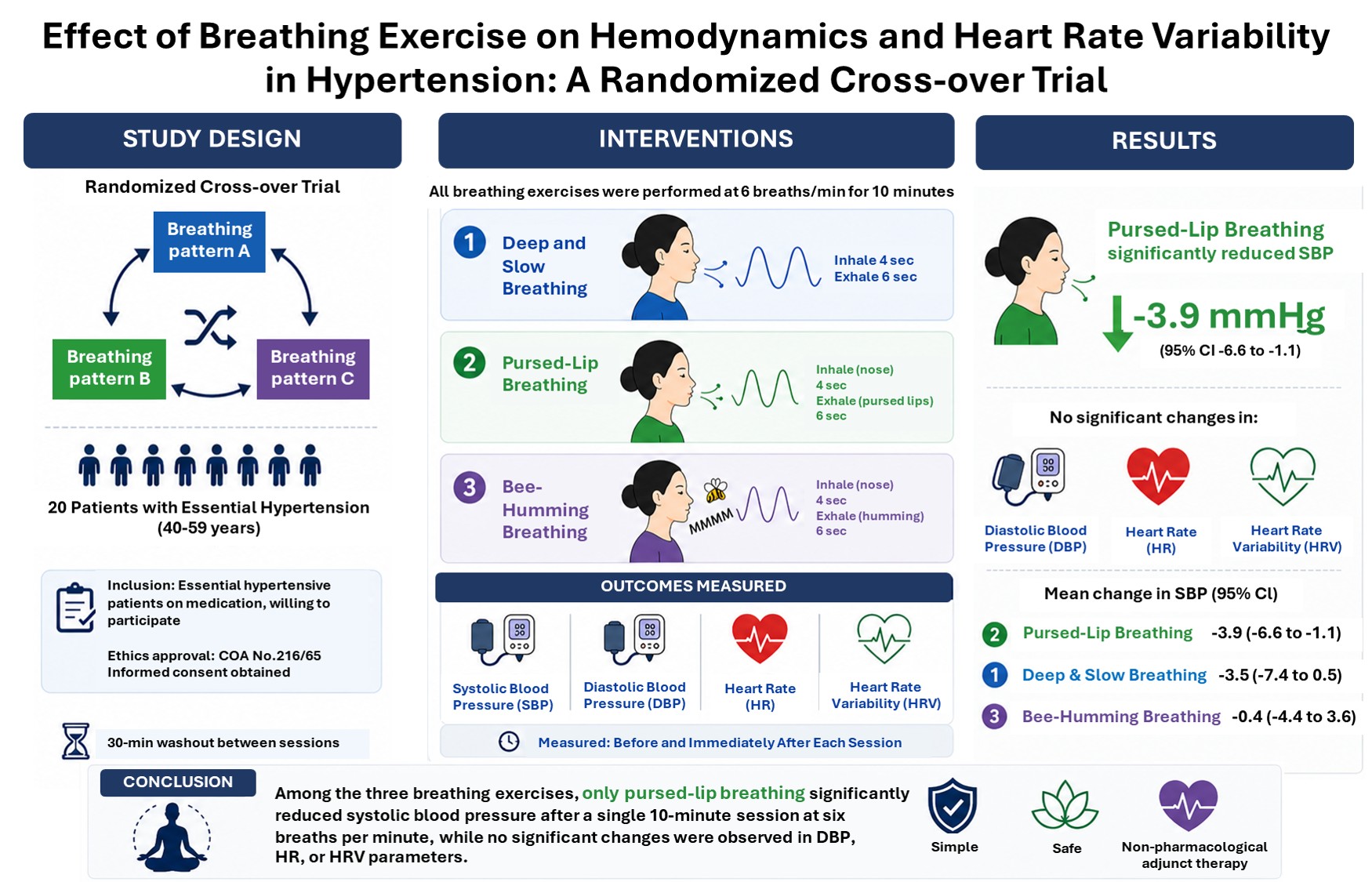
Materials and methods: The study was a randomized crossover design. 20 hypertensive patients performed deep and slow, pursed-lip, and bee-humming breathing in a random sequence of the three breathing patterns. Hemodynamics and HRV parameters were measured before and immediately after exercise.
Results: At a rate of six breaths/min for ten minutes, there was a significant effect of time on SBP (F (1,19)=5.17, p<0.05). The post hoc Bonferroni test indicated a significant reduction in SBP during pursed-lip breathing compared to baseline (p<0.01). In addition, no significant differences were found in DBP, HR, and HRV parameters. Moreover, pursed-lip breathing showed the largest change in mean difference with 95% CI in SBP (-3.9 (-6.6, -1.1)). While deep and slow and bee-humming breathing were (-3.5(-7.4, 0.5)) and (-0.4(-4.4, 3.6)), respectively.
Conclusion: Among the three breathing exercises, only pursed-lip breathing significantly reduced SBP after a single 10-minute session at six breaths per minute, while no significant changes were observed in DBP, HR, or HRV parameters. These findings suggest that pursed-lip breathing may be the most effective technique for short-term BP reduction in hypertensive patients under standardized conditions.
Article Details

This work is licensed under a Creative Commons Attribution-NonCommercial-NoDerivatives 4.0 International License.
Personal views expressed by the contributors in their articles are not necessarily those of the Journal of Associated Medical Sciences, Faculty of Associated Medical Sciences, Chiang Mai University.
References
Bolin LP, Saul AD, Bethune Scroggs LL, Horne C. A pilot study investigating the relationship between heart rate variability and blood pressure in young adults at risk for cardiovascular disease. Clin Hypertens. 2022; 28(1): 1-8. doi: 10.1186/s40885-021-00185-z.
Joseph CN, Porta C, Casucci G, Casiraghi N, Maffeis M, Rossi M, et al. Slow breathing improves arterial baroreflex sensitivity and decreases blood pressure in essential hypertension. Hypertension. 2005; 46(4): 714-8. doi: 10.1161/01.HYP.0000179581.68566.7d.
Oparil S, Acelajado MC, Bakris GL, Berlowitz DR, Cífková R, Dominiczak AF, et al. Hypertension. Nat Rev Dis Primers. 2018; 4: 18014. doi: 10.1038/nrdp.2018.14.
Brook RD, Julius S. Autonomic imbalance, hypertension, and cardiovascular risk. Am J Hypertens. 2000; 13(S4): 112S-22S. doi: 10.1016/S0895-7061(00)00228-4.
Grossman E, Grossman A, Schein MH, Zimlichman R, Gavish B. Breathing-control lowers blood pressure. J Hum Hypertens. 2001;15(4):263-9. doi: 10.1038/sj.jhh.1001147.
Solomen S, Aaron P. Breathing techniques-A review. Int J Phys Educ Sports Health. 2015; 2: 237-41.
Innocenti D. An overview of the development of breathing exercises into the specialty of physiotherapy for heart and lung conditions. Physiotherapy. 1996; 82(12): 681-93. doi: 10.1016/S0031-9406(05)66377-8.
Hoffman LA, Owens GR, Rogers RM, Mazzocco MC. Breathing exercises in chest physical therapy. Chest. 1987; 92(1): 191. doi: 10.1016/S0012-3692(16)37676-0.
Brandani JZ, Mizuno J, Ciolac EG, Monteiro HL. The hypotensive effect of Yoga’s breathing exercises: A systematic review. Complement Ther Clin Pract. 2017; 28: 38-46. doi: 10.1016/j.ctcp.2017.05.002.
Kuppusamy M, Kamaldeen D, Pitani R, Amaldas J, Shanmugam P. Effects of Bhramari Pranayama on health - A systematic review. J Tradit Complement Med. 2017; 8(1): 11-6. doi: 10.1016/j.jtcme.2017.02.003.
Yau KK-Y, Loke AY. Effects of diaphragmatic deep breathing exercises on prehypertensive or hypertensive adults: A literature review. Complement Ther Clin Pract. 2021; 43: 101315. doi: 10.1016/j.ctcp.2021.101315.
Chaddha A, Modaff D, Hooper-Lane C, Feldstein DA. Device and non-device-guided slow breathing to reduce blood pressure: A systematic review and meta-analysis. Complement Ther Med. 2019; 45: 179-84. doi: 10.1016/j.ctim.2019.03.005.
Koul BR, Pity KP, Kota V. A systematic review and meta-analysis of effectiveness of breathing exercises on blood pressure of patients with hypertension. Int J Sci Eng Manag. 2020; 5(12): 51-6.
Zahroh C, Nurjanah S, Widyarti NKS. Abdominal breathing affects blood pressure in hypertension sufferers. J Public Health Afr. 2019; 10(S1): 23-5. doi: 10.4081/jphia.2019.1174.
Mitsungnern T, Srimookda N, Imoun S, Wansupong S, Kotruchin P. The effect of pursed-lip breathing combined with number counting on blood pressure and heart rate in hypertensive urgency patients: A randomized controlled trial. J Clin Hypertens (Greenwich). 2021; 23(3): 672-79. doi: 10.1111/jch.14168.
Ghati N, Killa AK, Sharma G, Karunakaran B, Agarwal A, Mohanty S, et al. A randomized trial of the immediate effect of Bee-Humming Breathing exercise on blood pressure and heart rate variability in patients with essential hypertension. Explore. 2021; 17(4): 312-9. doi: 10.1016/j.explore.2020.03.009.
Nuttaset M, Apiwan M, Rattana V, Jittima S, Naruemon L. Heart rate variability assessment and clinical uses. J Thai Rehabil Med. 2018; 28: 32-6. (inThai).
Rajendra Acharya U, Paul Joseph K, Kannathal N, Lim CM, Suri JS. Heart rate variability: a review. Med Biol Eng Comput. 2006; 44(12): 1031-51. doi: 10.1007/s11517-006-0119-0.
Fryar CD, Ostchega Y, Hales CM, Zhang G, Kruszon-Moran D. Hypertension prevalence and control among adults: United States, 2015-2016. NCHS Data Brief. 2017; (289): 1-8.
Telles S, Yadav A, Kumar N, Sharma S, Visweshwaraiah NK, Balkrishna A. Blood pressure and purdue pegboard scores in individuals with hypertension after alternate nostril breathing, breath awareness, and no intervention. Med Sci Monit. 2013; 19: 61-6. doi: 10.12659/MSM.883743.
Umemura S, Arima H, Arima S, Asayama K, Dohi Y, Hirooka Y, et al. The Japanese society of hypertension guidelines for the management of hypertension (JSH 2019). Hypertens Res. 2019;42(9):1235-481. doi: 10.1038/s41440-019-0284-9.
Klabunde RE. Cardiovascular physiology concepts. 2nd ed. Philadelphia: Lippincott Williams & Wilkins; 2012.
Nguyen JD, Duong H. Pursed-lip breathing. In: StatPearls [Internet]. Treasure Island (FL): StatPearls Publishing; 2024 [cited 2026 May 5]. Available from: https://www.ncbi.nlm.nih.gov/books/NBK545289/
Malone DJ, Adler J. The patient with respiratory failure-preferred practice pattern 6F. In: Irwin S, Tecklin JS, editors. Cardiopulmonary physical therapy. 4th ed. Saint Louis: Mosby; 2004. p. 372-99.
Kai S, Nagino K, Aoki T, Imura T, Kiyoshima K, Satake Y, et al. Cardiac autonomic nervous system activity during slow breathing in supine position. Rehabil Res Pract. 2021; 2021: 6619571. doi: 10.1155/2021/6619571.
