
Development of a self-report questionnaire for evaluating the occupational performance and satisfaction in daily occupations in seven occupational areas of university students with game addiction
Article Sidebar
Main Article Content
Abstract
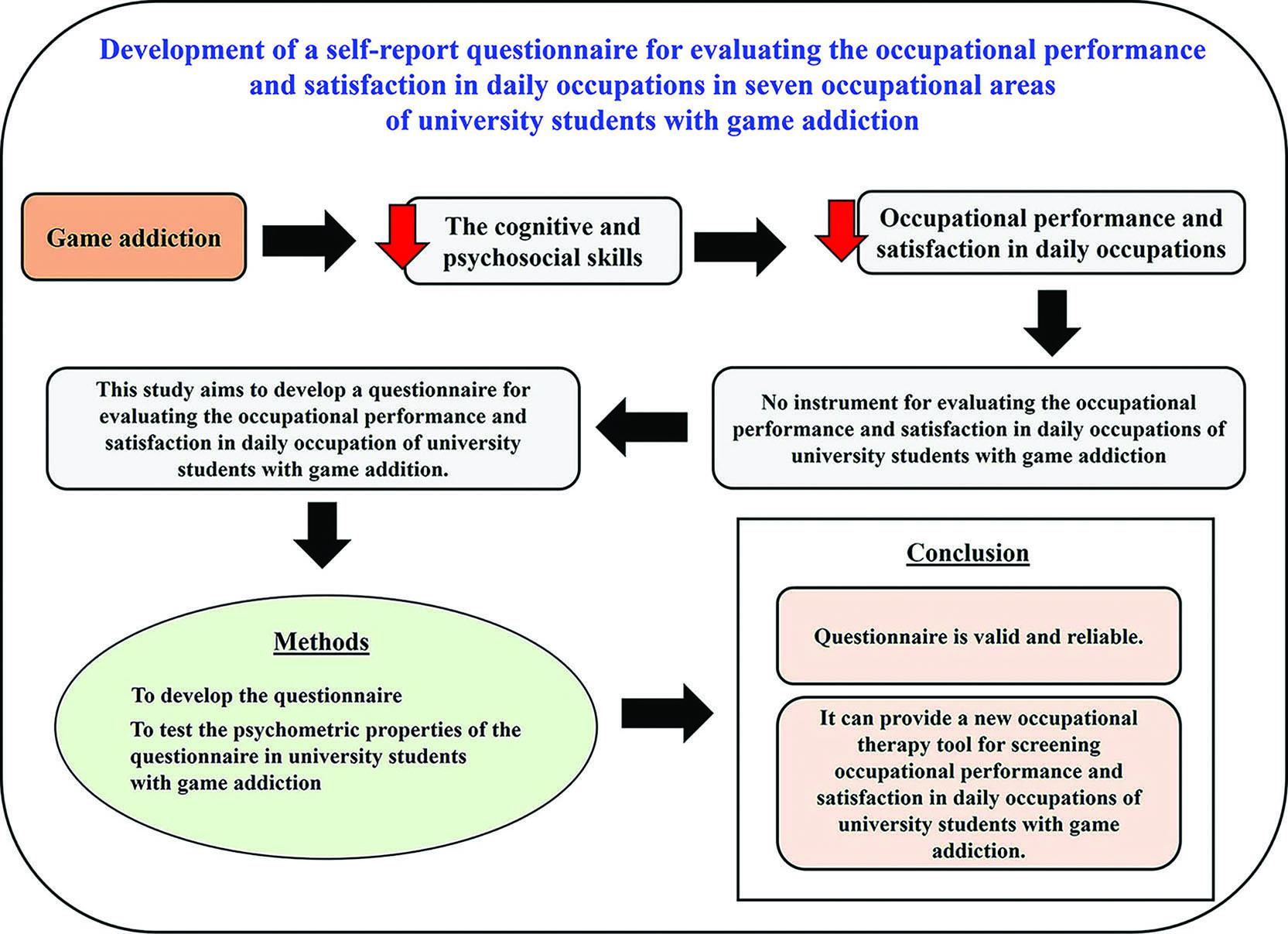
Background: Nowadays, the prevalence of internet usage for university students’ game playing is increasing worldwide. However, overabundant gaming may lead to game addiction. Studies have demonstrated that game addiction increases the risks of health problems. Moreover, it also decreases occupational performance via cognitive and psychosocial skill reduction. In occupational therapy, cognitive and psychosocial performance are necessary for daily activities. Furthermore, occupational satisfaction also correlates positively with participation in occupations. Thus, occupational therapists should know the occupational performance and satisfaction in daily occupations of university students with game addiction to explore occupational issues and plan interventions. However, an instrument for evaluating the occupational performance and satisfaction in daily occupations of university students with game addiction has never been investigated.
Objective: This study developed a questionnaire to evaluate the occupational performance and satisfaction in the daily occupation of university students with game addition.
Materials and methods: The questionnaire, comprising 22 items, assessed the impacts of game addiction on occupational performance and satisfaction in daily occupations of seven occupational areas. Afterwards, the psychometric properties of the questionnaire were investigated in 78 university students with game addiction.
Results: This study showed that the questionnaire had sufficient content and construct validity for evaluating the impacts of game addiction on occupational performance and satisfaction in the daily occupations of university students. Moreover, the internal consistency of the questionnaire in occupational performance is good (Cronbach’s alpha coefficient =0.812). Also, the internal consistency of the questionnaire in satisfaction of daily occupation is good (Cronbach’s alpha coefficient =0.82).
Conclusion: The questionnaire is valid and reliable for evaluating the occupational performance and satisfaction in daily occupation of university students with game addiction. Screening these components can provide a new occupational therapy tool for such students.
Article Details

This work is licensed under a Creative Commons Attribution-NonCommercial-NoDerivatives 4.0 International License.
Personal views expressed by the contributors in their articles are not necessarily those of the Journal of Associated Medical Sciences, Faculty of Associated Medical Sciences, Chiang Mai University.
References
Cotten SR, Goldner M, Hale TM, Drentea P. The importance of type, amount, and timing of internet use for understanding psychological distress. Soc Sci Q. 2011; 92(1): 119-39. doi: 10.1111/j.1540-6237.2011.00760.x
Alrahili N, Alreefi M, Alkhonain IM, Aldakhilallah M, Alothaim J, Alzahrani A, et al. The Prevalence of Video Game Addiction and Its Relation to Anxiety, Depression, and Attention Deficit Hyperactivity Disorder (ADHD) in Children and Adolescents in Saudi Arabia: A Cross-Sectional Study. Cureus. 2023; 15(8): e42957. doi: 10.7759/cureus.42957
Derevensky JL, Hayman V, Lynette G. Behavioral Addictions: Excessive Gambling, Gaming, Internet, and Smartphone Use Among Children and Adolescents. Pediatr Clin North Am. 2019; 66(6): 1163-82. doi: 10.1016/j.pcl.2019.08.008
Rumpf HJ, Achab S, Billieux J, Bowden-Jones H, Carragher N, Demetrovics Z, et al. Including gaming disorder in the ICD-11: The need to do so from a clinical and public health perspective. J Behav Addict. 2018; 7(3): 556-61. doi: 10.1556/2006.7.2018.59.
Vaccaro AG, Potenza MN. Diagnostic and Classification Considerations Regarding Gaming Disorder: Neurocognitive and Neurobiological Features. Front Psychiatry. 2019; 10: 405. doi: 10.3389/fpsyt.2019.00405
Gulu M, Yagin FH, Gocer I, Yapici H, Ayyildiz E, Clemente FM, et al. Exploring obesity, physical activity, and digital game addiction levels among adolescents: A study on machine learning-based prediction of digital game addiction. Front Psychol. 2023; 14: 1097145. doi: 10.3389/fpsyg.2023.1097145
Wong HY, Mo HY, Potenza MN, Chan MNM, Lau WM, Chui TK, et al. Relationships between Severity of Internet Gaming Disorder, Severity of Problematic Social Media Use, Sleep Quality and Psychological Distress. Int J Environ Res Public Health. 2020;17(6): 1879. doi: 10.3390/ijerph17061879
Pallavicini F, Pepe A, Mantovani F. The Effects of Playing Video Games on Stress, Anxiety, Depression, Loneliness, and Gaming Disorder During the Early Stages of the COVID-19 Pandemic: PRISMA Systematic Review. Cyberpsychol Behav Soc Netw. 2022; 25(6): 334-54. doi: 10.1089/cyber.2021.0252
Ngetich R, Burleigh TL, Czako A, Vekony T, Nemeth D, Demetrovics Z. Working memory performance in disordered gambling and gaming: A systematic review. Compr Psychiatry. 2023; 126: 152408. doi: 10.1016/j.comppsych.2023.152408
Tiznado D, Clark JMR, McDowd J. Cognitive predictors of a performance-based measure of instrumental activities of daily living following stroke. Top Stroke Rehabil. 2021; 28(6): 401-9. doi: 10.1080/10749357.2020.1834269
Goktas A, Varli M. Psychosocial health and activities during the COVID-19 pandemic. Work. 2023; 75(4): 1127-38. doi: 10.3233/WOR-220007
Law M, Baptiste S, McColl M, Opzoomer A, Polatajko H, Pollock N. The Canadian occupational performance measure: an outcome measure for occupational therapy. Can J Occup Ther. 1990 ;57(2): 82-7. doi: 10.1177/000841749005700207
Larsson-Lund M, Nyman A. Participation and occupation in occupational therapy models of practice: A discussion of possibilities and challenges. Scand J Occup Ther. 2017; 24(6): 393-7.
Christiansen C. H. BCM, Bass J. D. Occupational therapy: Performance, participation and well-being. 3rd ed. ed: SLACK Inc.; 2005, p.372-92.
Schmitt ZL, Livingston MG. Video game addiction and college performance among males: results from a 1 year longitudinal study. Cyberpsychol Behav Soc Netw. 2015; 18(1): 25-9. doi: 10.1089/cyber.2014.0403
Chang E, Kim B. School and individual factors on game addiction: A multilevel analysis. Int J Psychol. 2020; 55(5): 822-31. doi: 10.1002/ijop.12645
Abdullah EJ, Badr HE, Manee F. MS People’s Performance and Satisfaction With Daily Occupations: Implications for Occupational Therapy. OTJR (Thorofare N J). 2018; 38(1): 28-37. doi: 10.1177/1539449217719867
Bergstrom A, Guidetti S, Tham K, Eriksson G. Association between satisfaction and participation in everyday occupations after stroke. Scand J Occup Ther. 2017; 24(5): 339-48. doi: 10.1080/11038128.2016.1245782
Occupational Therapy Practice Framework: Domain and Process-Fourth Edition. Am J Occup Ther. 2020; 74(Suppl2): 7412410010p1-p87. doi: 10.5014/ajot.2020.74S2001
Boot WR, Kramer AF, Simons DJ, Fabiani M, Gratton G. The effects of video game playing on attention, memory, and executive control. Acta Psychol (Amst). 2008; 129(3): 387-98. doi: 10.1016/j.actpsy.2008.09.005
Chan V, Moore J, Derenne J, Fuchs DC. Transitional Age Youth and College Mental Health. Child Adolesc Psychiatr Clin N Am. 2019; 28(3): 363-75. doi: 10.1016/j.chc.2019.02.008
Sayeed MA, Rasel MSR, Habibullah AA, Hossain MM. Prevalence and underlying factors of mobile game addiction among university students in Bangladesh. Glob Ment Health (Camb). 2021; 8: e35. doi: 10.1017/gmh.2021.34
van den Eijnden R, Koning I, Doornwaard S, van Gurp F, Ter Bogt T. The impact of heavy and disordered use of games and social media on adolescents’ psychological, social, and school functioning. J Behav Addict. 2018; 7(3): 697-706. doi: 10.1556/2006.7.2018.65
Pornnoppadol P. SB, Khamklieng K., Pattana-amorn S. , The Development of Game Addiction Screening Test (GAST). J Psychiatr Assoc Thailand. 2014; 59(1): 3-14.
Bujang MA, Omar ED, Baharum NA. A Review on Sample Size Determination for Cronbach’s Alpha Test: A Simple Guide for Researchers. Malays J Med Sci. 2018; 25(6): 85-99. doi: 10.21315/mjms2018.25.6.9
van Stiphout L, Rolfes J, Waardenburg S, Kimman M, Guinand N, Perez Fornos A, et al. Construct validity and reliability of the Bilateral Vestibulopathy Questionnaire (BVQ). Front Neurol. 2023; 14: 1221037. doi: 10.3389/fneur.2023.1221037
Green SB, Yang Y, Alt M, Brinkley S, Gray S, Hogan T, et al. Use of internal consistency coefficients for estimating reliability of experimental task scores. Psychon Bull Rev. 2016;23(3):750-63. doi: 10.3758/ s13423-015-0968-3
Mylona I, Deres ES, Dere GS, Tsinopoulos I, Glynatsis M. The Impact of Internet and Videogaming Addiction on Adolescent Vision: A Review of the Literature. Front Public Health. 2020; 8: 63. doi: 10.3389/fpubh.2020.00063
Wang JL, Sheng JR, Wang HZ. The Association Between Mobile Game Addiction and Depression, Social Anxiety, and Loneliness. Front Public Health. 2019; 7: 247. doi: 10.3389/fpubh.2019.00247
