Sensory processing patterns link alcohol consumption in undergraduate students
Article Sidebar
Main Article Content
Abstract
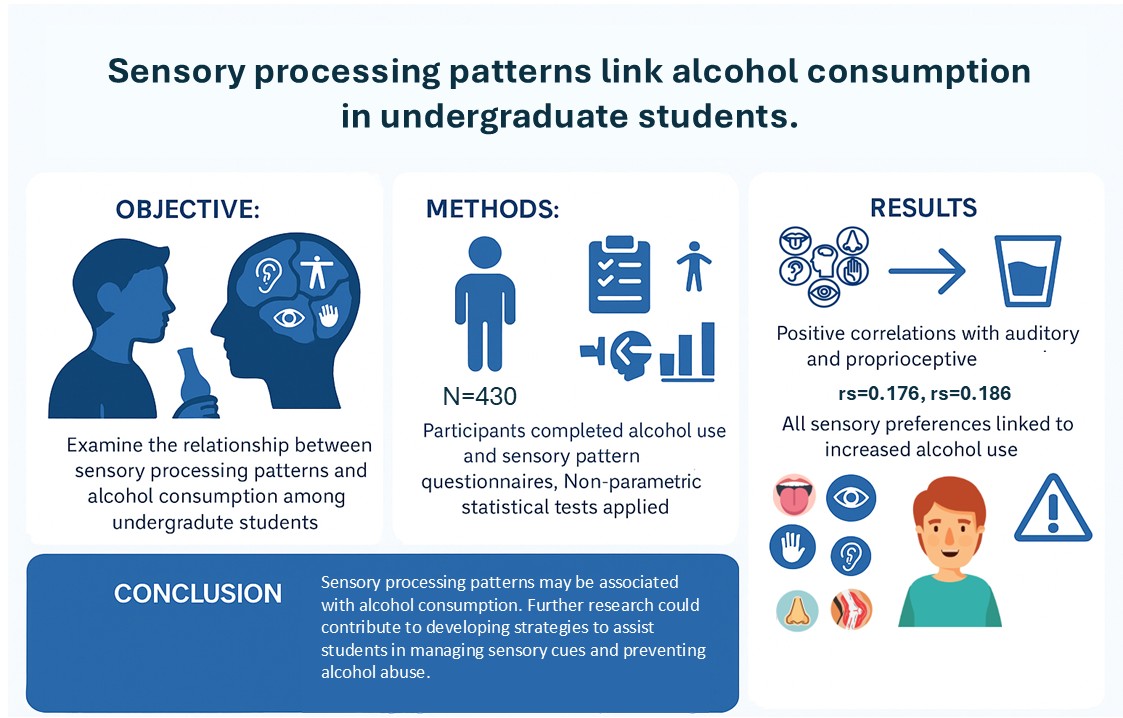
Background: Alcohol consumption among undergraduate students is a public health concern. Sensory processing refers to how individuals receive, organize, and respond to sensory information from their environment, influencing their emotions and behavior. However, no research has yet explored the relationship between sensory processing patterns in specific modalities and alcohol consumption among undergraduate students.
Objective: The purpose of this study was to examine the relationship between sensory processing patterns and alcohol consumption among undergraduate students.
Materials and methods: Participants included 430 students. Participants completed a demographic questionnaire, the Functional-Belief-Based Alcohol Use Questionnaire and the Thai Sensory Patterns Assessment. Descriptive statistics, Spearman’s correlation analysis, Mann-Whitney U test, Kruskal-Wallis H test, and chi-squared test were used to analyze the data.
Results: The findings indicated that alcohol consumption was positively correlated with sensory arousal in the auditory and proprioceptive modalities (r=0.176 and 0.186, respectively; p<0.01), as well as with sensory preferences across all modalities (rs ranged from 0.116 to 0.204; p<0.01; p<0.05).
Conclusion: This research found that sensory processing patterns may be associated with alcohol consumption. Further research and public health efforts could contribute to developing strategies to assist students in managing sensory cues and preventing alcohol abuse.
Article Details

This work is licensed under a Creative Commons Attribution-NonCommercial-NoDerivatives 4.0 International License.
Personal views expressed by the contributors in their articles are not necessarily those of the Journal of Associated Medical Sciences, Faculty of Associated Medical Sciences, Chiang Mai University.
References
World Health Organization. Global status report on alcohol and health and treatment of substance use disorders. Geneva: World Health Organization; 2024. Available from: https://www.who.int/publications/i/ item/9789240096745
National Statistical office. Health behavior of population survey 2021. Bangkok: National Statistical Office; 2021. Available from: https://www.nso.go.th/ nsoweb/nso/survey_detail/w6?set_lang=en
Burden of Disease Thailand Study Group. Burden ofdisease attributable to risk factors in Thailand 2019. Nonthaburi: International Health Policy Planning; 2023. Available from: https://www.trc.or.th/en/burdenof-disease-attributable-to-risk-factors-in-thailand-2019/
Pengpid S, Peltzer K. Prevalence of overweight and underweight and its associated factors among male and female university students in Thailand. Homo. 2015; 66(2): 176-86. doi: 10.1016/j.jchb.2014.11.002
Booranasuksakul U, Singhato A, Rueangsri N, Prasertsri P. Association between alcohol consumption and body mass index in university students. Asian Pac Isl Nurs J. 2019; 4(1): 57. doi: 10.31372/20190401.1035
Grab J, Green M, Norris J, Pilchik K, Fisher GS. Exploring the impact of OT student stress: Professor and student perspectives. J Occup Ther Educ. 2021; 5(1): Art. 3. doi: 10.26681/jote.2021.050103
Thompson SM, Simmons AN, McMurray MS. The effects of multiple early life stressors on adolescent alcohol consumption. Behav Brain Res. 2020; 380:112449. doi: 10.1016/j.bbr.2019.112449
Promyod P. The correlation between self-confidence in refusing an invitation to drink alcohol and alcohol drinking behavior of undergraduate students of Rajabhat Maha Sarakham University for academic year 2020. MKHJ 2021; 18(2): 81-7. Available from: https://he02.tci-thaijo.org/index.php/MKHJ/article/ download/251057/172216 [in Thai]
Pourmohammadi B, Jalilvand MA. Prevalence of alcohol consumption and related factors among students of higher education centers in one of the northeastern cities of Iran. AIMS Public Health. 2019; 6(4): 523-33. doi: 10.3934/publichealth.2019.4.523
Phoosuwan N. Prevalence and factors related to alcohol consumption among undergraduate students in a northeast Thailand province. PHJBUU. 2019; 14: 1-15. Available from: https://journal.lib.buu.ac.th/ index.php/health/article/view/5785 [in Thai].
Pagliano P. The multisensory handbook: a guide for children and adults with sensory learning disabilities. New York, NY: Taylor & Francis Group; 2012.
Dunn W. Living sensationally: understanding your senses. London: Jessica Kingsley; 2008.
Gutman S. Why addiction has a chronic, relapsing course. the neurobiology of addiction. Occup Ther Ment Health. 2006; 22(2): 1-29. doi: 10.1300/J004v 22n02_01
Becker HC. Influence of stress associated with chronic alcohol exposure on drinking. Neuropharmacology. 2017; 122: 115-26. doi: 10.1016/j.neuropharm.2017. 04.028
Kelly J, Meredith PJ, Taylor M, Morphett A, Wilson H. Substances and your senses: the sensory patterns of young people within an alcohol and drug treatment service. Subst Abus. 2021; 42(4): 998-1006. doi:10.1080/ 08897077.2021.1901177.
Meredith P, Moyle R, Kerley L. Substance use: links with sensory sensitivity, attachment insecurity, and distress in young adults. Subst Use Misuse. 2020; 55(11): 1817-24. doi: 10.1080/10826084.2020.1766502.
Yamane T. Statistics: An introductory analysis. 3rd Ed. New York: Harper & Row; 1973.
Phinyo P, Ungrungseesopon N, Namsongwong N, Visavakul O, Chaiya S, Wattananukorn T, et al. Pre-screening ability of the Functional-Belief-Based Alcohol Use Questionnaire (FBAQ) among Chiang Mai University undergraduates: an external validation study. Drug Alcohol Depend. 2021; 227: 109002. doi:10.1016/j.drugalcdep.2021.109002
Pomngen I, Srikhamjak, T, Putthinoi, S. Development of the sensory patterns assessment [Thesis]. Faculty of Associated Medical Sciences, Chiang Mai University;
[in Thai]
Chen WL, Chen JH. College fields of study and substance use. BMC Public Health. 2020;20(1):1631. doi: 10.1186/s12889-020-09722-1
Brito APA, Lima AS, Rocha ÁC, Gonçalves BM, Freitas DMCB, Oliveira GJ, et al. Alcohol consumption habits and their impact on academic performance: analysis of ethanol patterns among health students. A crosssectional study. Sao Paulo Med. J. 2024; 142(6): e2023410. doi: 10.1590/1516-3180.2023.0410.R1.05 062024
Suparan K, Wongsuthipol J, Hiranwong T, Rojanasumapong A, Pinyopornpanish K, Angkurawaranon C, et al. A study of the association between alcohol consumption, road accidents, learning behavior and academic achievement in university students. BSCM 2019; 58(3): 133-43. Available from: https://he01.tci-thaijo. org/index.php/CMMJ-MedCMJ/article/view/121381 [in Thai].
Mekonen T, Fekadu W, Chane T, Bitew S. Problematic alcohol use among university students. Front Psychiatry. 2017; 8: 86. doi: 10.3389/fpsyt.2017.00086
Collier L, Staal J, Homel P. Multisensory environmental therapy (Snoezelen) for job stress reduction in mental health nurses: a randomized trial. Int j complement altern med. 2018; 11(2): 1-7. doi 10.15406/ijcam. 2018.11.00346
Borges JM, Castillo JAGd, Marzo JC, Castillo-López ÁGd. Relationship between sensory processing, resilience, attitudes and drug use in Portuguese adults. Paidéia (Ribeirão Preto). 2017; 27(68): 255-62. doi:10.1590/1982-43272768201702
Niemelä O, Bloigu A, Bloigu R, Halkola AS, Niemelä M, Aalto M, et al. Impact of physical activity on the characteristics and metabolic consequences of alcohol consumption: A cross-sectional population-based study. Int J Environ Res Public Health. 2022; 19(22):15048. doi: 10.3390/ijerph192215048
Gligoroski A, Stojmanovska DS. Alcohol consumption habits among young adults, with sedentary and active lifestyle. RPESH. 2018; 7(2): 1857-8160. Retrieve from https://www.researchgate.net/publication/33 8829575
Ashok K. Critical review of alcohol, alcoholism and the withdrawal symptoms I. mechanisms of addiction and withdrawal syndrome. Arch Addict Rehabil. 2017; 1(1): 11-30. doi:10.36959/843/421
Supawat A, Phunikhom K, Sattayasai J. Alcohol addiction, alcohol withdrawal syndrome and treatment. Srinagarind Med Journal. 2015;30(6):618-29. Available from: https://www.thaiscience.info/Journals/Article/SRMJ/ 10981942.pdf [in Thai].
Horii Y, Nagai K, Nakashima T. Order of exposure to pleasant and unpleasant odors affects autonomic nervous system response. Behav Brain Res. 2013; 243: 109-17. doi: 10.1016/j.bbr.2012.12.042
Newbury-Birch D, Gilvarry E, McArdle P, Ramesh V, Stewart S, Walker J, et al. Impact of alcohol consumption on young people: a review of reviews. [internet] Nottingham: Department for Children, Schools and Families; 2009 [cited 2023 Mar 29]. Available from: https://www.drugsandalcohol.ie/12292/.
