
Seroprevalence and potential risk factors associated with severe scrub typhus infection: an experience from a tertiary care set up in Odisha, India
Article Sidebar
Main Article Content
Abstract
diseases.
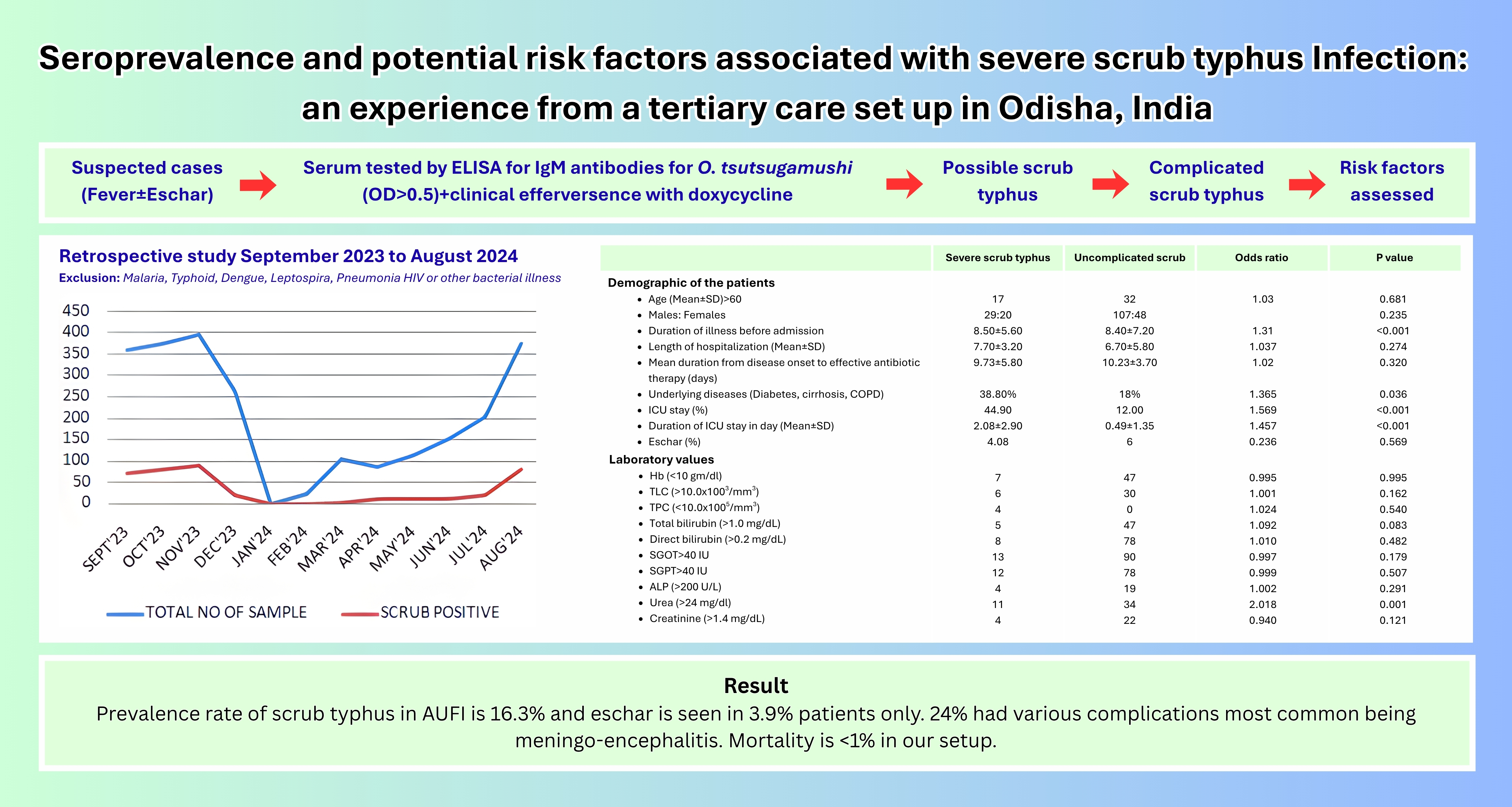
Objectives: Owing to the lack of adequate prevalence data from our region, the present study aims to denote the prevalence of scrub typhus in Odisha and factors associated with development of various complications of this disease.
Material and Methods: All patients who were clinically suspected as scrub typhus during the study period of one year coming to our hospital were tested for IgM antibodies against Orientia tsutsugamushi by commercially available enzyme-linked immunosorbent assay (ELISA) kit. Other common endemic diseases were ruled out by appropriate tests. Clinical data for admitted patients were obtained from case sheets. The patient demographics, treatment and laboratory data of the complicated and uncomplicated scrub typhus cases were noted. Data was entered in excel sheet and tabulated by SPSS software.
Results: In the study among 2449 suspected cases, 398(16.3%) were positive for scrub typhus by IgM ELISA with peak incidence from August to November months. There was male preponderance of the illness with peak age of affection being 51-60 years. Eschar was noted only in 6 cases, and 49 cases went on to have various complications, commonest being meningoencephalitis. Mortality was very low in our study. Longer duration of fever before seeking treatment was significantly associated with development of complications.
Conclusion: The prevalence of scrub typhus was 16.3 % among the study population. Taking scrub typhus diagnostics to the peripheral level is the need of the hour to ensure early diagnosis and prevent severe disease.
Article Details

This work is licensed under a Creative Commons Attribution-NonCommercial-NoDerivatives 4.0 International License.
Personal views expressed by the contributors in their articles are not necessarily those of the Journal of Associated Medical Sciences, Faculty of Associated Medical Sciences, Chiang Mai University.
References
Rout D, Praharaj I, Dalai SP, Mishra S, Otta S. Rising menace of scrub typhus – Current status and challenges. J Pure Appl Microbiol. 2023; 17(4): 2060‑73. doi:10.22207/JPAM.17.4.39.
Abarca K, Martínez‑Valdebenito C, Angulo J, Jiang J, Farris CM, Richards AL, et al. Molecular description of a novel Orientia species causing scrub typhus in Chile. Emerg Infect Dis. 2020; 26(9): 2148‑56. doi:10.3201/eid2609.200918.
Kala D, Gupta S, Nagraik R, VermaV, Thakur A, Kausal A. Diagnosis of scrub typhus: recent advancements and challenges. Biotech. 2020; 10: 396. doi:10.1007/s13205‑020‑02389‑w.
Dasgupta S, Asish PR, Rachel G, Bagepally BS, Chethrapilly Purushothaman GK. Global seroprevalence of scrub typhus: a systematic review and meta-analysis. Sci Rep. 2024;14(1): 10895. doi:10.1038/s41598-024-61555-9.
Bonell A, Lubell Y, Newton PN, Crump JA, Paris DH. Estimating the burden of scrub typhus: A systematic review. PLoS Negl Trop Dis. 2017; 11(9):e0005838. doi:10.1371/journal.pntd.0005838.
Devasagayam E, Dayanand D, Kundu D, Kamath MS, Kirubakaran R, Varghese GM. The burden of scrub typhus in India: A systematic review. PLoS Negl Trop Dis. 2021; 15(7): e0009619. doi:10.1371/journal.pntd.0009619.
Rajapakse S, Rodrigo C, Fernando D. Scrub typhus: pathophysiology, clinical manifestations and prognosis. Asian Pac J Trop Med. 2012; 5(4): 261‑4. doi:10.1016/S1995-7645(12)60045-4.
Varghese GM, Janardhanan J, Mahajan SK, Tariang D, Trowbridge P, Prakash JA, et al. Molecular epidemiology and genetic diversity of Orientia tsutsugamushi from patients with scrub typhus in 3 regions of India. Emerg Infect Dis. 2015; 21(1): 64‑71. doi:10.3201/eid2101.140727.
Behera B, Biswal M, Das RR, Dey A, Jena J, Dhal S, et al. Clinico‑epidemiological analysis of scrub typhus in hospitalised patients presenting with acute undifferentiated febrile illness: a hospitalbased study from Eastern India. Indian J Med Microbiol. 2019; 37(2): 278‑80. doi:10.4103/ijmm.IJMM_18_217.
Xu G, Walker DH, Jupiter D, Melby PC, Arcari CM. A review of the global epidemiology of scrub typhus. PLoS Negl Trop Dis. 2017; 11(11): e0006062. doi:10.1371/journal.pntd.0006062.
Das P, Singh D, Das M, Nayak RK, Mohakud NK. Epidemiological and clinical features of scrub typhus in Odisha, Eastern India. Med J Dr DY Patil Univ. 2019; 12(5): 419‑23. doi:10.4103/mjdrdypu.mjdrdypu_76_19.
Lakshmanan S, Sagayaraj B, Sujatha B, Vasudevan LD. Clinical and laboratory profile of pediatric scrub typhus in a tertiary care teaching hospital in Southern India. Int J Contemp Pediatr. 2018; 5(5): 2092‑6. doi:10.18203/2349‑3291.ijcp20183500.
Kumar S, Kumar M, Aggarwal B, Kumari R. Scrub typhus in children: clinical profile and complications at a tertiary care teaching hospital in Uttarakhand. Indian J Child Health. 2017; 4(2): 188‑92. doi:10.32677/IJCH.2017.v04.i02.023.
Rodkvamtook W, Ruang‑Areerate T, Gaywee J, Richards AL, Jeamwattanalert P, Bodhidatta D, et al. Isolation and characterization of Orientia tsutsugamushi from rodents captured following a scrub typhus outbreak at a military training base, Bothong district, Chonburi province, central Thailand. Am J Trop Med Hyg. 2011; 84(4): 599‑606. doi:10.4269/ajtmh.2011.10-0466.
Thapa S, Hamal P, Chaudhary NK,Sapkota LB, Singh JP.Burden of scrub typhus among patients with acute febrile illness attending tertiary care hospital in Chitwan, Nepal. BMJ Open. 2020; 10: e034727. doi:10.1136/bmjopen-2019-034727.
Lee HB, Kwon KS. Risk factors leading to fatal outcome in scrub typhus patients. Am J Trop Med Hyg. 2009; 81(3): 484‑8. doi:10.4269/ajtmh.2009.81.484.
Kim DM, Yun NR, Neupane GP, Shin SH, Ryu SY, Yoon HJ, et al. Differences in clinical features according to Boryoung and Karp genotypes of Orientia tsutsugamushi. PLoS One. 2011; 6(8): e22731. doi:10.1371/journal.pone.0022731.
Park J, Woo SH, Lee CS. Evolution of eschar in scrub typhus. Am J Trop Med Hyg. 2016; 95(6): 1223‑5. doi:10.4269/ajtmh.16-0644.
Yoo JS, Kim D, Choi HY, Yoo S, Hwang JH, Hwang JH, et al. Prevalence rate and distribution of eschar in patients with scrub typhus. Am J Trop Med Hyg. 2022; 106(5): 1358‑66. doi:10.4269/ajtmh.22-0040.
Paris DH, Phetsouvanh R, Tanganuchitcharnchai A, Jones M, Jenjaroen K, Vongsouvath M, et al. Orientia tsutsugamushi in human scrub typhus eschars shows tropism for dendritic cells and monocytes rather than endothelium. PLoS Negl Trop Dis. 2012; 6(1): e1466. doi:10.1371/journal.pntd.0001466.
Lalrinkima H, Lalremruata R, Lalchhandama C, Khiangte L, Siamthara FH, Lalnunpuia C, et al. Scrub typhus in Mizoram, India. J Vector Borne Dis. 2017; 54(4): 369‑71. doi:10.4103/0972-9062.219888.
Liu YX, Feng D, Suo JJ, Xing YB, Liu G, Liu LH, et al. Clinical characteristics of the autumn‑winter type scrub typhus cases in south of Shandong province, northern China. BMC Infect Dis. 2009; 9: 1. doi:10.1186/1471-2334-9-1.
Bal M, Mohanta MP, Sahu S, Dwibedi B, Pati S, Ranjit M. Profile of pediatric scrub typhus in Odisha, India. Indian Pediatr. 2019; 56: 304‑6.doi:10.1007/s13312-019-1448-7.
Xu G, Walker DH, Jupiter D, Melby PC, Arcari CM. A review of the global epidemiology of scrub typhus. PLoS Negl Trop Dis. 2017; 11(11): e0006062.doi:10.1371/journal.pntd.0006062.
Lee HW, Cho PY, Moon SU, Na BK, Kang YJ, Sohn Y, et al. Current situation of scrub typhus in South Korea from 2001‑2013. Parasites & Vectors. 2015; 8: 1‑4. doi:10.1186/s13071-015-1154-9.
Gupta N, Chaudhry R, Kabra SK, Lodha R, Mirdha BR, Das BK, et al. In search of scrub typhus: a prospective analysis of clinical and epidemiological profile of patients from a tertiary care hospital in New Delhi. Adv Infect Dis. 2015; 5(4): 140‑7. doi:10.4236/aid.2015.54015.
Vivekanandan M, Mani A, Priya YS, Singh AP, Jayakumar S, Purty S. Outbreak of scrub typhus in Pondicherry. J Assoc Physicians India. 2010; 58(1): 24‑8. doi:10.4103/0972-6748.77644.
Varghese GM, Trowbridge P, Janardhanan J, Thomas K, Peter JV, Mathews P, et al. Clinical profile and improving mortality trend of scrub typhus in South India. Int J Infect Dis. 2014; 23: 39‑43. doi:10.1016/j.ijid.2013.11.016.
Wang Q, Ma T, Ding F, Lim A, Takaya S, Saraswati K, et al. Global and regional seroprevalence, incidence, mortality of, and risk factors for scrub typhus: a systematic review and meta‑analysis. Int J Infect Dis. 2024; 146: 107151. doi:10.1016/j.ijid.2024.107151.
Kim DM, Kim SW, Choi SH, Yun NR. Clinical and laboratory findings associated with severe scrub typhus. BMC Infect Dis. 2010; 10: 1‑7. doi:10.1186/1471-2334-10-7.
