
Medial longitudinal arch collapse of flexible flatfoot during running
Article Sidebar
Main Article Content
Abstract
Background: Uncertainty regarding an actual amount of the medial longitudinal arch (MLA) collapse during running among the flexible flatfoot and normal foot individuals has been existed. Additionally, it was unclear whether the alterations of
muscle activation and lower limb motion enhanced the MLA collapse in the flexible flatfoot individuals.
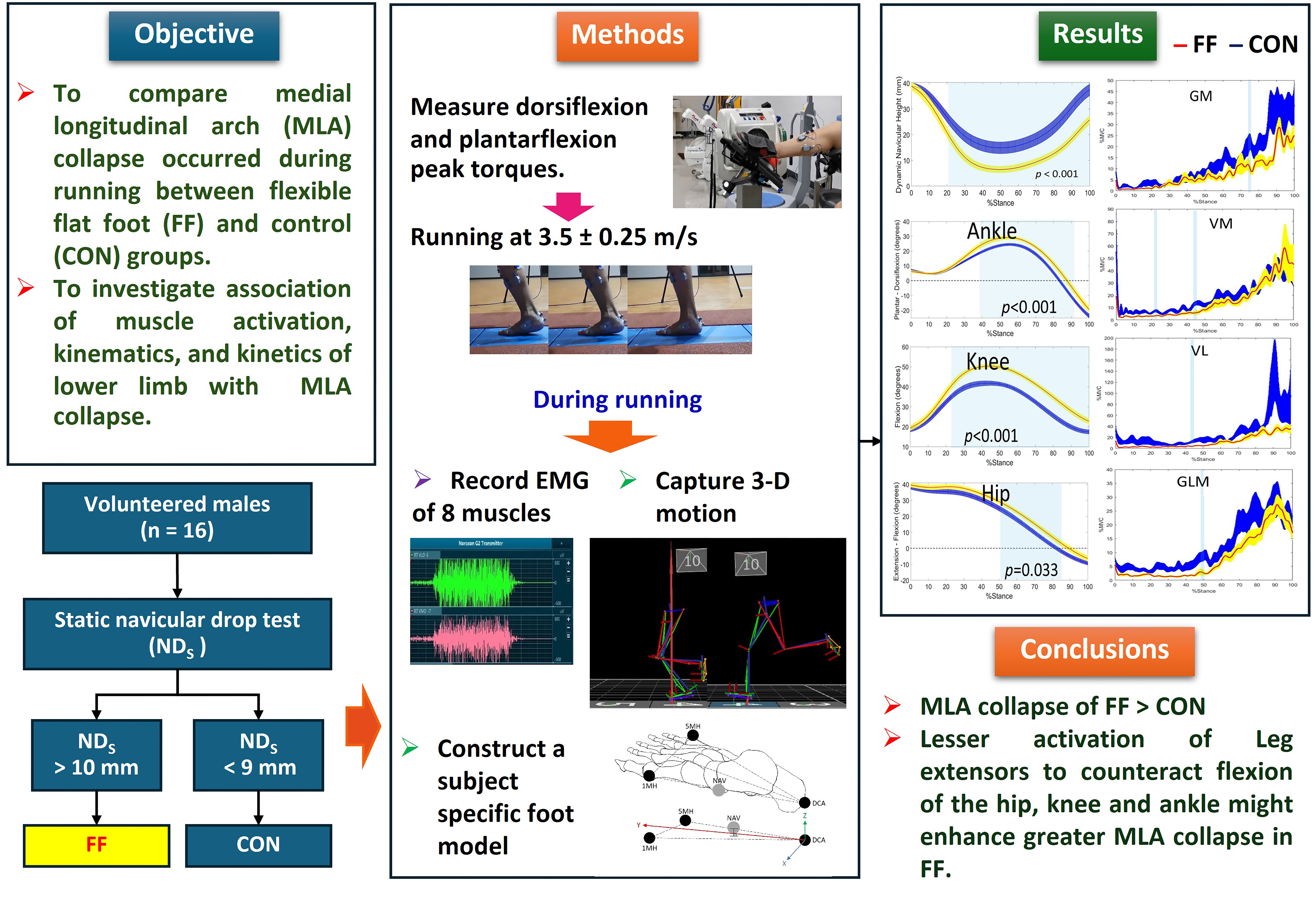
Objective: This cross-sectional study aimed to compare the dynamic MLA collapse during running between the flexible flatfoot and the normal foot individuals. It also sought to investigate whether the greater MLA collapse in the flexible flatfoot individuals was related to the alteration of kinematics, kinetics, and muscle activation.
Materials and methods: Sixteen-volunteered males participated in this study. Based on their static navicular drop test, they were assigned into either the flexible flatfoot or the control groups totally 8 participants in each group. They performed barefoot running at a speed of 3.5±0.25 m/s while the three-dimensional motion of the lower body, electromyography and ground reaction force were recorded synchronously. A subject-specific foot model was constructed from the additional reflective markers attached on their feet to determine the maximal dynamic navicular drop (ND Dmax) during the stance phase.
Results: The flexible flatfoot group had greater MLA collapse during midstance and propulsion which coincided with greater hip and knee flexions, and ankle dorsiflexion. The 95% CI of their NDDmax was in the ranges of 27.18 to 37.68 mm while that of the control group ranged between 20.71 mm and 27.82 mm. The flexible flatfoot group had lesser activations of the hip, knee, and ankle extensors to counteract the flexion moments. They also had larger ankle inversion (p=0.04) without greater activation of peroneus longus.
Conclusion: Greater MLA collapse in the flexible flatfoot individuals at midstance and propulsion was associated with greater hip and knee flexions, and ankle dorsiflexion. It might be the consequence of the lower activation of their leg extensors.
Article Details

This work is licensed under a Creative Commons Attribution-NonCommercial-NoDerivatives 4.0 International License.
Personal views expressed by the contributors in their articles are not necessarily those of the Journal of Associated Medical Sciences, Faculty of Associated Medical Sciences, Chiang Mai University.
References
Atik A, Ozyurek S. Flexible flatfoot. North Clin Istanb. 2014; 1(1): 57–64. doi: 10.14744/nci.2014.29292.
McPoil TG, Knecht HG. Biomechanics of the foot in walking: A function approach. J Orthop Sports Phys Ther. 1985; 7(2): 69–72. doi: 10.2519/jospt.1985.7.2.69.
Franco AH. Pes Cavus and Pes Planus: Analyses and treatment. Phys Ther. 1987; 67(5): 688–694. doi: 10.1093/ptj/67.5.688.
McKeon PO, Hertel J, Bramble D, Davis I. The foot core system: A new paradigm for understanding intrinsic foot muscle function. Br J Sports Med. 2015; 49(5): 290. doi: 10.1136/bjsports-2013-092690.
Fiolkowski P, Brunt D, Bishop M, Woo R, Horodyski M. Intrinsic pedal musculature support of the medial longitudinal arch: An electromyography study. J Foot Ankle Surg. 2003; 42(6): 327–333. doi: 10.1053/j.jfas.2003.10.003.
Headlee DL, Leonard JL, Hart JM, Ingersoll CD, Hertel J. Fatigue of the plantar intrinsic foot muscles increases navicular drop. J Electromyogr Kinesiol. 2008; 18(3): 420–425. doi: 10.1016/j.jelekin.2006.11.004.
Reinking MF. Exercise-related leg pain in female collegiate athletes: The influence of intrinsic and extrinsic factors. Am J Sports Med. 2006; 34(9): 1500–1507. doi: 10.1177/0363546506287298.
Wiegand K, Tandy R, Freedman Silvernail J. Plantar fasciitis injury status influences foot mechanics during running. Clin Biomech (Bristol). 2022; 97: 105712. doi: 10.1016/j.clinbiomech.2022.105712.
Zhang X, Aeles J, Vanwanseele B. Comparison of foot muscle morphology and foot kinematics between recreational runners with normal feet and with asymptomatic over-pronated feet. Gait Posture. 2017; 54: 290–294. doi: 10.1016/j.gaitpost.2017.03.030.
Okamura K, Hasegawa M, Ikeda T, Fukuda K, Egawa K, Kanai S. Classification of medial longitudinal arch kinematics during running and characteristics of foot muscle morphology in novice runners with pronated foot. Gait Posture. 2022; 93: 20–25. doi: 10.1016/j.gaitpost.2022.01.006.
Hollander K, Zech A, Rahlf AL, Orendurff MS, Stebbins J, Heidt C. The relationship between static and dynamic foot posture and running biomechanics: A systematic review and meta-analysis. Gait Posture. 2019; 72: 109–122. doi: 10.1016/j.gaitpost.2019.05.031.
Kruger KM, Graf A, Flanagan A, McHenry BD, Altiok H, Smith PA, et al. Segmental foot and ankle kinematic differences between rectus, planus, and cavus foot types. J Biomech. 2019; 94: 180–186. doi: 10.1016/j.jbiomech.2019.07.032.
Caravaggi P, Sforza C, Leardini A, Portinaro N, Panou A. Effect of plano-valgus foot posture on midfoot kinematics during barefoot walking in an adolescent population. J Foot Ankle Res. 2018; 11: 55. doi: 10.1186/s13047-018-0297-7.
Phan CB, Lee KM, Kwon SS, Koo S. Kinematic instability in the joints of flatfoot subjects during walking: A biplanar fluoroscopic study. J Biomech. 2021; 127: 110681. doi: 10.1016/j.jbiomech.2021.110681.
Powell DW, Williams DS 3rd, Windsor B, Butler RJ, Zhang S. Ankle work and dynamic joint stiffness in high-compared to low-arched athletes during a barefoot running task. Hum Mov Sci. 2014; 34: 147–156. doi: 10.1016/j.humov.2014.01.007.
Williams DS, McClay IS, Hamill J, Buchanan TS. Lower extremity kinematic and kinetic differences in runners with high and low arches. J Appl Biomech. 2001; 17(2): 153–163. doi: 10.1123/jab.17.2.153.
Tweed JL, Campbell JA, Avil SJ. Biomechanical risk factors in the development of medial tibial stress syndrome in distance runners. J Am Podiatr Med Assoc. 2008; 98(6): 436–444. doi: 10.7547/0980436.
Langley B, Cramp M, Morrison SC. Clinical measures of static foot posture do not agree. J Foot Ankle Res. 2016; 9: 45. doi: 10.1186/s13047-016-0180-3.
Faul F, Erdfelder E, Lang AG, Buchner A. G*Power 3: A flexible statistical power analysis program for the social, behavioral, and biomedical sciences. Behav Res Methods. 2007; 39(2): 175–191. doi: 10.3758/bf03193146.
Zuil-Escobar JC, Martínez-Cepa CB, Martín-Urrialde JA, Gómez-Conesa A. Evaluating the medial longitudinal arch of the foot: Correlations, reliability, and accuracy in people with a low arch. Phys Ther. 2019; 99(3): 364–372. doi: 10.1093/ptj/pzy149.
Hannigan-Downs K, Harter R, Smith G. Radiographic validation and reliability of selected clinical measures of pronation. J Athl Train. 2000; 35: S12.
Akiyama K, Noh B, Fukano M, Miyakawa S, Hirose N, Fukubayashi T. Analysis of the talocrural and subtalar joint motions in patients with medial tibial stress syndrome. J Foot Ankle Res. 2015; 8: 25. doi: 10.1186/s13047-015-0084-7.
Žukauskas S, Barauskas V, Čekanauskas E. Comparison of multiple flatfoot indicators in 5–8-year-old children. Open Med (Wars). 2021; 16(1): 246–256. doi: 10.1515/med-2021-0227.
Nielsen RG, Rathleff MS, Simonsen OH, Langberg H. Determination of normal values for navicular drop during walking: A new model correcting for foot length and gender. J Foot Ankle Res. 2009; 2: 12. doi: 10.1186/1757-1146-2-12.
Sacco IC, Gomes AA, Otuzi ME, Pripas D, Onodera AN. A method for better positioning bipolar electrodes for lower limb EMG recordings during dynamic contractions. J Neurosci Methods. 2009; 180(1): 133–137. doi: 10.1016/j.jneumeth.2009.02.017.
Harput G, Ulusoy B, Akmese R, Ergun N. Comparison of muscle activation levels and knee valgus between individuals with medial patellofemoral ligament reconstruction and healthy individuals during fatiguing stepdown task. Clin Biomech (Bristol). 2020; 78: 105067. doi:10.1016/j.clinbiomech.2020.105067.
Worrell TW, Karst G, Adamczyk D, Moore R, Stanley C, Steimel B, et al. Influence of joint position on electromyographic and torque generation during maximal voluntary isometric contractions of the hamstrings and gluteus maximus muscles. J Orthop Sports Phys Ther. 2001; 31(12): 730–40. doi:10.2519/jospt.2001.31.12.730.
Eichelberger P, Blasimann A, Lutz N, Krause F, Baur H. A minimal marker set for three-dimensional foot function assessment: measuring navicular drop and drift under dynamic conditions. J Foot Ankle Res. 2018; 11: 15. doi:10.1186/s13047-018-0257-2.
Lourenço TF, Nunes LAS, Martins LEB, Brenzikofer R, Macedo DV. The performance in 10 km races depends on blood buffering capacity. J Athl Enhanc. 2019; 8: 1. doi:10.4172/2324-9080.1000312.
Orendurff MS, Kobayashi T, Tulchin-Francis K, Tullock AMH, Villarosa C, Chan C, et al. A little bit faster: Lower extremity joint kinematics and kinetics as recreational runners achieve faster speeds. J Biomech. 2018; 71: 167–75. doi:10.1016/j.jbiomech.2018.02.010.
Tuominen J, Leppänen M, Jarske H, Pasanen K, Vasankari T, Parkkari J. Test-retest reliability of isokinetic ankle, knee and hip strength in physically active adults using Biodex System 4 Pro. Methods Protoc. 2023; 6(2): 26. doi:10.3390/mps6020026.
Serrien B, Goossens M, Baeyens JP. Statistical parametric mapping of biomechanical one-dimensional data with Bayesian inference. Int Biomech. 2019; 6(1): 9–18. doi:10.1080/23335432.2019.1597643.
Pohl J, Jaspers T, Ferraro M, Krause F, Baur H, Eichelberger P. The influence of gait and speed on the dynamic navicular drop – A cross-sectional study on healthy subjects. Foot (Edinb). 2018; 36: 67–73. doi:10.1016/j.foot.2018.04.001.
Shono H, Matsumoto Y, Kokubun T, Tsuruta A, Miyazawa T, Kobayashi A, et al. Determination of relationship between foot arch, hindfoot, and hallux motion using Oxford foot model: Comparison between walking and running. Gait Posture. 2022; 92: 96–102. doi:10.1016/j.gaitpost.2021.10.043.
Stolwijk NM, Koenraadt KL, Louwerens JW, Grim D, Duysens J, Keijsers NL. Foot lengthening and shortening during gait: a parameter to investigate foot function? Gait Posture. 2014; 39(2): 773–7. doi:10.1016/j.gaitpost.2013.10.014.
Caravaggi P, Pataky T, Günther M, Savage R, Crompton R. Dynamics of longitudinal arch support in relation to walking speed: contribution of the plantar aponeurosis. J Anat. 2010; 217(3): 254–61. doi:10.1111/j.1469-7580.2010.01261.x.
Murley GS, Menz HB, Landorf KB. Foot posture influences the electromyographic activity of selected lower limb muscles during gait. J Foot Ankle Res. 2009; 2: 35. doi:10.1186/1757-1146-2-35.
Williams DS 3rd, Davis IM, Scholz JP, Hamill J, Buchanan TS. High-arched runners exhibit increased leg stiffness compared to low-arched runners. Gait Posture. 2004; 19(3): 263–9. doi:10.1016/S0966-6362(03)00087-0.
Akl AR, Baca A, Richards J, Conceição F. Leg and lower limb dynamic joint stiffness during different walking speeds in healthy adults. Gait Posture. 2020; 82: 294–300. doi:10.1016/j.gaitpost.2020.09.023.
Caravaggi P, Rogati G, Leardini A, Ortolani M, Barbieri M, Spasiano C. Accuracy and correlation between skin-marker based and radiographic measurements of medial longitudinal arch deformation. J Biomech. 2021; 128: 110711. doi:10.1016/j.jbiomech.2021.110711.
