
The effects of computer-based cognitive training on attention and working memory in Thai older adults with mild cognitive impairment
Article Sidebar
Main Article Content
Abstract
Background: Mild cognitive impairment (MCI) is an intermediate state occurring between healthy aging and dementia among the elderly which result in cognitive, especially regarding attention and working memory. However, the declined state can be abated if training or stimulations are promptly promoted by a computerbased cognitive training program.
Objective: The aim of this study was to explore the effects of the Neofect Cognition as a computer-based cognitive training program on attention and working memory in Thai older adults with MCI.
Materials and methods: Twenty-three Thai older adults with MCI were divided into two groups; the experimental group (N=13) receiving the Neofect Cognition program for 6 executive weeks, 3 times per week, 45 minutes per session, and the control group (N=10) receiving education about MCI. Data was collected by assessing before and after participating in the program using the Trail Making Test (TMT) and the Memory subtest of the Thai Cognitive-Perceptual Test (Thai-CPT).
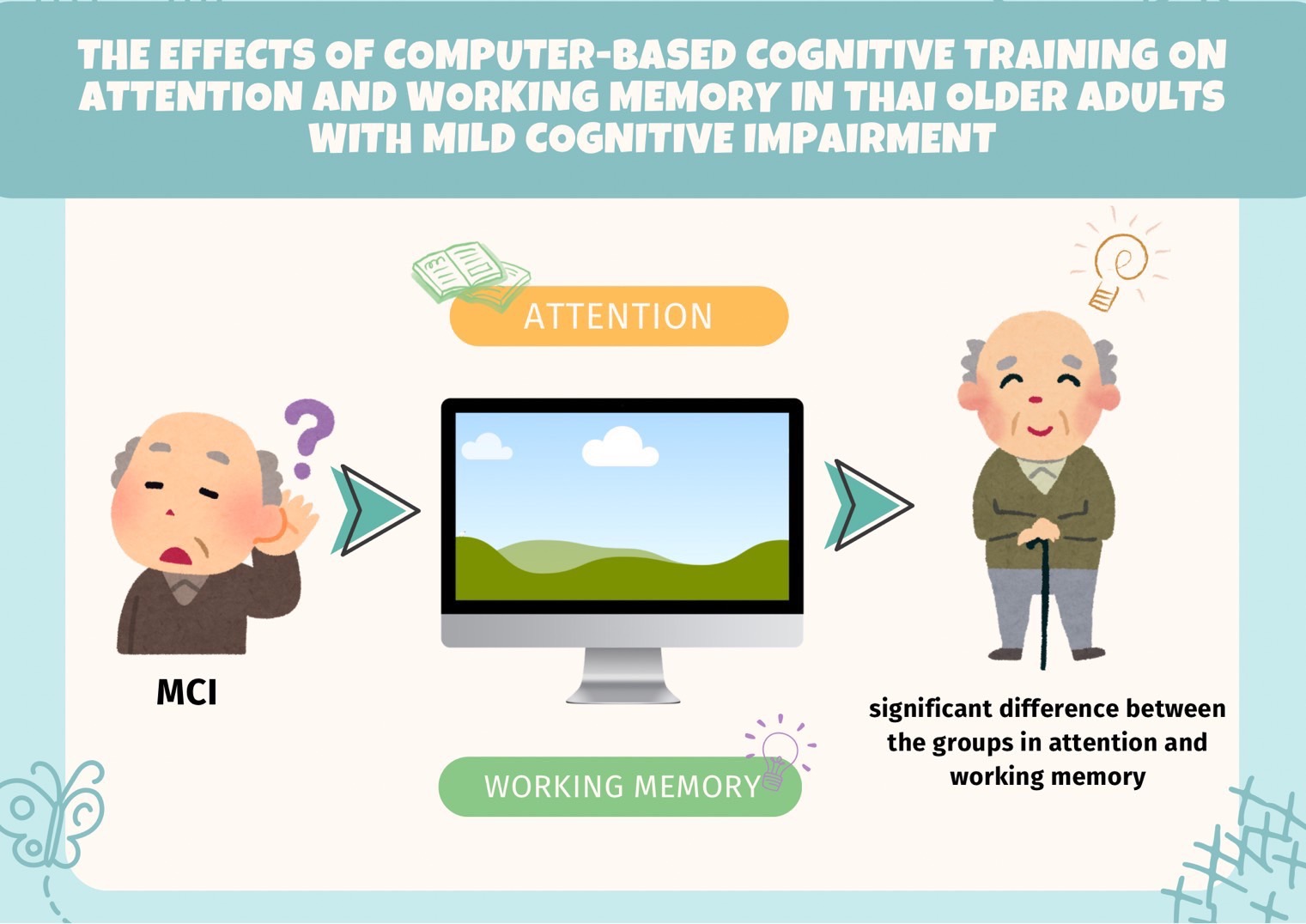
Results: The results showed that the experimental group had a statistically significant difference of attention (TMT-B) and working memory scores, while the control group had no statistically significant difference for both attention and working memory. Furthermore, there was a significant difference between the groups in attention (TMT-B) and working memory.
Conclusion: From the results, it can be stated that the computer-based training program (Neofect Cognition) might improve attention and working memory in Thai older adults with MCI.
Article Details

This work is licensed under a Creative Commons Attribution-NonCommercial-NoDerivatives 4.0 International License.
Personal views expressed by the contributors in their articles are not necessarily those of the Journal of Associated Medical Sciences, Faculty of Associated Medical Sciences, Chiang Mai University.
References
Petersen RC, Lopez O, Armstrong MJ, Getchius SD, Ganguli M, Gloss D, Gronseth SG, Marson D, Pringsheim T, Day GS, et al. Practice guideline update summary: Mild cognitive impairment. Neurology. 2018; 90: 126-35. doi: 10.1212/WNL.0000000000004826.
Panpalli AM, Yilmaz CF. Which factors can we control the transition from mild cognitive impairment to dementia?. J Clin Neurosci. 2020; 73: 108-10. doi: 10.1016/j.jocn.2020.01.015
Kurz A. Cognitive stimulation, training, and rehabilitation. Dialogues Clin Neurosci. 2019; 21: 35-41.
Alzheimer’s association. Mild cognitive impairment (MCI). 2020 [cited 2021 Jan 4]. Available from https:// www.alz.org/alzheimers-dementia/what-is-dementia/ related_conditions/mild-cognitive-impairment.
Peng Z, Jiang H, Wang X, Huang K, Zuo Y, Wu X, Abdullah AS, Yang L. The efficacy of cognitive training for elderly Chinese individuals with mild cognitive impairment. BioMed Res Int. 2019; 4347281. doi: 10.1155/2019/4347281.
Bai W, Chen P, Cai H, Zhang Q, Su Z, Cheung T, Jackson T, Sha S, Xiang, Y-T. Worldwide prevalence of mild cognitive impairment among community dwellers aged 50 years and older: a meta-analysis and systematic review of epidemiology studies. Age Ageing. 2022; 51: afac173. doi: 10.1093/ageing/afac173.
Song W-X, Wu W-W, Zhao Y-Y, Xu H-L, Chen G-C, Jin S-Y, Chen J, Xian S-X, Liang J-H. Evidence from a metaanalysis and systematic review reveals the global prevalence of mild cognitive impairment. Front Aging Neurosci. 2023; 15: 1227112. doi: 10.3389/fnagi.2023. 1227112.
Lu Y, Liu C, Yu D, Fawkes S, Ma J, Zhang M, Li C. Prevalence of mild cognitive impairment in communitydwelling Chinese populations aged over 55 years: a meta-analysis and systematic review. BMC Geriatr. 2021; 21: 10. doi: 10.1186/s12877-020-01948-3.
Griffiths J, Thaikruea L, Wongpakaran N, Munkhetvit P, Kittisares A, Varnado P. Effects of combined physical movement activity and multifaceted cognitive training in older people with mild neurocognitive disorder in a rural community: A randomized control trial. Dement Geriatr Cogn Disord. 2020; 49: 194-201. doi: 10.1159/000507922.
Yang H-L, Chu H, Kao C-C, Miao N-F, Chang P-C, Tseng P, O’Brien AP, Chou K-R. Construction and evaluation of multidomain attention training to improve alertness attention, sustained attention, and visual-spatial attention in older adults with mild cognitive impairment: A randomized controlled trial. Int J Geriatr Psychiatry. 2020; 35: 537-46. doi: 10.1002/gps.5269.
Shimada H, Doi T, Lee S, Makizako H. Reversible predictors of reversion from mild cognitive impairment to normal cognition: A 4-year longitudinal study. Alzheimers Res Ther. 2019; 11: 1-9. doi: 10.1186/ s13195-019-0480-5.
Zuschnegg J, Schoberer D, Häussl A, Herzog SA, Russegger S, Ploder K, Fellner M, HofmarcherHolzhacker MM, Roller-Wirnsberger R, Paletta L, et al. Effectiveness of computer-based interventions for community-dwelling people with cognitive decline: a systematic review with meta-analyses. BMC Geriatr. 2023; 23: 229. doi: 10.1186/s12877-023-03941-y.
Jean L, Bergeron M-E, Thivierge S, Simard M. Cognitive intervention programs for individuals with mild cognitive impairment: Systematic review of the literature. Am J Geriatr Psychiatr. 2010; 18: 281-96. doi: 10.1097/ JGP.0b013e3181c37ce9.
Rodakowski J, Saghafi E, Butters MA, Skidmore ER. Non-pharmacological interventions for adults with mild cognitive impairment and early-stage dementia: An updated scoping review. Mol Aspects Med. 2015; 38-53. doi: 10.1016/j.mam.2015.06.003.
Irazoki E, Contreras-Somoza LM, Toribio-Guzmán JM, Jenaro-Río C, van der Roest H, Franco-Martín MA. Technologies for cognitive training and cognitive rehabilitation for people with mild cognitive impairment and dementia. A Systematic Review. Front Psychol. 2020; 11: 648-8. doi: 10.3389/fpsyg.2020.00648.
Teixeira CVL, Gobbi LTB, Corazza DI, Stella F, Costa JLR, Gobbi S. Non-pharmacological interventions on cognitive functions in older people with mild cognitive impairment (MCI). Arch Gerontol Geriatr. 2012; 54: 175-80. doi: 10.1016/j.archger.2011.02.014.
Chandler MJ, Parks AC, Marsiske M, Rotblatt LJ, Smith GE. Everyday impact of cognitive interventions in mild cognitive impairment: A systematic review and meta-analysis. Neuropsychol Rev. 2016; 26: 225- 51. doi: 10.1007/s11065-016-9330-4.
Ge S, Zhu Z, Wu B, McConnell ES. Technology-based cognitive training and rehabilitation interventions for individuals with mild cognitive impairment: a systematic review. BMC geriatr. 2018; 18: 213. doi: 10.1186/s12877-018-0893-1
van der Steen JT, van Soest-Poortvilet MC, van der Wouden JC, Bruinsma MS, Scholten RJ, Vink AC.
Music-based therapeutic interventions for people with dementia. Cochrane Database Syst Rev. 2017; 5: Cd003477. doi: 10.1002/14651858.CD003477.pub3.
Zhang H, Huntley J, Bhome R, Holmes B, Cahill J, Gould RL, Wang H, Yu X, Howard R. Effect of computerised cognitive training on cognitive outcomes in mild cognitive impairment: A systematic review and meta-analysis. BMJ Open 2019; 9: e027062. doi: 10.1136/bmjopen-2018-027062.
Hill NT, Mowszowski L, Naismith SL, Chadwick VL, Valenzuela M, Lampit A. Computerized cognitive training in older adults with mild cognitive impairment or dementia: A Systematic Review and Meta-Analysis. Am J Psychiatry. 2017; 174: 329-40. doi: 10.1176/ appi. ajp.2016.16030360.
Al Mahmud A, Slikboer R, Stargatt J, Bhar S. Computerbased cognitive interventions for mild cognitive impairment and dementia in older adults: Protocol for a systematic review of published studies and meta- analysis. Syst Rev. 2019; 8: 231. doi: 10.1186/ s13643-019-1146-x
Gooding AL, Choi J, Fiszdon JM, Wilkins K, Kirwin PD, van Dyck CH, Devanand D, Bell MD, Mindt MR. Comparing three methods of computersed cognitive training for older adults with subclinical cognitive decline. Neuropsychol Rehab. 2016; 26: 810-21. doi: 10.1080/09602011.2015.1118389.
World Health Organization. Thailand’s leadership and innovations towards healthy ageing. 2023 [cited 2023 April 20]. Available from https://www.who.int/southeastasia/news/feature-stories/detail/thailandsleadership-and-innovation-towards-healthy-ageing.
Neofect. Computerized cognitive rehabilitation program. 2020 [cited 2021 January 18]. Available from https://www.neofect.com/us/cognition.
Shim J-M, Kim H-H, Lee Y-S. Effects of computerized neurocognitive function program induced memory and attention for patients with stroke. J Kor Phys Ther. 2007; 19: 25-32.
Kim Y-H, Yoo W-K, Ko M-H, Park C-H, Kim,] S-T, Na DL. Plasticity of the attentional network after brain injury and cognitive rehabilitation. Neurorehabil Neural Repair. 2009; 23: 468-477. doi: 10.1177/154 5968308328728.
Hwang J-H, Cha H-G, Cho Y-S, Kim T-S, Cho H-S. The effects of computer-assisted cognitive rehabilitation on alzheimer’s dementia patient’s memories. J PhysTher Sci. 2015; 27: 2921-3. doi: 10.1589/jpts.27.2921.
Kyung HL. Effects of a computerized cognitive training programs attention abilities and memory abilities of children with tendency of ADHD. J Emo Behavl Disord. 2012; 28: 91-108.
Chung H-S. The effect of computerized cognitive rehabilitation therapy (COMCOG) on children with high functioning autism spectrum disorder. J Neorocog Rehabil. 2018; 10: 43-50.
Kim S, Park E, Cha H, Jung J-C, Jung T-D, Chang Y. Effects of cognitive training in mild cognitive impairment measured by resting state functional imaging. Behav Sci. 2020; 10: 175. doi.org/10.3390/ bs10110175.
Laohaprasitiporn P, Jarusriwanna A, Unnanuntana A. Validity and reliability of the Thai version of the Barthel Index for elderly patients with femoral neck fracture. J Med Assoc Thai. 2017 [cited 2020 August 18]; 100: 539-48. Avilable from: http://www.med. nu.ac.th/dpmed/fileResearch/348_research_-.pdf
Boongird P. Mental State Examination T10. Dementia Association of Thailand Newsletter. 2018; 10.
Julayanont P, Tangwongchai S, Hemrungrojn S, Tunvirachaisakul C, Phanthumchinda K, Hongsawat J, Suwichanarakul P, Thamnasirorat S, Nasreddine ZS. The Montreal Cognitive Assessment-Basic: A screening tool for mild cognitive impairment in illiterate and low-educated elderly adults. J Am Geriatr Soc. 2015; 63: 2550-4. doi: 10.1111/jgs.13820.
Shiekh J, Yesavage J. Geriatric Depression Scale (GDS): Recent evidence and development of a shorter version. In Clinical Gerontology: A Guide to Assessment and Intervention; Brink, T., Ed.; The Haworth Press: Binghamton, NY, USA, 1986.
Wongpakaran N, Wongpakaran T. Prevalence of major depressive disorders and suicide in long-term care facilities: a report from northern Thailand. Psychogeriatrics 2012; 12: 11-7. doi: 10.1111/j.1479-8301. 2011.00383.x.
Bornstein R A, Baker GB, Douglass AB. Short-term retest reliability of the Halstead-Reitan battery in a normal sample. J Nerv Ment Dis. 1987; 175: 229-32. doi: 10.1097/00005053-198704000-00007.
Dikmen SS, Heaton RK, Grant I, Temkin NR. Test-retest reliability and practice effects of expanded HalsteadReitan neuropsychological test battery. J Int Neuropsychol Soc. 1999; 5: 346-56.
Peereya M. Manual of Thai Cognitive-PerceptionTest (Thai-CPT). Suthin Publishing: Chiangmai, 2010.
Finn M, McDonald S. Computerised cognitive training for older persons with mild cognitive impairment: A pilot study using a randomised controlled trial design. Brain impairment 2011; 12: 187-199.
Hu C, Wang L, Guo Y, Cao Z, Lu Y, Qin H. Study of the risk and preventive factors for progress of mild cognitive impairment to dementia. Amer J Alzheimers Dis Other Demen. 2020; 35: 1-7. doi: 10.1177/15333 17520925324.
Kim S, Park E, Cha H, Jung J-C, Jung T-D, Chang Y. Effects of cognitive training in mild cognitive impairment measured by resting state functional imaging. Behav Sci (Basel). 2020; 10: 175. doi: 10.3390/ bs10110175.
Nousia A, Martzoukou M, Siokas V, Aretouli E, Aloizou A-M, Folia V, Peristeri E, Messinis L, Nasios G, Dardiotis E. Beneficial effect of computer-based multidomain cognitive training in patients with mild cognitive impairment. Appl Neuropsychol Adult. 2021; 28: 717-26. doi: 10.1080/23279095.2019.1692842.
Aurtenetxe S, García-Pacios J, del Río D, López ME, Pineda-Pardo JA, Marcos A, Delgado Losada ML, López-Frutos JM, Maestú F. Interference Impacts Working Memory in Mild Cognitive Impairment. Front Neurosci. 2016; 10: 1-9. doi: 10.3389/fnins. 2016.00443.
Knopman DS, Petersen RC. Mild cognitive impairment and mild dementia: A clinical perspective. Mayo Clin Proc. 2014; 89: 1452-9. doi: 10.1016/j.mayocp. 2014.06.019.
