
Determining the optimal frequency and current intensity of microcurrent stimulation for postural sway induction: A pilot study
Article Sidebar
Main Article Content
Abstract
Background: Maintaining postural balance is crucial for various daily activities, and the vestibular system plays a significant role in this process. Dysfunction in the vestibular system can result in impaired postural control and balance. Microcurrent therapy, which uses lower current intensities than traditional electrical stimulation methods, may offer a less painful alternative for vestibular system training.
Objective: This pilot study aimed to investigate the effects of microcurrent stimulation on vestibular system training for posture control, with an emphasis on sway velocity and muscle activity, and to determine its optimal frequency and electric current intensity.
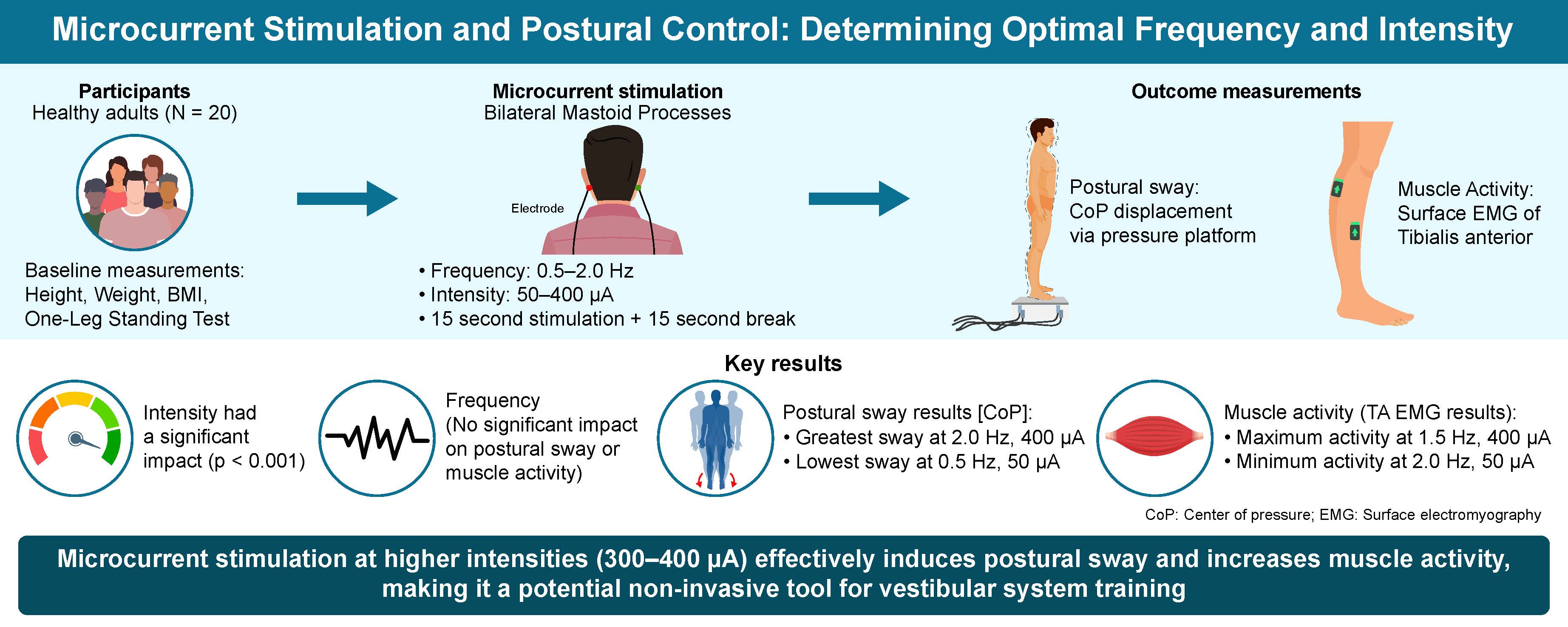
Materials and methods: Twenty healthy young adults (mean age, 22.35 years; 76.5% female; mean body mass index, 24.5±3.5 kg/m²) participated in this study. Surface electromyography (EMG) of the tibialis anterior muscle and postural sway were measured during microcurrent stimulation at varying frequencies (0.5 Hz to 2.0 Hz) and intensities (50 μA to 400 μA) on the bilateral mastoid processes of 15 seconds each. The center of pressure displacement was recorded using a pressure platform, and muscle activity was assessed through EMG data. Results: The results showed that frequency did not significantly affect postural sway or muscle activity, whereas intensity did. Muscle activity was greatest at 1.5 Hz and 400 μA, and postural sway was most pronounced at 2.0 Hz and 400 μA. No adverse reactions were reported during or after the stimulation sessions.
Conclusion: Microcurrent stimulation with optimal current and intensity may be a useful, non-invasive option for vestibular system training, particularly in populations where traditional electrical stimulation may cause discomfort. Further studies involving older adults and individuals with vestibular dysfunction are necessary to validate these findings.
Article Details

This work is licensed under a Creative Commons Attribution-NonCommercial-NoDerivatives 4.0 International License.
Personal views expressed by the contributors in their articles are not necessarily those of the Journal of Associated Medical Sciences, Faculty of Associated Medical Sciences, Chiang Mai University.
References
Alonso AC, Brech GC, Bourquin AM, Greve JM. The influence of lower-limb dominance on postural balance. Sao Paulo Med J. 2011; 129(6): 410-3. doi: 10.1590/s1516-31802011000600007.
Cherng RJ, Chen JJ, Su FC. Vestibular system in performance of standing balance of children and young adults under altered sensory conditions. Percept Mot Skills. 2001; 92(3 Pt 2): 1167-79. doi: 10.2466/pms.2001.92.3c.1167.
Grace Gaerlan M, Alpert PT, Cross C, Louis M, Kowalski S. Postural balance in young adults: the role of visual, vestibular and somatosensory systems. J Am Acad Nurse Pract. 2012; 24(6): 375-81. doi: 10.1111/j.1745-7599.2012.00699.x.
Inukai Y, Otsuru N, Masaki M, Saito K, Miyaguchi S, Kojima S, et al. Effect of noisy galvanic vestibular stimulation on center of pressure sway of static standing posture. Brain Stimul. 2018; 11(1): 85-93. doi: 10.1016/j.brs.2017.10.007.
Kuo AD. An optimal state estimation model of sensory integration in human postural balance. J Neural Eng. 2005; 2(3): S235-49. doi: 10.1088/1741-2560/2/3/S07.
Angelaki DE, Cullen KE. Vestibular system: the many facets of a multimodal sense. Annu Rev Neurosci. 2008; 31: 125-50. doi: 10.1146/annurev.neuro.31.060407.125555.
Welgampola MS, Ramsay E, Gleeson MJ, Day BL. Asymmetry of balance responses to monaural galvanic vestibular stimulation in subjects with vestibular schwannoma. Clin Neurophysiol. 2013; 124(9): 1835-9. doi: 10.1016/j.clinph.2013.03.015.
Morita H, Kaji H, Ueta Y, Abe C. Understanding vestibular-related physiological functions could provide clues on adapting to a new gravitational environment. J Physiol Sci. 2020; 70(1): 17. doi: 10.1186/s12576-020-00744-3.
Marchetti GF, Whitney SL, Redfern MS, Furman JM. Factors associated with balance confidence in older adults with health conditions affecting the balance and vestibular system. Arch Phys med Rehabil. 2011; 92(11): 1884-91. doi: 10.1016/j.apmr.2011.06.015.
Han BI, Song HS, Kim JS. Vestibular rehabilitation therapy: review of indications, mechanisms, and key exercises. J Clin Neurol. 2011; 7(4): 184-96. doi: 10.3988/jcn.2011.7.4.184.
Sharma KG, Gupta AK. Efficacy and comparison of vestibular rehabilitation exercises on quality of life in patients with vestibular disorders. Indian J Otolaryngol Head Neck Surg. 2020; 72(4): 474-9. doi: 10.1007/s12070-020-01920-y.
Kanekar N, Aruin AS. Improvement of anticipatory postural adjustments for balance control: effect of a single training session. J Electromyogr Kinesiol. 2015; 25(2): 400-5. doi: 10.1016/j.jelekin.2014.11.002.
Sutter K, Oostwoud Wijdenes L, van Beers RJ, Medendorp WP. Even well-practiced movements benefit from repetition. J Neurophysiol. 2022; 127(5): 1407-16. doi: 10.1152/jn.00003.2022.
Zemková E. Physiological mechanisms of exercise and its effects on postural sway: Does sport make a difference? Front Physiol. 2022; 13: 792875. doi: 10.3389/fphys.2022.792875.
Kolimechkov S, Seijo M, Swaine I, Thirkell J, Colado JC, Naclerio F. Physiological effects of microcurrent and its application for maximising acute responses and chronic adaptations to exercise. Eur J Appl Physiol. 2023; 123(3): 451-65. doi: 10.1007/s00421-022-05097-w.
Piras A, Zini L, Trofè A, Campa F, Raffi M. Effects of acute microcurrent electrical stimulation on muscle function and subsequent recovery strategy. Int J Environ Res Public Health. 2021; 18(9): 4597. doi: 10.3390/ijerph18094597.
Williams NP, Kushwah N, Dhawan V, Zheng XS, Cui XT. Effects of central nervous system electrical stimulation on non-neuronal cells. Front Neurosci. 2022; 16: 967491. doi: 10.3389/fnins.2022.967491.
Scinicariello AP, Eaton K, Inglis JT, Collins JJ. Enhancing human balance control with galvanic vestibular stimulation. Biol Cybern. 2001; 84(6): 475-80. doi: 10.1007/PL00007991.
Lee A-R, Yu M, Kim J-H, Kim D-W, Kim J-JJJoBER. A response to postural response to sine curve vestibular electric stimulation during standing. J Biomed Eng Res. 2010; 31(3): 210-6. doi: 10.9718/JBER.2010.31.3.210
Carvalho RL, Gomes MM, Franco LFdR, Abreu DCCd. Postural responses of galvanic vestibular stimulation: comparison between groups of older adults and young people. Revista Brasileira de Geriatria e Gerontologia. 2019; 22(05): e190091.
Choi H-J, Kim S-SJJoKMR. Efficacy of microcurrent electrical neuromuscular stimulation with different types of stimulating electrodes. J Korean Med Rehabil. 2013; 23(3): 107-16.
Mulavara AP, Fiedler MJ, Kofman IS, Wood SJ, Serrador JM, Peters B, et al. Improving balance function using vestibular stochastic resonance: optimizing stimulus characteristics. Exp Brain Res. 2011; 210(2): 303-12. doi: 10.1007/s00221-011-2633-z.
Yi D, Lim H, Yim J. Effect of microcurrent stimulation on pain, shoulder function, and grip strength in early post-operative phase after rotator cuff repair. Medicina (Kaunas). 2021; 57(5): 491. doi: 10.3390/medicina57050491.
Pires A, Silva TR, Torres MS, Diniz ML, Tavares MC, Gonçalves DU. Galvanic vestibular stimulation andits applications: a systematic review. Braz J Otorhinolaryngol. 2022; 88(Suppl 3): S202-S11. doi: 10.1016/j.bjorl.2022.05.010.
Khowailed IA, Lee HJIJoSM. Neuromuscular control of ankle-stabilizing muscles-specific effects of sex and menstrual cycle. Int J Sports Med. 2021; 42(3):270-276. doi: 10.1055/a-1236-3654.
Maharaj JN, Cresswell AG, Lichtwark GA. Tibialis anterior tendinous tissue plays a key role in energy absorption during human walking. J Exp Biol. 2019; 222(11): jeb191247. doi: 10.1242/jeb.191247.
Juul-Kristensen B, Fallentin N, Hansson G-Å, Madeleine P, Andersen J, Ekdahl CJIJoIE. Physical workload during manual and mechanical deboning of poultry. Int J Ind Ergon. 2002; 29(2): 107-15. doi: 10.1016/S0169-8141(01)00051-8.
Jonsson BJJohe. Measurement and evaluation of local muscular strain in the shoulder during constrained work. J Hum Ergol (Tokyo). 1982; 11(1): 73-88.
Ko S-H, Yoon B-C, Kim J-S, Min K-O. Effects of microcurrent and high voltage pulsed galvanic current stimulation on fibular fracture healing of the rabbits. J Korea Contents Assoc. 2011; 11(10): 286-92. doi: 10.5392/JKCA.2011.11.10.286
Chen H, Hu Z, Chai Y, Tao E, Chen K, Asakawa T. Galvanic vestibular stimulation with low intensity improves dynamic balance. Transl Neurosci. 2021; 12(1): 512-21. doi: 10.1515/tnsci-2020-0197.
Matsugi A, Oku K, Mori N. The effects of stochastic galvanic vestibular stimulation on body sway and muscle activity. Front Hum Neurosci. 2020; 14:591671. doi: 10.3389/fnhum.2020.591671.
Brandt T, Daroff RB. Physical therapy for benign paroxysmal positional vertigo. Arch Otolaryngol. 1980; 106(8): 484-5. doi: 10.1001/archotol.1980.00790320036009.
Hall CD, Herdman SJ, Whitney SL, Cass SP, Clendaniel RA, Fife TD, et al. Vestibular rehabilitation for peripheral vestibular hypofunction: an evidence-based clinical practice guideline: from the American Physical Therapy Association Neurology Section. J Neurol Phys Ther. 2016; 40(2): 124-55. doi: 10.1097/NPT.0000000000000120.
Kolimechkov S, Seijo M, Swaine I, Thirkell J, Colado JC, Naclerio F. Physiological effects of microcurrent and its application for maximising acute responses and chronic adaptations to exercise. Eur J Appl Physiol. 2023;123(3):451-465. doi: 10.1007/s00421-022-05097-w.
