
การใช้อัตราส่วนโมโนไซต์ต่อลิมโฟไซต์ก่อนการปลูกถ่ายเพื่อทำนายภาวะการทำงานล่าช้าในผู้ป่วยที่ได้รับการปลูกถ่ายไต
Article Sidebar
Main Article Content
บทคัดย่อ
บทนำ: ภาวะการทำงานล่าช้าของไตที่ปลูกถ่าย (delayed graft function) ส่งผลเสียต่อการอยู่รอดของไตในระยะยาว จากการศึกษาพบว่าตัวบ่งชี้การอักเสบและการตอบสนองของระบบภูมิคุ้มกันในผู้ป่วยที่ได้รับการปลูกถ่ายมีความสัมพันธ์กับผลลัพธ์ของไตที่ปลูกถ่าย อย่างไรก็ตามยังไม่เคยมีการศึกษาถึงความสัมพันธ์ระหว่างอัตราส่วนโมโนไซต์ต่อลิมโฟไซต์ (Monocyte-to-Lymphocyte Ratio: MLR) ก่อนการปลูกถ่ายไตของผู้ป่วยที่จะได้รับการปลูกถ่ายไต กับภาวะการทำงานล่าช้าของไตที่ได้รับการปลูกถ่าย
ระเบียบวิธีวิจัย: งานวิจัยนี้ได้รวบรวมผู้ป่วยจำนวน 162 รายที่ได้รับการปลูกถ่ายไประหว่างเดือนมกราคม พ.ศ. 2532 ถึงเดือนธันวาคม พ.ศ. 2566 ค่าตัดขอบของ MLR ก่อนการปลูกถ่ายที่เหมาะสมที่สุดในการทำนายภาวะการทำงานล่าช้าของไตได้รับการวิเคราะห์โดยวิธี Receiver Operating Characteristic นอกจากนี้ยังใช้การวิเคราะห์ถดถอยลอจิสติกแบบตัวแปรเดียวและและแบบพหุตัวแปรเพื่อระบุปัจจัยที่เกี่ยวข้องกับภาวะการทำงานล่าช้าของไตที่ปลูกถ่าย
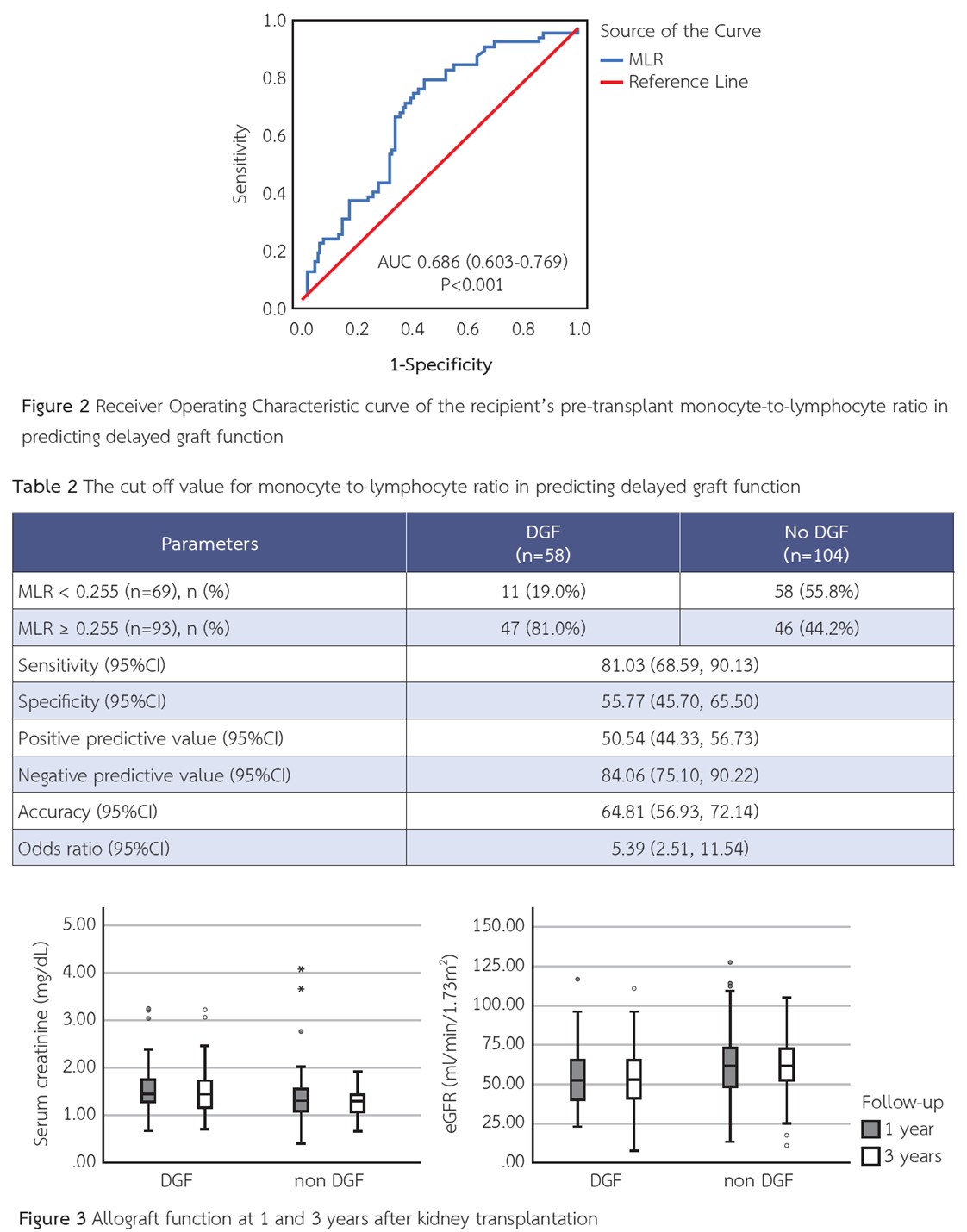
ผลการวิจัย: ภาวะการทำงานล่าช้าของไตที่ปลูกถ่ายเกิดขึ้นในผู้ป่วย 58 ราย (ร้อยละ 35.8) ค่าตัดขอบของ MLR ที่เหมาะสมที่สุดในการทำนายภาวะการทำงานล่าช้าของไตที่ได้รับการปลูกถ่าย คือ 0.255 (Area under the curve (95% confidence interval) = 0.686 (0.603–0.769), P < 0.001) โดยมีความไวที่ร้อยละ 81.0 และความจำเพาะที่ร้อยละ 55.8 ในการวิเคราะห์แบบพหุตัวแปรพบว่า MLR ≥ 0.255 มีความสัมพันธ์อย่างอิสระกับการเกิดภาวะการทำงานล่าช้าของไตที่ได้รับการปลูกถ่าย (Odds ratio (95% confidence interval) = 3.74 (1.55–9.02), P = 0.003). นอกจากนี้ค่า MLR ที่สูงขึ้นยังสัมพันธ์กับระยะเวลาการนอนโรงพยาบาลที่นานขึ้น
สรุป: ค่า MLR ก่อนการปลูกถ่ายที่เพิ่มขึ้นสามารถทำนายภาวะการทำงานล่าช้าของไตที่ได้รับการปลูกถ่าย ดังนั้น MLR อาจเป็นตัวบ่งชี้ทางชีวภาพที่มีประโยชน์ในการประเมินความเสี่ยงและการทำนายผลลัพธ์ของไตที่ได้รับการปลูกถ่าย
Article Details

อนุญาตภายใต้เงื่อนไข Creative Commons Attribution-NonCommercial-NoDerivatives 4.0 International License.
บทความนี้ตีพิมพ์ภายไต้การอนุญาต CC BY-NC-ND 4.0 ซึ่งอนุญาตให้สามารถใช้บทความนี้พื่อวัตถุประสงค์ใดๆ ก็ตามที่ไม่ใช่เชิงพาณิชย์ โดยต้องมีการอ้างถึงที่มาของบทความอย่างครบถ้วน ใครก็ตามสามารถคัดลอกและแจกจ่ายทุกส่วนของบทความนี้โดยไม่ต้องขออนุญาตจากผู้ประพันธ์หรือสมาคมโรคไตแห่งประเทศไทย
เอกสารอ้างอิง
Lubetzky M, Tantisattamo E, Molnar MZ, Lentine KL, Basu A, Parsons RF, et al. The failing kidney allograft: A review and recommendations for the care and management of a complex group of patients. Am J Transplant 2021;21(9):2937-49. doi: 10.1111/ajt.16717.
Gill JS, Rose C, Joffres Y, Landsberg D, Gill J. Variation in Dialysis Exposure Prior to Nonpreemptive Living Donor Kidney Transplantation in the United States and Its Association With Allograft Outcomes. Am J Kidney Dis 2018;71(5):636-47. doi: 10.1053/j.ajkd.2017.11.012.
Kiberd BA, Tennankore KK, Vinson AJ. Comparing the Net Benefits of Adult Deceased Donor Kidney Transplantation for a Patient on the Preemptive Waiting List vs a Patient Receiving Dialysis. JAMA Netw Open 2022;5(7):e2223325. doi: 10.1001/jamanetworkopen.2022.23325.
Port FK, Wolfe RA, Mauger EA, Berling DP, Jiang K. Comparison of survival probabilities for dialysis patients vs cadaveric renal transplant recipients. JAMA 1993;270(11):1339-43. doi: 10.1001/jama.1993.03510110079036.
Shoskes DA, Halloran PF. Delayed graft function in renal transplantation: etiology, management and long-term significance. J Urol 1996;155(6):1831-40. doi: 10.1016/s0022-5347(01)66023-3.
Miglinas M, Supranaviciene L, Mateikaite K, Skebas K, Kubiliene A. Delayed graft function: risk factors and the effects of early function and graft survival. Transplant Proc 2013;45(4):1363-7. doi: 10.1016/j.transproceed.2013.03.014.
Ponticelli C, Reggiani F, Moroni G. Delayed Graft Function in Kidney Transplant: Risk Factors, Consequences and Prevention Strategies. J Pers Med 2022;12(10). doi: 10.3390/jpm12101557.
Wu MY, Yiang GT, Liao WT, Tsai AP, Cheng YL, Cheng PW, et al. Current Mechanistic Concepts in Ischemia and Reperfusion Injury. Cell Physiol Biochem 2018;46(4):1650-67. doi: 10.1159/000489241.
Faucher Q, Alarcan H, Marquet P, Barin-Le Guellec C. Effects of Ischemia-Reperfusion on Tubular Cell Membrane Transporters and Consequences in Kidney Transplantation. J Clin Med 2020;9(8). doi: 10.3390/jcm9082610.
Kierans SJ, Taylor CT. Regulation of glycolysis by the hypoxia-inducible factor (HIF): implications for cellular physiology. J Physiol 2021;599(1):23-37. doi: 10.1113/JP280572.
Heldal TF, Asberg A, Ueland T, Reisaeter AV, Pischke SE, Mollnes TE, et al. Inflammation in the early phase after kidney transplantation is associated with increased long-term all-cause mortality. Am J Transplant 2022;22(8):2016-27. doi: 10.1111/ajt.17047.
de Vries LV, Minovic I, Franssen CFM, van Faassen M, Sanders JS, Berger SP, et al. The tryptophan/kynurenine pathway, systemic inflammation, and long-term outcome after kidney transplantation. Am J Physiol Renal Physiol 2017;313(2):F475-F86. doi: 10.1152/ajprenal.00690.2016.
Chen H, Li M, Liu L, Dang X, Zhu D, Tian G. Monocyte/lymphocyte ratio is related to the severity of coronary artery disease and clinical outcome in patients with non-ST-elevation myocardial infarction. Medicine (Baltimore) 2019;98(26):e16267. doi: 10.1097/MD.0000000000016267.
Shi L, Qin X, Wang H, Xia Y, Li Y, Chen X, et al. Elevated neutrophil-to-lymphocyte ratio and monocyte-to-lymphocyte ratio and decreased platelet-to-lymphocyte ratio are associated with poor prognosis in multiple myeloma. Oncotarget 2017;8(12):18792-801. doi: 10.18632/oncotarget.13320.
Hu RJ, Liu Q, Ma JY, Zhou J, Liu G. Preoperative lymphocyte-to-monocyte ratio predicts breast cancer outcome: A meta-analysis. Clin Chim Acta 2018;484:1-6. doi: 10.1016/j.cca.2018.05.031.
Ji H, Li Y, Fan Z, Zuo B, Jian X, Li L, et al. Monocyte/lymphocyte ratio predicts the severity of coronary artery disease: a syntax score assessment. BMC Cardiovasc Disord 2017;17(1):90. doi: 10.1186/s12872-017-0507-4.
Yang Y, Xu Y, Lu P, Zhou H, Yang M, Xiang L. The prognostic value of monocyte-to-lymphocyte ratio in peritoneal dialysis patients. Eur J Med Res 2023;28(1):152. doi: 10.1186/s40001-023-01073-y.
Pilichowska E, Ostrowski P, Sienko J. The Impact of Hematological Indices on the Occurrence of Delayed Graft Function (DGF) of Transplanted Kidney. J Clin Med 2023;12(24). doi: 10.3390/jcm12247514.
Siddiqui MA, Baskin E, Gülleroğlu KS, Çaltik Yilmaz A, Moray G, Haberal M. The Role of Platelet-Lymphocyte Ratio and Neutrophil-Lymphocyte Ratio in Predicting the Delayed Graft Function in Pediatric Renal Transplant Patients. Experimental and Clinical Transplantation 2022;20 (Suppl 3):118-21. doi: 10.6002/ect.PediatricSymp2022.O38.
Urbanowicz T, Michalak M, Olasin´ska-Wis´niewska A, Witkowska A, Rodzki M, Błaz˙ejowska E, et al. Monocyte-to-Lymphocyte Ratio as a Predictor of Worse Long-Term Survival after Off-Pump Surgical Revascularization-Initial Report. Medicina 2021;57(12). doi: 10.3390/medicina57121324.
