อุบัติการณ์และปัจจัยที่สัมพันธ์กับภาวะการสร้างเม็ดเลือดแดงมากขึ้นหลังการปลูกถ่ายไต
Article Sidebar
Main Article Content
บทคัดย่อ
บทนำ: ภาวะการสร้างเม็ดเลือดแดงมากขึ้นหลังการปลูกถ่ายไตสามารถ เพิ่มโอกาสการเกิดภาวะลิ่มเลือดอุดตัน อาจทำให้เกิดภาวะแทรกซ้อนและส่งผลต่ออัตราการอยู่รอดของผู้ป่วยที่ได้รับการปลูกถ่ายไต การศึกษานี้มีวัตถุประสงค์เพื่อศึกษาอุบัติการณ์ของภาวะการสร้างเม็ดเลือดแดงมากขึ้นหลังการปลูกถ่ายไต และปัจจัยที่มีความสัมพันธ์กับการเกิดโรค
ระเบียบวิธีวิจัย: การศึกษานี้เป็นการศึกษาย้อนหลังในผู้ป่วยที่ได้รับการปลูกถ่ายไต ระหว่างปี พ.ศ.2541 ถึงปี พ.ศ.2565 จำนวนทั้งสิ้น 286 ราย ภาวะการสร้างเม็ดเลือดแดงมากขึ้นหลังการปลูกถ่ายไต หมายถึงการมีระดับของฮีโมโกลบินสูงกว่า 17 กรัม ต่อเดซิลิตร และ/หรือ มีระดับฮีมาโทคริตสูงกว่าร้อยละ 51 หลังได้รับการปลูกถ่ายไต มีการวิเคราะห์ปัจจัยพื้นฐานที่สัมพันธ์กับการเกิดภาวะการสร้างเม็ดเลือดแดงมากขึ้นหลังการปลูกถ่ายไตด้วยวิธี Cox-proportional hazard regression model
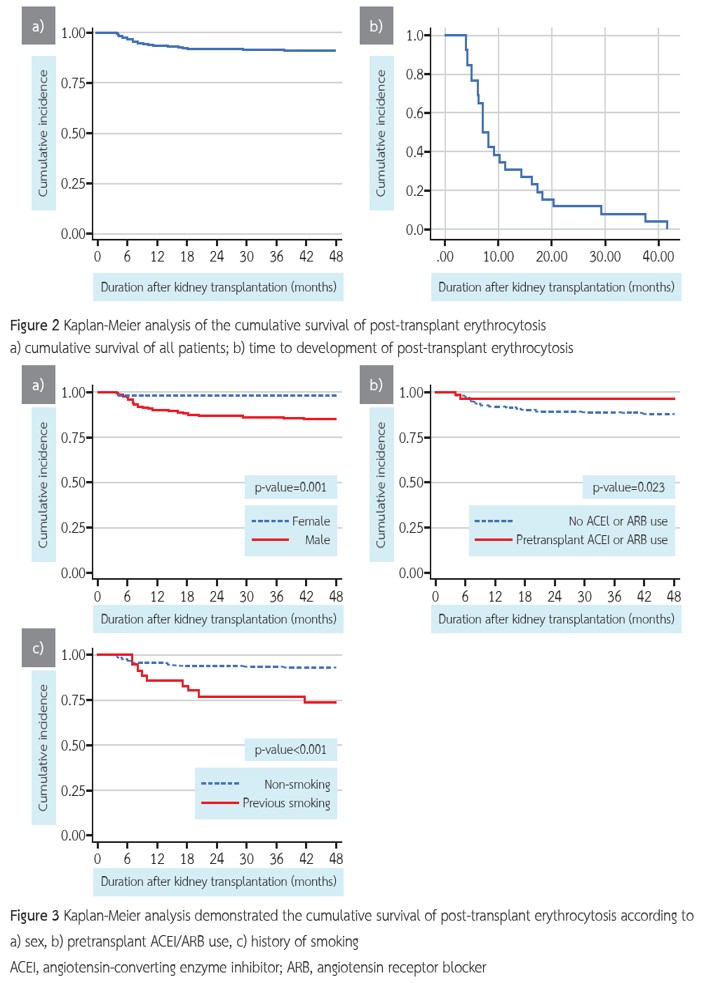
ผลการวิจัย: จากการศึกษาพบอุบัติการณ์ของการเกิดภาวะการสร้าง เม็ดเลือดแดงมากขึ้นหลังการปลูกถ่ายไตในผู้ป่วย 26 ราย (ร้อยละ 9.1) โดยมีระยะเวลาเกิดโรคที่ค่ามัธยฐาน 7.1 (4-41.6) เดือนหลังการปลูก ถ่ายไต ปัจจัยพื้นฐานที่พบว่ามีความสัมพันธ์ต่อการเกิดโรค ได้แก่ เพศชาย ประวัติการสูบบุหรี่ ค่าดัชนีมวลกายที่สูงขึ้น ระดับของฮีมาโทคริตก่อนการปลูกถ่ายไตที่สูง และ การไม่เคยได้รับยาในกลุ่ม renin- angiotensin-aldosterone system (RAAS) blockade การวิเคราะห์แบบพหุตัวแปรพบว่าปัจจัยที่มีความสัมพันธ์ต่อการเกิดภาวะนี้ คือ เพศชาย และค่าดัชนีมวลกายที่สูงขึ้น ผู้ป่วยส่วนใหญ่ตอบสนองต่อการรักษาด้วยยาในกลุ่ม RAAS blockade มีผู้ป่วยจำนวน 7 ราย (ร้อยละ 27) ที่อาการดีขึ้นเองโดยไม่ได้รับการรักษา และผู้ป่วยอีก 7 ราย (ร้อยละ 27) ที่ได้รับการเจาะเส้นเลือดดำเพื่อถ่ายเลือดออกจากร่างกาย (phlebotomy) มีผู้ป่วยจำนวน 3 ราย (ร้อยละ 11.5) ที่ได้รับการวินิจฉัยว่ามีภาวะหลอดเลือดแดงที่ไปเลี้ยงไตตีบ (transplant renal artery stenosis)
สรุป: พบอุบัติการณ์ของการเกิดภาวะการสร้างเม็ดเลือดแดงมากขึ้นหลังการปลูกถ่ายไตอยู่ที่ร้อยละ 9 และเกิดขึ้นประมาณ 7 เดือน หลังได้รับการปลูกถ่ายไต ปัจจัยพื้นฐานที่พบว่าสัมพันธ์กับการเกิดภาวะนี้ คือ เพศชาย และดัชนีมวลกายที่เพิ่มขึ้น ผู้ป่วยส่วนใหญ่ตอบสนองต่อการรักษาด้วยยาในกลุ่ม RAAS blockade และมีผู้ป่วยจำนวนหนึ่งในสี่ที่หายเองโดยไม่ต้องรักษา
Article Details

อนุญาตภายใต้เงื่อนไข Creative Commons Attribution-NonCommercial-NoDerivatives 4.0 International License.
บทความนี้ตีพิมพ์ภายไต้การอนุญาต CC BY-NC-ND 4.0 ซึ่งอนุญาตให้สามารถใช้บทความนี้พื่อวัตถุประสงค์ใดๆ ก็ตามที่ไม่ใช่เชิงพาณิชย์ โดยต้องมีการอ้างถึงที่มาของบทความอย่างครบถ้วน ใครก็ตามสามารถคัดลอกและแจกจ่ายทุกส่วนของบทความนี้โดยไม่ต้องขออนุญาตจากผู้ประพันธ์หรือสมาคมโรคไตแห่งประเทศไทย
เอกสารอ้างอิง
Kidney Disease: Improving Global Outcomes Transplant Work G. KDIGO clinical practice guideline for the care of kidney transplant recipients. Am J Transplant. 2009;9 Suppl 3(Suppl 3):S1-155.
Alzoubi B, Kharel A, Osman F, Aziz F, Garg N, Mohamed M, et al. Incidence, risk factors, and outcomes of post-transplant erythrocytosis after kidney transplantation. Clin Transplant. 2021;35(2):e14166.
Einollahi B, Lessan-Pezeshki M, Nafar M, Pour-Reza-Gholi F, Firouzan A, Farhangi F, et al. Erythrocytosis after renal transplantation: review of 101 cases. Transplant Proc. 2005;37(7):3101-2.
Kurella M, Butterly DW, Smith SR. Post transplant erythrocytosis in hypercalcemic renal transplant recipients. Am J Transplant. 2003;3(7):873-7.
Mekraksakit P, Boonpheng B, Leelaviwat N, Duangkham S, Deb A, Kewcharoen J, et al. Risk factors and outcomes of post-transplant erythrocytosis among adult kidney transplant recipients: a systematic review and meta-analysis. Transpl Int. 2021;34(11):2071-86.
Wickre CG, Norman DJ, Bennison A, Barry JM, Bennett WM. Postrenal transplant erythrocytosis: a review of 53 patients. Kidney Int. 1983;23(5):731-7.
Sadiq S, Manzoor A, Riaz W, Ashraf H, Attiq H. Prevalence of Erythrocytosis and Associated Clinical Manifestations in Renal Transplant Recipients. European Journal of Medical and Health Sciences. 2023;5(4):42-7.
Arivazhagan S, Rajasekar D, Dhanapriya J, Dineshkumar T, Sakthirajan R, Balasubramaniyan T, et al. Erythrocytosis in renal transplant recipients: A single-center experience. Indian Journal of Transplantation. 2018;12(3).
Kiberd BA. Post-transplant erythrocytosis: a disappearing phenomenon? Clin Transplant. 2009;23(6):800-6.
Alasfar S, Hall IE, Mansour SG, Jia Y, Thiessen-Philbrook HR, Weng FL, et al. Contemporary incidence and risk factors of post transplant Erythrocytosis in deceased donor kidney transplantation. BMC Nephrol. 2021;22(1):26.
Qunibi WY, Barri Y, Devol E, al-Furayh O, Sheth K, Taher S. Factors predictive of post-transplant erythrocytosis. Kidney Int. 1991;40(6):1153-9.
Abro SUA, Saleem Q, Begum A, Azhar S, Naseer A, Qureshi A. Association of BMI (Body Mass Index) to hemoglobin and red blood cell indices among adolescents. The Professional Medical Journal. 2020;27:2210-5.
