
การรักษาใหม่สำหรับ membranous nephropathy ชนิดปฐมภูมิ
Article Sidebar
Main Article Content
บทคัดย่อ
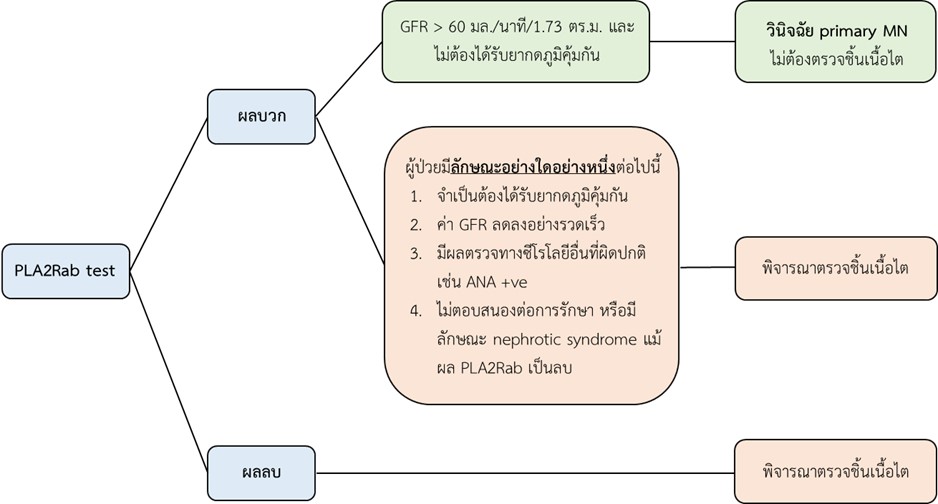
โรคไต membranous nephropathy (MN) แบบปฐมภูมิเป็นสาเหตุที่พบได้บ่อยของกลุ่มอาการเนฟโฟรติคในผู้ใหญ่มีอาการบวมแบบค่อยเป็นค่อยไป มีโปรตีนรั่วในปัสสาวะปริมาณมาก ส่วนใหญ่ไม่พบตะกอนเม็ดเลือดแดงในปัสสาวะ การทำงานของไตและความดันโลหิตปกติ มีอุบัติการณ์ร้อยละ 70-85 ของโรค MN ทั้งหมด สาเหตุเกิดจากความผิดปกติของระบบภูมิคุ้มกันโดยมีการสร้างสารภูมิคุ้มกันต่อแอนติเจนบนผนัง podocytes โดยหนึ่งในแอนติเจนที่เป็นตัวก่อโรคที่สำคัญของ MN ชนิดปฐมภูมิ คือ M-type phospholipase A2 receptor (PLA2R) พบได้ถึงร้อยละ 75-80 โดยพบความชุกของ PLA2R ต่อการเกิดโรคขึ้นกับแต่ละเชื้อชาติ ปัจจุบันมีการใช้แอนติบอดีต่อ PLA2R (PLA2R antibody) เพื่อการวินิจฉัยโรคและพยากรณ์โรคอย่างกว้างขวาง เนื่องจากมีความไวและความจำเพาะสูง หลักการรักษาของ MN ชนิดปฐมภูมิ คือการรักษาแบบประคับประคองและติดตามอาการ หากมีโปรตีนรั่วในปัสสาวะอย่างต่อเนื่องร่วมกับการทำงานของไตลดลงจึงจะพิจารณาการให้ยากดภูมิคุ้มกัน ซึ่งปัจจุบันมีการศึกษาที่แสดงประสิทธิภาพของยากลุ่มใหม่มากขึ้นโดยเฉพาะ rituximab ซึ่งออกฤทธิ์ควบคุมการทำงานของ B-cell แบบเจาะจง
Article Details

อนุญาตภายใต้เงื่อนไข Creative Commons Attribution-NonCommercial-NoDerivatives 4.0 International License.
บทความนี้ตีพิมพ์ภายไต้การอนุญาต CC BY-NC-ND 4.0 ซึ่งอนุญาตให้สามารถใช้บทความนี้พื่อวัตถุประสงค์ใดๆ ก็ตามที่ไม่ใช่เชิงพาณิชย์ โดยต้องมีการอ้างถึงที่มาของบทความอย่างครบถ้วน ใครก็ตามสามารถคัดลอกและแจกจ่ายทุกส่วนของบทความนี้โดยไม่ต้องขออนุญาตจากผู้ประพันธ์หรือสมาคมโรคไตแห่งประเทศไทย
เอกสารอ้างอิง
Parichatikanond P, Chawanasuntorapoj R, Shayakul C, Cheunsuchon B, Vasuvattakul S, Vareesangthip K, et al. An analysis of 3,555 cases of renal biopsy in Thailand. J Med Assoc Thai. 2006;89 suppl 2:106-11.
Chawanasuntorapoj R, Chuensuchon B, Kitiyakara C, Thai Glomerular Disease Collaborative Network. Improvement of Clinical Outcome in Kidney Diseases via On-line Thai Glomerular Disease Registry: 2nd Year. 2017.
Xu X, Wang G, Chen N, Lu T, Nie S, Xu G, et al. Long-Term Exposure to Air Pollution and Increased Risk of Membranous Nephropathy in China. J Am Soc Nephrol. 2016;27(12):3739-46.
Satirapoj B. Clinical features and renal pathology of glomerular disease in Phramongkutklao Hospital. Royal Thai Army Medical Journal. 2010;63(2):53-64.
Cattran DC, Brenchley PE. Membranous nephropathy: integrating basic science into improved clinical management. Kidney Int. 2017;91(3):566-74.
Ronco P, Debiec H. Pathogenesis of membranous nephropathy: recent advances and future challenges. Nat Rev Nephrol. 2012;8(4):203-13.
Du Y, Li J, He F, Lv Y, Liu W, Wu P, et al. The diagnosis accuracy of PLA2R-AB in the diagnosis of idiopathic membranous nephropathy: a meta-analysis. PLoS One. 2014;9(8):e104936.
Wiech T, Stahl RAK, Hoxha E. Diagnostic role of renal biopsy in PLA2R1-antibody-positive patients with nephrotic syndrome. Mod Pathol. 2019;32(9):1320-8.
Tampoia M, Migliucci F, Villani C, Abbracciavento L, Rossini M, Fumarulo R, et al. Definition of a new cut-off for the anti-phospholipase A2 receptor (PLA2R) autoantibody immunoassay in patients affected by idiopathic membranous nephropathy. J Nephrol. 2018;31(6):899-905.
KDIGO Glomerular Diseases Work Group. KDIGO 2021 Clinical Practice Guideline for the Management of Glomerular Diseases. Kidney Int 2021;100(4S):S128-39.
Tomas NM, Beck LH, Jr., Meyer-Schwesinger C, Seitz-Polski B, Ma H, Zahner G, et al. Thrombospondin type-1 domaincontaining 7A in idiopathic mem-branous nephropathy. N Engl J Med. 2014;371(24):2277-87.
Sethi S, Debiec H, Madden B, Charlesworth MC, Morelle J, Gross L, et al. Neural epidermal growth factor-like 1 protein (NELL-1) associated membranous nephropathy. Kidney Int. 2020;97(1):163-74.
Sethi S, Debiec H, Madden B, Vivarelli M, Charlesworth MC, Ravindran A, et al. Semaphorin 3B-associated membranous nephropathy is a distinct type of disease predominantly present in pediatric patients. Kidney Int. 2020;98(5):1253-64.
Seitz-Polski B, Debiec H, Rousseau A, Dahan K, Zaghrini C, Payre C, et al. Phospholipase A2 Receptor 1 Epitope Spreading at Baseline Predicts Reduced Likelihood of Remission of Membranous Nephropathy. J Am Soc Nephrol. 2018;29(2):401-8.
Pei Y, Cattran D, Greenwood C. Predicting chronic renal insufficiency in idiopathic membranous glomerulonephritis. Kidney Int. 1992;42(4):960-6.
Shiiki H, Saito T, Nishitani Y, Mitarai T, Yorioka N, Yoshimura A, et al. Prognosis and risk factors for idiopathic membranous nephropathy with nephrotic syndrome in Japan. Kidney Int. 2004;65(4):1400-7.
Ponticelli C, Zucchelli P, Imbasciati E, Cagnolo L, Pozzi C, Passerini P, et al. Controlled trial of methylprednisolone and chlorambucil in idiopathic membranous nephropathy. N Engl J Med. 1984;310:946-50.
Ponticelli C, Zucchelli P, Passerini P, Cesana B, Locatelli F, Pasquali S, et al. A 10-year follow-up of a randomized study with methylprednisolone and chlorambucil in membranous nephropathy. Kidney Int. 1995;48(5):1600-4.
Ponticelli C, Altieri P, Passerini P, Roccatello D, Cesana B, Melis P, et al. A randomized study comparing methylprednisolone plus chlorambucil versus methylprednisolone plus cyclophosphamide in idiopathic membranous nephropathy. J Am Soc Nephrol. 1998;9:444-50.
Branten AJ, Reichert LJ, Koene RA, Wetzels JF. Oral cyclophosphamide versus chlorambucil in the treatment of patients with membranous nephropathy and renal insufficiency. Q J Med. 1998;91:359-66.
Howman A, Chapman TL, Langdon MM, Ferguson C, Adu D, Feehally J, et al. Immunosuppression for progressive membranous nephropathy: a UK randomised controlled trial. Lancet. 2013;381(9868):744-51.
Chen M, Li H, L XY, Lu FM, Ni ZH, Xu FF, et al. Tacrolimus Combined With Corticosteroids in Treatmentof Nephrotic Idiopathic Membranous Nephropathy: A Multicenter Randomized Controlled Trial. Am J Med Sci. 2010;339(3):233–8.
Naumovic R, Jovanovic D, Pavlovic S, Stosovic M, Marinkovic J, Basta-Jovanovic G. Cyclosporine versus azathioprine therapy in high-risk idiopathic membranous nephropathy patients: A 3-year prospective study. Biomed Pharmacother. 2011;65(2):105-10.
Qiu TT, Zhang C, Zhao HW, Zhou JW. Calcineurin inhibitors versus cyclophosphamide for idiopathic membranous nephropathy: A systematic review and meta-analysis of 21 clinical trials. Autoimmun Rev. 2017;16(2):136-45.
Dahan K, Debiec H, Plaisier E, Cachanado M, Rousseau A, Wakselman L, et al. Rituximab for Severe Membranous Nephropathy: A 6-Month Trial with Extended Follow-Up. J Am Soc Nephrol. 2017;28(1):348-58.
Fervenza FC, Appel GB, Barbour SJ, Rovin BH, Lafayette RA, Aslam N, et al. Rituximab or Cyclosporine in the Treatment of Membranous Nephropathy. N Engl J Med. 2019;381(1):36-46.
Fernandez-Juarez G, Rojas-Rivera J, Logt AV, Justino J, Sevillano A, Caravaca-Fontan F, et al. The STARMEN trial indicates that alternating treatment with corticosteroids and cyclophosphamide is superior to sequential treatment with tacrolimus and rituximab in primary membranous nephropathy. Kidney Int. 2021;99(4):986-98.
Lindskog A, Ebefors K, Johansson ME, Stefansson B, Granqvist A, Arnadottir M, et al. Melanocortin 1 receptor agonists reduce proteinuria. J Am Soc Nephrol. 2010;21(8):1290-8.
Chan TM, Lin AW, Tang SC, Qian JQ, Lam MF, Ho YW, et al. Prospective controlled study on mycophenolate mofetil and prednisolone in the treatment of membranous nephropathy with nephrotic syndrome. Nephrology (Carlton). 2007;12(6):576-81.
Nikolopoulou A, Condon M, Turner-Stokes T, Cook HT, Duncan N, Galliford JW, et al. Mycophenolate mofetil and tacrolimus versus tacrolimus alone for the treatment of idiopathic membranous glomerulonephritis: a randomised controlled trial. BMCNephrol. 2019;20(1):352.
Sethi S, Kumar S, Lim K, Jordan SC. Obinutuzumab is Effective for the Treatment of Refractory Membranous Nephropathy. Kidney Int Rep. 2020;5(9):1515-8.
