
Effect of High‑Dose Oral Vitamin C on 24‑Hour Urinary Oxalate Excretion: A Systematic Review and Meta‑analysis of Intervention Trials
Article Sidebar
Main Article Content
Abstract
Background: High-dose oral vitamin C (≥ 1,000 mg/day) is widely consumed, yet its impact on 24-hour urinary oxalate—a primary driver of calcium oxalate supersaturation—remains a critical clinical concern, particularly for patients with nephrolithiasis. This study evaluated the effect of high-dose vitamin C on changes in 24-hour urinary oxalate concentration, with specific subgroup analyses comparing stone formers (SF) to non-stone formers (NSF).
Methods: We conducted a systematic review and random-effects meta-analysis of human intervention trials published between January 2000 and December 2025. Eligible studies included adults receiving oral vitamin C (≥1,000 mg/day) for >2 days, with documented 24-hour urinary oxalate measurements.
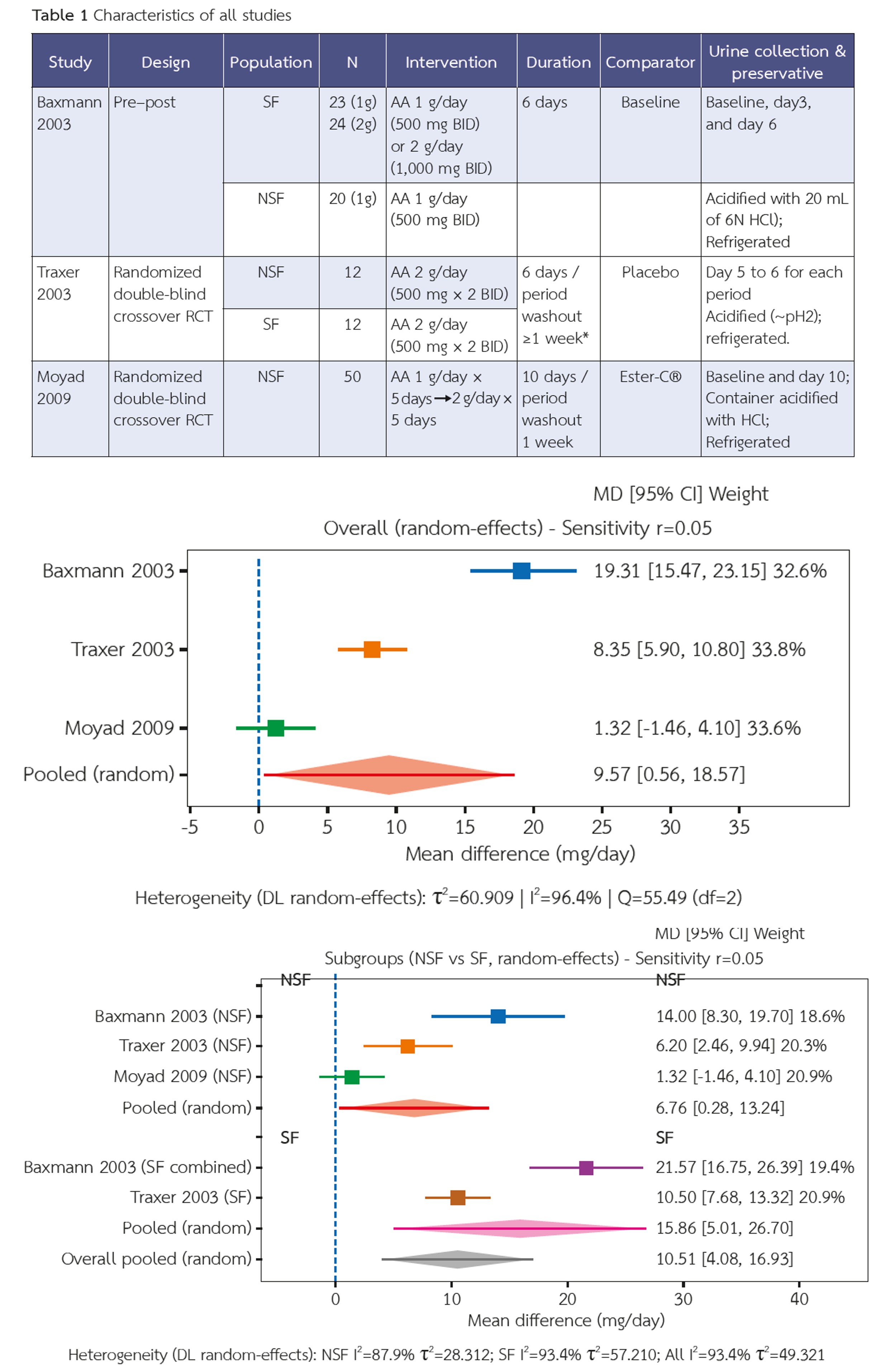
Results: Three short-term trials (n=141$; SF=59, NSF=82) were included. In the primary analysis (r=0.50), high-dose vitamin C significantly increased 24-hour urinary oxalate concentration by a pooled mean difference (MD) of 9.57 mg/day (95% CI: 0.56 to 18.57; I2=96.4 %). Subgroup analysis revealed a significantly larger increase in SF (MD 15.86 mg/day; 95% CI: 5.01 to 26.70) compared to NSF (MD 6.76 mg/day; 95% CI: 0.28 to 13.24; p < 0.001). While the magnitude of statistical significance for the overall and NSF effects was sensitive to the correlation coefficient, the direction of the effect remained consistently positive.
Conclusion: High-dose oral vitamin C is associated with increased 24-hour urinary oxalate excretion, with a more pronounced effect observed in the SF group. Given the high heterogeneity and the sensitivity of the results, supplementation in high-risk individuals should be managed with caution.
Article Details

This work is licensed under a Creative Commons Attribution-NonCommercial-NoDerivatives 4.0 International License.
This article is published under CC BY-NC-ND 4.0 license, which allows for non-commercial reuse of the published paper as long as the published paper is fully attributed. Anyone can share (copy and redistribute) the material in any medium or format without having to ask permission from the author or the Nephrology Society of Thailand.
References
Page MJ, McKenzie JE, Bossuyt PM, et al. The PRISMA 2020 statement: an updated guideline for reporting systematic reviews. BMJ. 2021;372:n71. doi:10.1136/bmj.n71.
Higgins JPT, Thomas J, Chandler J, et al., editors. Cochrane handbook for systematic reviews of interventions. 2nd ed. Chichester (UK): John Wiley & Sons; 2019. doi: 10.1002/9781119536604.
Chalmers AH, Cowley DM, McWhinney BC. Stability of ascorbate in urine: relevance to analyses for ascorbate and oxalate. Clin Chem. 1985 Oct;31(10):1703-5. doi:not available
Elbourne DR, Altman DG, Higgins JPT, Curtin F, Worthington HV, Vail A. Meta-analyses involving cross-over trials: methodological issues. Int J Epidemiol. 2002;31(1):140-149. doi:10.1093/ije/31.1.140.
Sterne JAC, Savović J, Page MJ, et al. RoB 2: a revised tool for assessing risk of bias in randomised trials. BMJ. 2019;366:l4898. doi:10.1136/bmj.l4898.
Sterne JAC, Hernán MA, Reeves BC, et al. ROBINS-I: a tool for assessing risk of bias in non-randomised studies of interventions. BMJ. 2016;355:i4919. doi:10.1136/bmj.i4919.
Guyatt GH, Oxman AD, Vist GE, et al. GRADE: an emerging consensus on rating quality of evidence and strength of recommendations. BMJ. 2008;336(7650):924-926. doi:10.1136/bmj.39489.470347.AD.
DerSimonian R, Laird N. Meta-analysis in clinical trials. Control Clin Trials. 1986;7(3):177-188. doi:10.1016/0197-2456(86)90046-2.
Higgins JPT, Thompson SG, Deeks JJ, Altman DG. Measuring inconsistency in meta-analyses. BMJ. 2003;327(7414):557-560. doi:10.1136/bmj.327.7414.557.
Baxmann AC, de O G Mendonça C, Heilberg IP. Effect of vitamin C supplements on urinary oxalate and pH in calcium stone-forming patients. Kidney Int. 2003;63(3):1066-1071. doi:10.1046/j.1523-1755.2003.00815.x.
Traxer O, Huet B, Poindexter J, Pak CYC, Pearle MS. Effect of ascorbic acid consumption on urinary stone risk factors. J Urol. 2003;170(2 Pt 1):397-401. doi:10.1097/01.ju.0000076001.21606.53.
Moyad MA, Combs MA, Crowley DC, Baisley JE, Sharma P, Vrablic AS, et al. Vitamin C with metabolites reduce oxalate levels compared to ascorbic acid: a preliminary and novel clinical urologic finding. Urol Nurs. 2009;29(2):95-102. doi: not available.
Tiselius HG. Aspects on estimation of the risk of calcium oxalate crystallization in urine. Urol Int. 1991;47(4):255-259. doi:10.1159/000282232.
Pearle MS, Goldfarb DS, Assimos DG, et al. Medical management of kidney stones: AUA guideline. J Urol. 2014;192(2):316-324. doi:10.1016/j.juro.2014.05.006.
