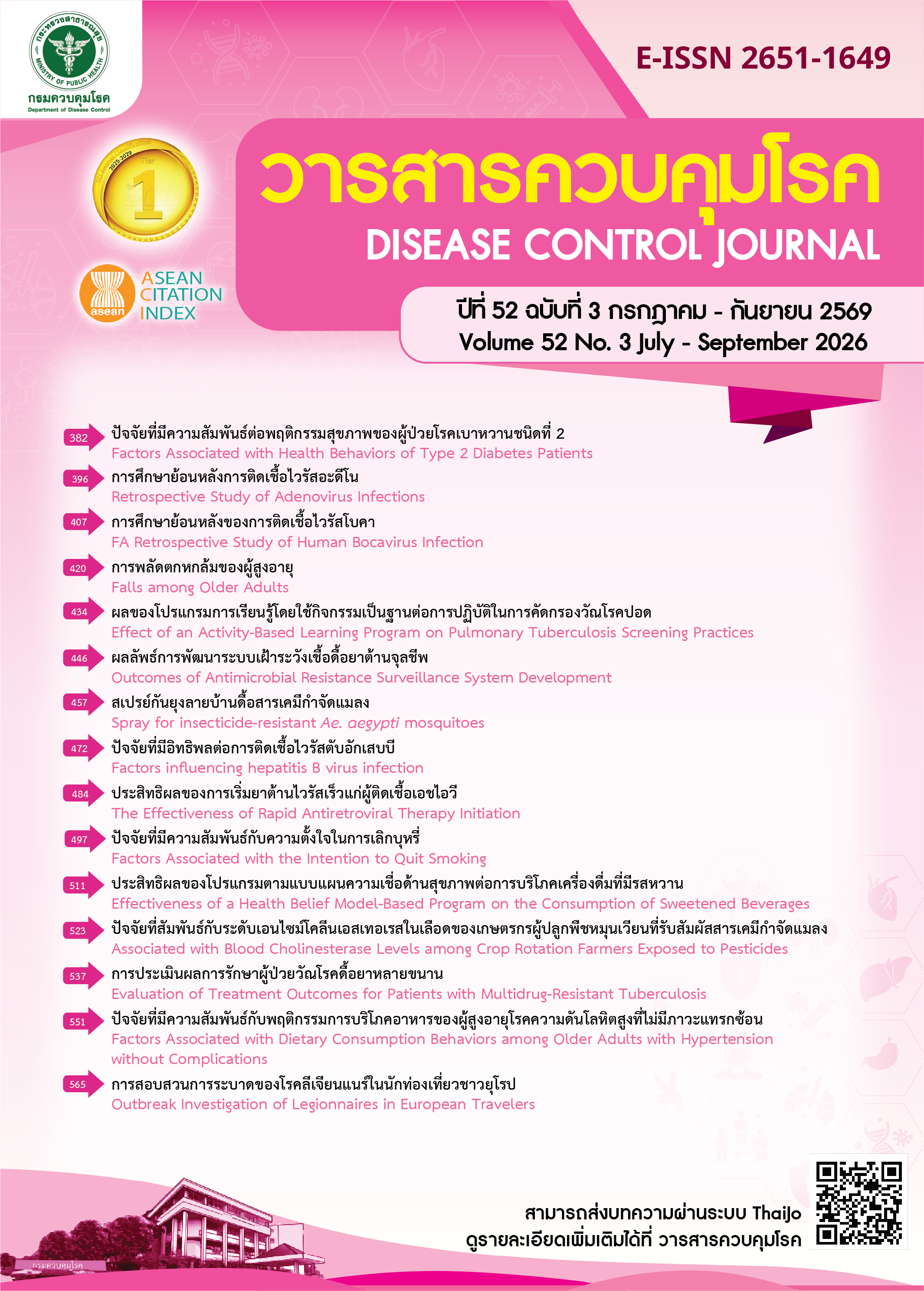
การสอบสวนการระบาดของโรคลีเจียนแนร์ในนักท่องเที่ยวชาวยุโรป ณ โรงแรมแห่งหนึ่ง ตำบลตลาดใหญ่ อำเภอเมือง จังหวัดภูเก็ต ระหว่างวันที่ 3-4 มีนาคม 2568
DOI:
https://doi.org/10.14456/dcj.2026.45คำสำคัญ:
เชื้อลิจิโอเนลลา, โรคลีเจียนแนร์, นักท่องเที่ยว, โรงแรม, การสอบสวนโรค, จังหวัดภูเก็ตบทคัดย่อ
วันที่ 28 กุมภาพันธ์ 2568 เวลา 15:26 น. สำนักงานป้องกันควบคุมโรคที่ 11 จังหวัดนครศรีธรรมราช (สคร.11 นศ.) ได้รับรายงานนักท่องเที่ยว 3 ราย ป่วยด้วยโรคลีเจียนแนร์ (Legionnaires' Disease) หลังเข้าพักที่โรงแรมแห่งหนึ่งในจังหวัดภูเก็ต ทีมสอบสวนโรคลงพื้นที่เมื่อวันที่ 3-4 มีนาคม 2568 เพื่อค้นหาแหล่งโรค สาเหตุการระบาดของโรค และยืนยันการระบาดของโรค ค้นหาผู้ป่วยเพิ่มเติม ประเมินมาตรการการควบคุมโรคและเสนอแนวทางในการควบคุมและป้องกันโรค โดยมีข้อค้นพบสำคัญ ได้แก่ 1. ผลตรวจทางห้องปฏิบัติการ : พบเชื้อ Legionella spp. จาก 3 ใน 14 ตัวอย่าง (22%) ในหอผึ่งเย็นและฝักบัวสระว่ายน้ำ 2. ระบบคลอรีน : พบคลอรีนคงเหลือต่ำกว่ามาตรฐาน 40% ของจุดตรวจ เนื่องจากถังเติมคลอรีนบนดาดฟ้าโดนแสงแดดจัด
ทำให้สารสลายตัว 3. ระบบน้ำร้อน : อุณหภูมิลดต่ำลงในช่วงที่มีการใช้งานสูง จนอยู่ในระดับที่เชื้อเจริญเติบโตได้ จึงสรุปได้ว่านักท่องเที่ยวมีโอกาสติดเชื้อจากโรงแรมจริง เนื่องจากระยะฟักตัวสอดคล้องกับการเข้าพัก และระบบฆ่าเชื้อมีข้อบกพร่อง ทีมงานสอบสวนโรคจึงเสนอให้โรงแรมปรับปรุงจุดเติมคลอรีน ควบคุมอุณหภูมิน้ำให้คงที่ใช้เครื่องมือในการตรวจวัดที่ถูกต้อง และเหมาะสม และบันทึกข้อมูลการตรวจสอบอย่างเคร่งครัด
Downloads
เอกสารอ้างอิง
European Centre for Disease Prevention and Control. Technical document: European Legionnaires’ Disease Surveillance Network (ELDSNet) [Internet]. 2017 [cited 2025 Jun 13]. Available from: http://www.ecdc.europa.eu/sites/default/files/documents/ELDSNET_2017-revised_guidelines_2017-web_0.pdf
Buathong R, Prasarnthong R. The Guidelines for Environmental Investigation of Travel-associated Legionnaires’ Disease. Weekly Epidemiological Surveillance Report [Internet]. 2008 [cited 2025 Jun 13];38(52):918-21. Available from: https://drive.google.com/file/d/1rridGustOCDAlrctjnZFJoiwtrPhZWTT/view (in Thai)
Pierre DM, Baron J, Yu VL, Stout JE. Diagnostic testing for legionnaires’ disease. Ann Clin Microbiol Antimicrob. 2017;16:59. doi: 10.1186/s12941-017-0229-6
Viasus D, Gaia V, Manzur-Barbur C, Carratalà J. Legionnaires' Disease: Update on Diagnosis and Treatment. Infect Dis Ther. 2022;11(3) :973-986. doi: 10.1007/s40121-022-00635-7.
Wong AY, Johnsson AT, Iversen A, Athlin S, Özenci V. Evaluation of four lateral flow assays for the detection of legionella urinary antigen. Microorganisms. 2021;9(3):493. doi: 10.3390/microorganisms9030493.
Ito A, Yamamoto Y, Ishii Y, Okazaki A, Ishiura Y, Kawagishi Y, et al.. Evaluation of a novel urinary antigen test kit for diagnosing legionella pneumonia. International Journal of Infectious Diseases. 2021;103:42-7. doi: 10.1016/j.ijid.2020.10.106.
Shimada T, Noguchi Y, Jackson JL, Miyashita J, Hayashino Y, Kamiya T, et al. Systematic review and meta analysis: urinary antigen tests for Legionellosis. Chest. 2009;136(6):1576-85. doi: 10.1378/chest.08-2602.
Lindsay DS, Abraham WH, Findlay W, Christie P, Johnston F, Edwards GF. Laboratory diagnosis of legionnaires’ disease due to Legionella pneumophila serogroup 1: comparison of phenotypic and genotypic methods. J Med Microbiol. 2004;53(3):183-7. doi: 10.1099/jmm.0.05464-0.
Erdoğan H. Legionnaires' disease. Mediterranean Journal of Infection Microbes and Antimicrobials. 2018;7:2. doi: 10.4274/mjima.2018.2. (in Turkey)
Techasuwanna R. Legionnaires’ diseases in travelers: Environmental outbreak investigation in the hotel located in Bangkok, January 2023. Weekly Epidemiological Surveillance Report [Internet]. 2023 [cited 2025 Mar 4];54(1):305-12. Available from: https://he05.tci-thaijo.org/index.php/WESR/article/view/214/191 (in Thai)
Chinda A., Balburi P., Phopluk W., Nuansri R., Chaturabandit N., Kanthanon O., et al. An Environmental Investigation at a Hotel in a Responded from European Notification of Cluster of Legionnaires’ Disease among Danish Travelers, Takuapa, Phang-nga Province, June 2008. Weekly Epidemiological Surveillance Report [Internet]. 2008 [cited 2025 Mar 4];39(37):653-57. Available from: https://he05.tci-thaijo.org/index.php/WESR/article/view/2415/2233 (in Thai)
Anont K, Buathong R, Bohna N, Lusida P, Promchaisri N, Chaturabantit N, et al. An Environmental Investigation of Legionnaires’ Disease among EU Travelers, Khuk Khak, Takuapa, Phangnga, Thailand, 2nd-5th June 2015. Weekly Epidemiological Surveillance Report [Internet]. 2015 [cited 2025 Mar 4];46:721-7. Available from: https://he05.tci-thaijo.org/index.php/WESR/article/view/1922/1785. (in Thai)
Ministry of Public Health (TH), Department of Health. Notification of the Department of Health on the act to control Legionella in the cooling system [Internet]. 2006 [cited 2024 Feb 29]. Available from: https://www.opsmoac.go.th/nongkhai-dwl-files-411391791908 (in Thai)
Suksai N., Niyomtoon I., Lawrence Sasitron, Porntaveewat Wimolsiri, Chaiyanun Saipin. Increasing Efficiency of Legionnaires’ Disease Surveillance System in a Selected Hotel of Khlongtoey Bangkok. Journal of Energy and Environment Technology [Internet]. 2020 [cited 2025 Mar 4];7(2):40-50. Available from: https://ph01.tci-thaijo.org/index.php/JEET/article/view/242483/165788 (in Thai)
ดาวน์โหลด
เผยแพร่แล้ว
รูปแบบการอ้างอิง
ฉบับ
ประเภทบทความ
สัญญาอนุญาต
ลิขสิทธิ์ (c) 2026 วารสารควบคุมโรค

อนุญาตภายใต้เงื่อนไข Creative Commons Attribution-NonCommercial-NoDerivatives 4.0 International License.
บทความที่ลงพิมพ์ในวารสารควบคุมโรค ถือว่าเป็นผลงานทางวิชาการหรือการวิจัย และวิเคราะห์ตลอดจนเป็นความเห็นส่วนตัวของผู้เขียน ไม่ใช่ความเห็นของกรมควบคุมโรค ประเทศไทย หรือกองบรรณาธิการแต่ประการใด ผู้เขียนจำต้องรับผิดชอบต่อบทความของตน