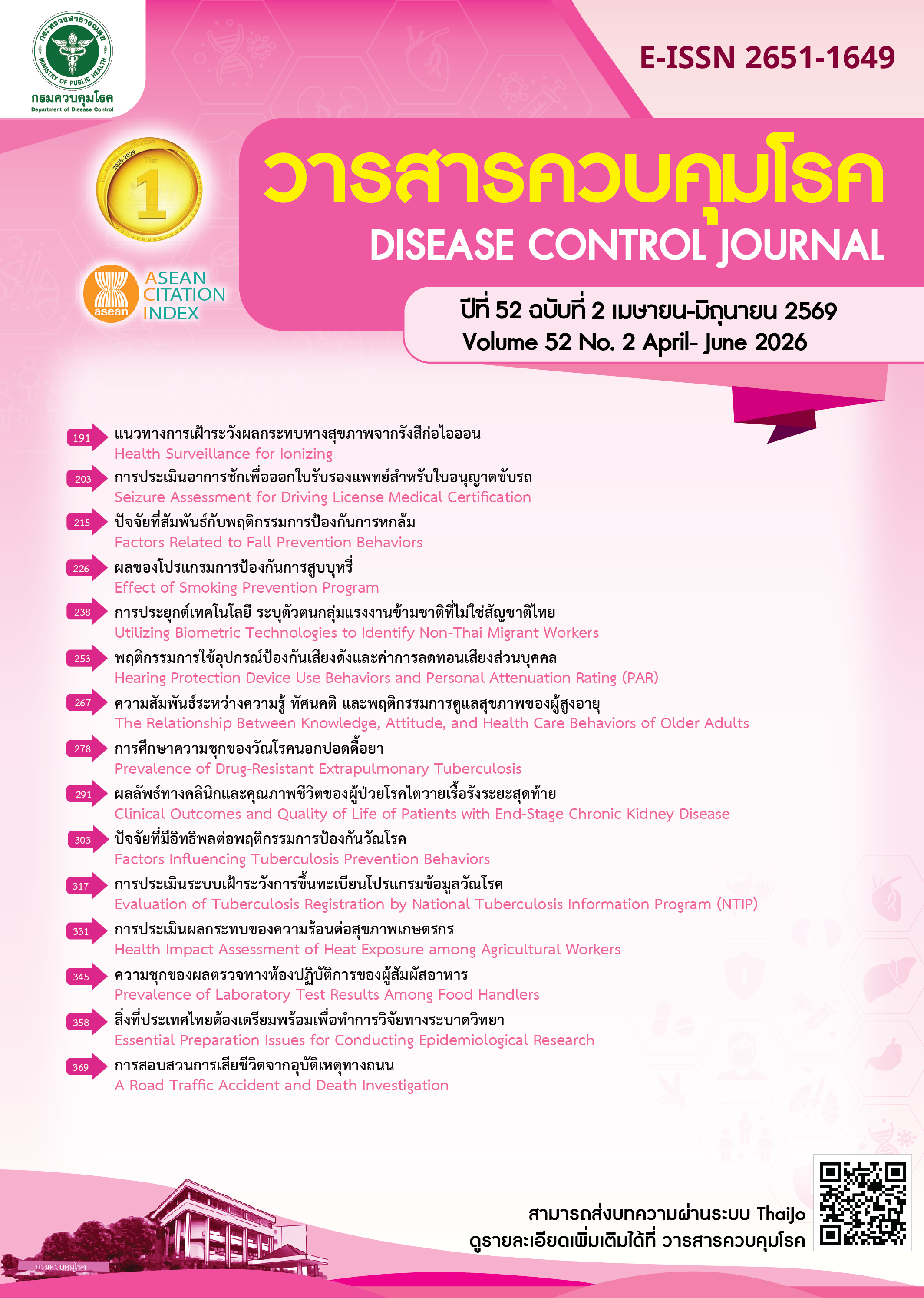
ผลลัพธ์ทางคลินิกและคุณภาพชีวิตของผู้ป่วยโรคไตวายเรื้อรังระยะสุดท้ายภายหลังการวางแผนการดูแลล่วงหน้าในชุมชน
DOI:
https://doi.org/10.14456/dcj.2026.24คำสำคัญ:
การวางแผนการดูแลล่วงหน้า, ผู้ป่วยโรคไตเรื้อรังระยะสุดท้าย, การดูแลแบบประคับประคอง, คุณภาพชีวิตบทคัดย่อ
การวิจัยเชิงปฏิบัติการแบบมีส่วนร่วมนี้มีวัตถุประสงค์เพื่อ 1) ศึกษาสถานการณ์และปัญหาการดูแลผู้ป่วยโรคไตวายเรื้อรังระยะสุดท้ายในชุมชน 2) พัฒนากระบวนการวางแผนการดูแลล่วงหน้าที่เหมาะสมกับบริบทพื้นที่ และ 3) ประเมินผลลัพธ์ของรูปแบบต่อผลลัพธ์ทางคลินิก คุณภาพชีวิต และการตัดสินใจเลือกแนวทางการรักษา กลุ่มตัวอย่างเป็นผู้ป่วยจำนวน 20 ราย เก็บข้อมูลระหว่างเดือนมกราคมถึงเมษายน พ.ศ. 2568 เครื่องมือวิจัยประกอบด้วยแบบสอบถามข้อมูลทั่วไป แบบประเมินคุณภาพชีวิต และแบบบันทึกผลลัพธ์ทางคลินิก วิเคราะห์ข้อมูลเชิงปริมาณด้วยสถิติพรรณนา และเปรียบเทียบค่าเฉลี่ยก่อน–หลังด้วยสถิติ Paired t-test ขณะที่ข้อมูลเชิงคุณภาพวิเคราะห์ด้วยวิธี Content Analysis ผลการศึกษาพบว่า ระบบการดูแลผู้ป่วยยังมีข้อจำกัดด้านโครงสร้างบริการ ทรัพยากร และการสื่อสารในทีมสหวิชาชีพ ภายหลังการพัฒนากระบวนการวางแผนการดูแลล่วงหน้า ผู้ป่วยมีความชัดเจนในการตัดสินใจเลือกแนวทางการรักษามากขึ้น โดยสัดส่วนผู้ป่วยที่เลือกการดูแลแบบประคับประคองเพิ่มขึ้นจากร้อยละ 30.0 เป็นร้อยละ 56.7 ขณะที่การเลือกการบำบัดทดแทนไตลดลงจากร้อยละ 70.0 เป็นร้อยละ 43.3 ด้านผลลัพธ์ทางคลินิก พบว่าความดันโลหิตตัวบนและตัวล่างลดลงอย่างมีนัยสำคัญทางสถิติ (p=0.010 และ 0.019 ตามลำดับ) ระดับโพแทสเซียมลดลง และค่า Hematocrit เพิ่มขึ้นอย่างมีนัยสำคัญ (p=0.005 และ 0.001 ตามลำดับ) รวมทั้งสัดส่วนผู้ป่วยที่ได้รับยา Erythropoietin เพิ่มขึ้นจากร้อยละ 2.9 เป็นร้อยละ 38.2 ด้านคุณภาพชีวิต พบว่าคะแนนคุณภาพชีวิตโดยรวมเพิ่มขึ้นอย่างมีนัยสำคัญทางสถิติ (p=0.003) โดยคะแนนด้านภาระของโรค อาการ และผลกระทบต่อการดำเนินชีวิตประจำวันลดลงอย่างมีนัยสำคัญ (p<0.001, 0.028 และ <0.001 ตามลำดับ) สรุปได้ว่า กระบวนการวางแผนการดูแลล่วงหน้าที่พัฒนาขึ้นโดยการมีส่วนร่วมของทีมสหสาขาวิชาชีพและชุมชน ช่วยส่งเสริมการตัดสินใจเลือกแนวทางการรักษาอย่างเหมาะสม และส่งผลให้ผลลัพธ์ทางคลินิกและคุณภาพชีวิตของผู้ป่วยดีขึ้นอย่างมีนัยสำคัญ
Downloads
เอกสารอ้างอิง
The Nephrology Society of Thailand. Clinical practice guidelines for chronic kidney disease. Bangkok: The Nephrology Society of Thailand; 2022. (in Thai)
Department of Medical Services (TH). Guidelines for end-of-life care. Bangkok: Ministry of Public Health; 2019. (in Thai)
Department of Disease Control (TH). Bureau of Risk Communication and Health Behavior Development, 2025 [Internet]. [cited 2025 Jul 31]. Available from: https://ddc.moph.go.th/brc/news.php?news=50932&deptcode=brc&news_views=274
Khon Kaen University. Chronic Kidney Disease Prevention in the Northeast of Thailand (CKDNET) [Internet]. 2016 [cited 2025 Jul 31]. Available from: https://ckd.kku.ac.th/?page_id=2
Udontak A, Wannakoth S, Lamaisri W, Chaisuk Mollerup T. Development of a care system for end-stage renal disease patients without palliative renal replacement therapy with the participation of a multidisciplinary team and a network in Khao Wong District, Kalasin Province. Journal of environmental and community health [Internet]. 2023 [cited 2025 Jul 31];8(2):532-44. Available from: https://he03.tci-thaijo.org/index.php/ech/article/view/1564/1049 (in Thai)
World Health Organization. Palliative care: Key facts. Geneva:WHO; 2020.
Bernacki R, Block SD. Communication about serious illness care goals: A review and synthesis of best practices. JAMA Internal Medicine. 2014:174(12):1994–2003. doi: 10.1001/jamainternmed.2014.5271
Department of Mental Health, Ministry of Public Health. The World Health Organization Quality of Life Brief Version, Thai edition (WHOQOL-BREF-THAI) [Internet]. 2015 [cited 2025 Jun 11]. Available from: https://dmh.go.th/test/whoqol/
Sudore RL, Lum HD, You JJ, Hanson LC, Meier DE, Pantilat SZ, et al. Defining advance care planning for adults: a consensus definition from a multidisciplinary delphi panel. J Pain Symptom Manage. 2017;53(5):821-32. doi: 10.1016/j.jpainsymman.2016.12.331
Department of Medical Services (TH). Guidelines for end-stage patient care. Nonthaburi: Department of Medical Services; 2019. (in Thai)
Siriyapan S, Chaigate N, Suntarutti N. Development of renal palliative care for end-stage renal disease with denial renal replacement therapy in Yala Hospital. Thai Journal of Public Health and Health Sciences [Internet]. 2021 [cited 2025 Jul 31];4(2):1-15. Available from: https://he02.tci-thaijo.org/index.php/tjph/article/view/245298 (in Thai)
Promarat C. The result of home palliative care model development, Ban Hong health network, Ban Hong district, Lamphun province. Lanna public health journal [Internet]. 2017 [cited 2025 Jul 31];13(1):25-36. Available from: https://he02.tci-thaijo.org/index.php/LPHJ/article/view/165596/119860 (in Thai)
Kidney Society of Thailand. Clinical practice guidelines for chronic kidney disease. Bangkok: Kidney Society of Thailand; 2022. (in Thai)
Tangpulpolwanit N, Suleesathira N, Chuenta S. The development of palliative care system for end of life patients at Yasothon Hospital. Journal of environmental and community health [Internet]. 2020 [cited 2025 Jul 31];5(2):36-45. Available from: https://so06.tci-thaijo.org/index.php/hej/article/view/252715/170589 (in Thai)
Noble HR, Agus A, Brazil K, Burns A, Goodfellow NA, Guiney M, et al. Palliative care in chronic Kidney disease: the PACKS study-quality of life, decision making, costs and impact on carers in people managed without dialysis. BMC nephrology. 2015;16(1):104. doi: 10.1186/s12882-015-0084-7.
Tonkhet C, Navapongsakorn O, Bonkhunthod P, Chaiwong N. Development of a palliative care model for patients with end-stage chronic kidney disease affecting clinical outcomes and quality of life. Journal of Environmental Education Medical and Health [Internet]. 2025 [cited 2025 Jul 31];10(1):20-27. Available from: https://so06.tci-thaijo.org/index.php/hej/article/view/280549 (in Thai)
ดาวน์โหลด
เผยแพร่แล้ว
รูปแบบการอ้างอิง
ฉบับ
ประเภทบทความ
สัญญาอนุญาต
ลิขสิทธิ์ (c) 2026 วารสารควบคุมโรค

อนุญาตภายใต้เงื่อนไข Creative Commons Attribution-NonCommercial-NoDerivatives 4.0 International License.
บทความที่ลงพิมพ์ในวารสารควบคุมโรค ถือว่าเป็นผลงานทางวิชาการหรือการวิจัย และวิเคราะห์ตลอดจนเป็นความเห็นส่วนตัวของผู้เขียน ไม่ใช่ความเห็นของกรมควบคุมโรค ประเทศไทย หรือกองบรรณาธิการแต่ประการใด ผู้เขียนจำต้องรับผิดชอบต่อบทความของตน