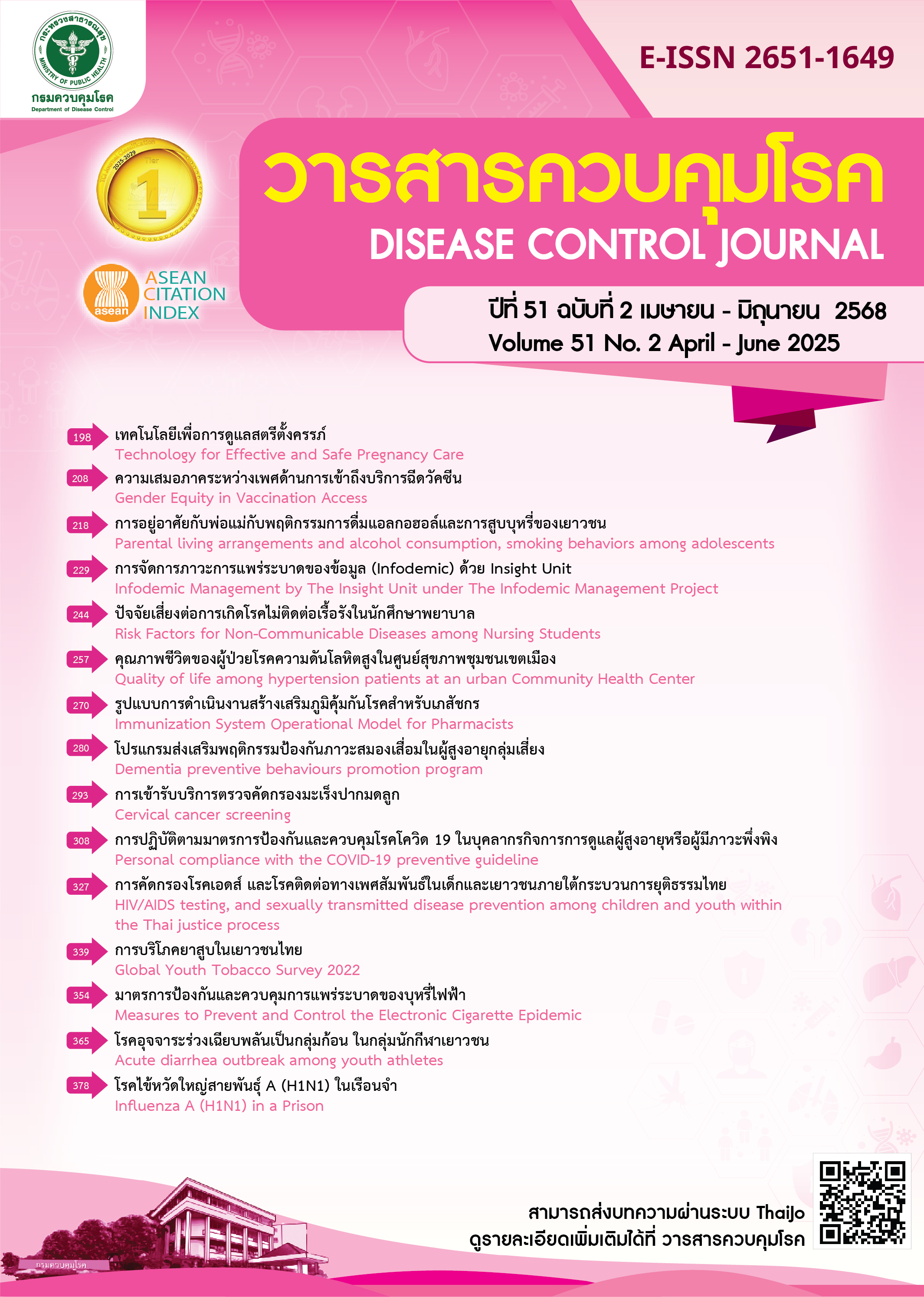
การทบทวนและถอดบทเรียนการจัดการภาวะการแพร่ระบาดของข้อมูล (Infodemic) ด้วย Insight Unit ภายใต้โครงการการจัดการการแพร่ระบาดของข้อมูล กรมควบคุมโรค เพื่อการบูรณาการเข้ากับบริบทกรมควบคุมโรค 2566-2567
DOI:
https://doi.org/10.14456/dcj.2025.20คำสำคัญ:
การแพร่ระบาดของข้อมูล, รายงานข้อมูลเชิงลึก, หน่วย Insight Unit, กรมควบคุมโรคบทคัดย่อ
ในช่วงปี 2566-2567 กรมควบคุมโรคได้ดำเนินโครงการการจัดการการแพร่ระบาดของข้อมูล โดยจัดตั้ง Insight Unit เพื่อเฝ้าระวังข้อมูลจากสื่อออนไลน์และจัดทำรายงานข้อมูลเชิงลึกเพื่อสนับสนุนการตอบสนองต่อการแพร่ระบาดของข้อมูล การศึกษานี้มีวัตถุประสงค์เพื่อทบทวนและถอดบทเรียนการทำงานของ Insight Unit เพื่อให้ข้อเสนอต่อการเปลี่ยนผ่านจากการดำเนินงานในลักษณะโครงการไปสู่งานประจำภายใต้บริบทของกรมควบคุมโรค เป็นการศึกษาเชิงคุณภาพ เก็บข้อมูลโดยการสัมภาษณ์ผู้ปฏิบัติงานใน Insight Unit เจ้าหน้าที่ของกรมควบคุมโรค ที่มีส่วนสนับสนุนในการปฏิบัติงานของ Insight Unit และผู้บริหารกรมควบคุมโรคจำนวน 12 คน วิเคราะห์ข้อมูลโดยใช้กรอบแนวคิด FHI 360 Research Utilization Framework ผลการศึกษาพบว่า Insight Unit เป็นโครงการที่ได้รับการสนับสนุนงบประมาณจากต่างประเทศ จึงมีความกังวลเรื่องความยั่งยืนของการดำเนินงาน อย่างไรก็ตามทั้งผู้บริหารและผู้ปฏิบัติงานเห็นว่าการจัดการการแพร่ระบาดของข้อมูลเป็นเรื่องสำคัญที่กรมควบคุมโรคจำเป็นต้องสานต่อ กิจกรรมที่เกิดขึ้นภายใต้ Insight Unit ได้แก่ การรับฟังสังคมจากสื่อออนไลน์ วิเคราะห์ข้อมูลและจัดทำรายงานข้อมูลเชิงลึก บางส่วนมีความทับซ้อนกับกิจกรรมที่กรมควบคุมโรคดำเนินการอยู่ ในช่วงระยะเวลาตั้งแต่เดือนกรกฎาคม 2566 ถึงพฤษภาคม 2567 Insight Unit จัดทำรายงานข้อมูลเชิงลึกเกี่ยวกับวัคซีนโควิด 19 และประเด็นโรคและภัยสุขภาพอื่นๆรวมจำนวน 14 ฉบับ โดยยังพบความท้าทายเรื่องการคัดเลือกประเด็นที่ใช้เฝ้าระวังข้อมูล แหล่งข้อมูลมีจำกัด การวิเคราะห์ข้อมูลที่ยังไม่เชื่อมโยงกับทฤษฎีทางพฤติกรรมสุขภาพ ตลอดจนขาดแผนการนำข้อมูลไปใช้ประโยชน์ทั้งจากแผนงานโรคและผู้บริหาร การพัฒนากระบวนการทำงานจากลักษณะโครงการสู่งานประจำในบริบทกรมควบคุมโรค จึงควรบูรณาการเข้ากับหน่วยงานที่มีประสบการณ์และความเชี่ยวชาญอยู่เดิม และขยายความร่วมมือไปสู่หน่วยงานอื่นในกรม เพื่อสร้างแนวปฏิบัติที่ชัดเจนและกำหนดเป้าหมายการใช้งานของรายงานข้อมูลเชิงลึก รวมถึงมีการประเมินผลลัพธ์และประสิทธิผลของระบบการจัดการการแพร่ระบาดของข้อมูลอย่างต่อเนื่อง
Downloads
เอกสารอ้างอิง
World Health Organization Thailand. What is infodemic? [Internet] 2021 [cited 2024 Nov 6]. Available from: https://www.facebook.com/WHOThailand/posts/what-is-an-infodemicinfodemic-information-epidemic-is-an-overabundance-of-inform/3831016243585903/
The Lancet Public Health. Rethinking information ecosystems and infodemics. The Lancet Public Health [Internet]. 2024 [cited 2024 Nov 6];9(6):e345. Available from: http://www.thelancet.com/article/S2468266724001063/fulltext
Pian W, Chi J, Ma F. The causes, impacts and countermeasures of COVID-19 “Infodemic”: A systematic review using narrative synthesis. Inf Process Manag. 2021;58(6):102713.
Islam MS, Sarkar T, Khan SH, Mostofa Kamal AH, Hasan SMM, Kabir A, et al. COVID-19-Related Infodemic and Its Impact on Public Health: A Global Social Media Analysis. Am J Trop Med Hyg. 2020;103(4):1621-9.
World Health Organization. WHO competency framework building a response workforce to manage infodemics. Geneva: World Health Organization; 2021.
World Health Organization, the United Nations International Children's Emergency Fund (UNICEF). How to build an infodemic insights report in six steps [Internet] 2023 [cited 2024 Nov 6]. Available from: https://iris.who.int/bitstream/handle/10665/370317/9789240075658-eng.pdf?sequence=1
Kim C, Wilcher R, Petruney T, Krueger K, Wynne L, Zan T. A research utilisation framework for informing global health and development policies and programmes. Health Res Policy Syst. 2018;16(1):9.
Sudathip P, Dharmarak P, Rossi S, Promda N, Newby G, Larson E, et al. Leveraging geo-referenced malaria information to increase domestic financial support for malaria elimination in Thailand. Malar J [Internet]. 2022 [cited 2024 Nov 5];21(1):1-15. Available from: https://malariajournal.biomedcentral.com/articles/10.1186/s12936-022-04227-1
The Global Fund. Guidance Note Sustainability, Transition and co-financing [Internet]. 2022 [cited 2024 Nov 5] Available from: https://resources.theglobalfund.org/media/13890/cr_sustainability-transition_guidancenote_en.pdf
Bunchum A, Boonchutima Smith. Public health risk communication of the Department of Disease Control: lessons learned on communicating risks in the coronavirus disease 2019 (COVID-19) Situation, Thailand. Journal of The Office of DPC7 Khon Kaen [Internet]. 2024 [cited 2025 Feb 12];31(3):80-91. (in Thai) Available from: https://he01.tci-thaijo.org/index.php/jdpc7kk/article/view/273206/185774
Purnat TD, Nguyen T, Ishizumi A, Yau B, White B, Cecchini S, et al. Delivering actionable infodemic insights and recommendations for the COVID-19 pandemic response. Weekly epidemiological record. 2022;97(27):313-24.
Chiou H, Voegeli C, Wilhelm E, Kolis J, Brookmeyer K, Prybylski D, et al. The future of infodemic surveillance as public health surveillance. Emerging Infectious Diseases [Internet]. [cited 2025 Apr 9];28(13):S121 -S128. Available from: https://doi.org/10.3201/eid2813.220696
Department of Health and Aged Care (AU). Protocol for making a change to the national notifiable diseases list (NNDL) in Australia [Internet]. 2015 [cited 2024 Nov 6] Available from: https://www.health.gov.au/sites/default/files/documents/2022/06/protocol-for-making-a-change-to-the-national-notifiable-diseases-list-in-australia.pdf
Purnat TD, Vacca P, Czerniak C, Ball S, Burzo S, Zecchin T, et al. Infodemic Signal Detection During the COVID-19 Pandemic: Development of a Methodology for Identifying Potential Information Voids in Online Conversations. JMIR Infodemiology. 2021;1(1):e30971.
Kolis J, Brookmeyer K, Chuvileva Y, Voegeli C, Juma S, Ishizumi A, et al. Infodemics and Vaccine Confidence: Protocol for Social Listening and Insight Generation to Inform Action. JMIR Public Health Surveill. 2024;10:e51909.
Lohiniva AL, Sibenberg K, Austero S, Skogberg N. Social Listening to Enhance Access to Appropriate Pandemic Information Among Culturally Diverse Populations: Case Study From Finland. JMIR Infodemiology. 2022;2(2):e38343.
Boender TS, Schneider PH, Houareau C, Wehrli S, Purnat TD, Ishizumi A, et al. Establishing infodemic management in Germany: a framework for social listening and integrated analysis to report infodemic insights at the National Public Health Institute. JMIR Infodemiology [Internet]. 2023 [cited 2024 Nov 6];3:e43646. Available from: https://infodemiology.jmir.org/2023/1/e43646
Wilhelm E, Ballalai I, Belanger ME, Benjamin P, Bertrand-Ferrandis C, Bezbaruah S, et al. Measuring the Burden of Infodemics: Summary of the Methods and Results of the Fifth WHO Infodemic Management Conference. JMIR Infodemiology. 2023;3:e44207.
ดาวน์โหลด
เผยแพร่แล้ว
รูปแบบการอ้างอิง
ฉบับ
ประเภทบทความ
สัญญาอนุญาต
ลิขสิทธิ์ (c) 2025 วารสารควบคุมโรค

อนุญาตภายใต้เงื่อนไข Creative Commons Attribution-NonCommercial-NoDerivatives 4.0 International License.
บทความที่ลงพิมพ์ในวารสารควบคุมโรค ถือว่าเป็นผลงานทางวิชาการหรือการวิจัย และวิเคราะห์ตลอดจนเป็นความเห็นส่วนตัวของผู้เขียน ไม่ใช่ความเห็นของกรมควบคุมโรค ประเทศไทย หรือกองบรรณาธิการแต่ประการใด ผู้เขียนจำต้องรับผิดชอบต่อบทความของตน