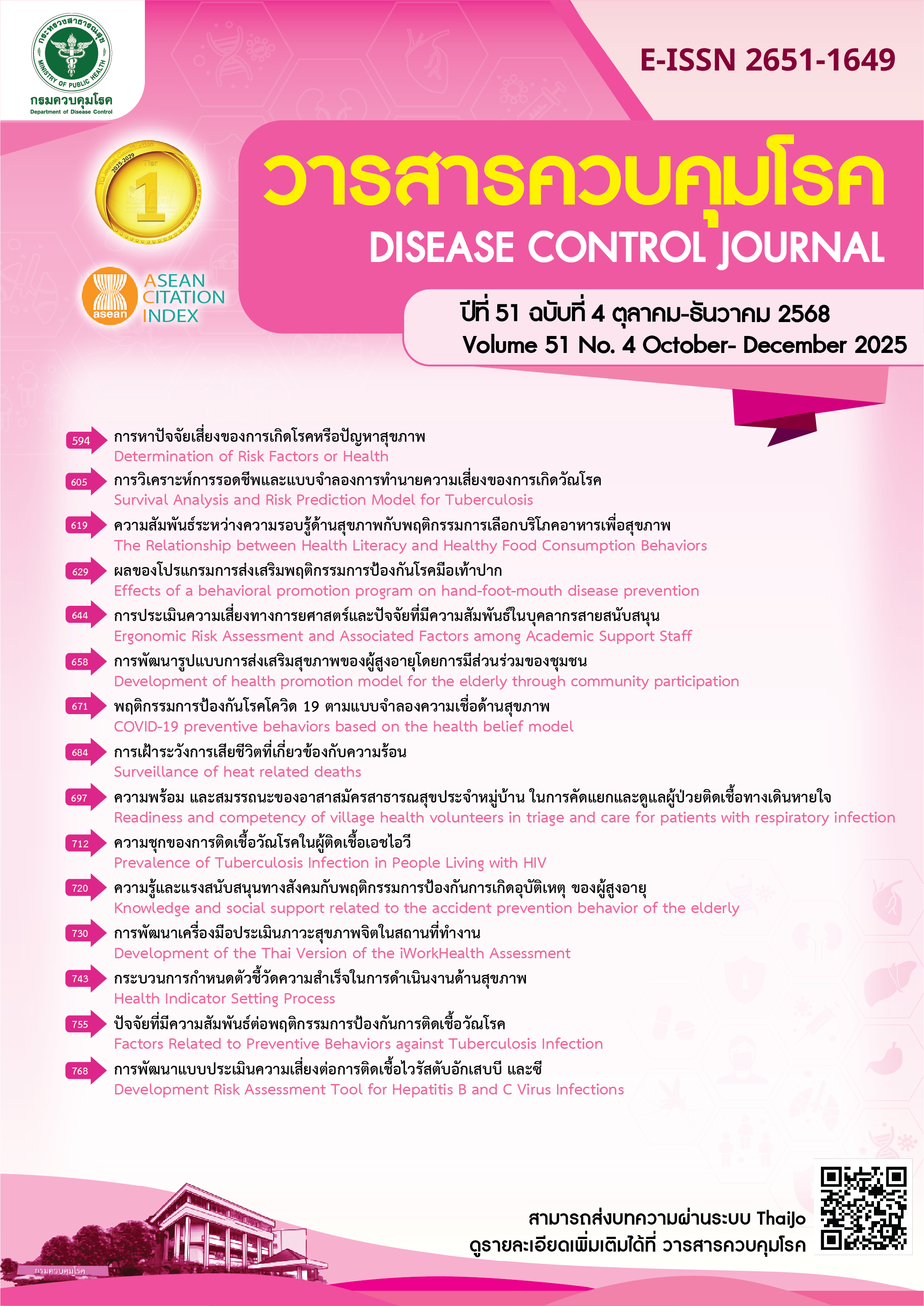
Survival Analysis and Risk Prediction Model for Tuberculosis Development in HIV-Infected Patients
DOI:
https://doi.org/10.14456/dcj.2025.48Keywords:
HIV, tuberculosis, survival analysis, Cox proportional hazards modelAbstract
HIV/TB coinfection is a significant public health problem in Thailand. Understanding risk factors and predicting tuberculosis (TB) development is therefore essential for developing effective strategies. The objective of this study was to analyze TB - free survival time and to develop a risk prediction model for TB in HIV-infected patients in Thailand. This retrospective cohort study utilized data from the National AIDS Program (NAP) database from 2009 to 2023 (B.E. 2552 to 2566), analyzing data from 289,847 HIV-
infected patients. Kaplan-Meier survival analysis revealed that the TB-free Restricted Mean Survival Time (RMST) was approximately 9 years. The developed Cox proportional hazards model effectively predicted the risk of TB development in HIV-infected patients in Thailand. Significant risk factors for TB development identified by the Cox proportional hazards analysis included older age, male sex, symptomatic HIV infection and AIDS stage (compared to asymptomatic stage), presence of other opportunistic infections, and use of alternative drug regimens. Conversely, higher CD4 count, receiving ART, and ART initiation within 1 week of diagnosis were significant protective factors. These findings can help identify high-risk individuals for targeted surveillance, potentially leading to a reduction in TB incidence and further improving clinical outcomes in this patient population.
Downloads
References
Jantharot B, Oba N, Champunot R, Puraya A. Effects of self-management program on self-management behaviors, viral load and CD4 level among HIV-infected persons. Thai AIDS Journal. 2024;36(2):68-81. (in Thai)
UNAIDS. The urgency of now: AIDS at a crossroads. Joint United Nations Programme on HIV/AIDS; 2024.
Department of Disease Control (TH). Annual report, Division of AIDS and STIs. Nonthaburi: Department of Disease Control (TH); 2023. (in Thai)
Wondmeneh TG, Mekonnen AT. The incidence rate of tuberculosis and its associated factors among HIV-positive persons in Sub-Saharan Africa: a systematic review and meta-analysis. BMC Infect Dis. 2023;23(1):613.
Prommongkol B, Putcharoen O, Patamatamkul S. Prevalence and incidence rates of tuberculosis in people with HIV during the coronavirus 2019 pandemic: a single center retrospective analysis. HIV Res Clin Pract. 2024;25(1):2348935.
World Health Organization. Global tuberculosis report 2024. Geneva: World Health Organization; 2024.
Umeta AK, Yermosa SF, Dufera AG. Bayesian parametric modeling of time to tuberculosis co-infection of HIV/AIDS patients at Jimma Medical Center, Ethiopia. Scientific Reports. 2022;12(1):16475.
Wolde HF, Clements ACA, Alene KA. Development and validation of a risk prediction model for pulmonary tuberculosis among presumptive tuberculosis cases in Ethiopia. BMJ Open. 2023;13(12):e076587.
Gatechompol S, Sophonphan J, Ubolyam S, Avihingsanon A, van Leth F, Cobelens F, Kerr SJ. Incidence and factors associated with active tuberculosis among people living with HIV after long-term antiretroviral therapy in Thailand: a competing risk model. BMC Infect Dis. 2022;22(1):346.
Tegegne AS, Minwagaw MT. Risk factors for the development of tuberculosis among HIV-positive adults under highly active antiretroviral therapy at government hospitals in Amhara region, Ethiopia. International Journal of General Medicine. 2022;15:3031-41.
Endalamaw A, Engeda EH, Tezera N. Incidence of tuberculosis in children on antiretroviral therapy: a retrospective cohort study. BMC Res Notes. 2018;11:745.
Negussie A, Debalke D, Belachew T, Tadesse F. Tuberculosis co-infection and its associated factors among people living with HIV/AIDS attending antiretroviral therapy clinic in southern Ethiopia: a facility based retrospective study. BMC Res Notes. 2018;11:417.
Hulu VT, Ginting R, Manalu P, Samosir FJ, Siregar SD, Siagian M, et al. The impact of tuberculosis on people living with HIV: Scoping Review. Public Health of Indonesia. 2024;10(3):262-73.
Gatechompol S, Sophonphan J, Ubolyam S, Avihingsanon A, van Leth F, Cobelens F, et al. Incidence and factors associated with active tuberculosis among people living with HIV after long-term antiretroviral therapy in Thailand: a competing risk model. BMC Infec Dis. 2022;22(1):346.
Kazibwe A, Oryokot B, Mugenyi L, Kagimu D, Oluka AI, Kato D, et al. Incidence of tuberculosis among PLHIV on antiretroviral therapy who initiated isoniazid preventive therapy: A multi-center retrospective cohort study. PLoS ONE [Internet]. 2022 [cited 2025 May 28];17(5):e0266285. Available from: https://doi.org/10.1371/journal.pone.0266285
Ayana GM, Akalu TY, Ayele TA. Joint modeling of incidence of tuberculosis and change in viral load over time among adult HIV/AIDS patients on anti-retroviral therapy at Zewditu memorial hospital in Addis Ababa, Ethiopia. HIV AIDS (Auckl). 2021;13:239-49.
Pimchan N, Suggaravetsiri P, Tesana N, Chaiklieng S. The associated factors with unsuccessful tuberculosis treatment outcomes among HIV-TB co-infected patients in Surin Province [Internet]. 2019 [cited 2025 May 28];18(3):59-72. Available at: https://he01.tci-thaijo.org/index.php/jdpc7kk/article/view/166452. (in Thai)
Ajema AT, Simachew Y, Meshesha MD, Gari T. Time to tuberculosis development and its predictors among HIV-positive patients: a retrospective cohort study. PloS ONE. 2024;19(2):e0298021.
Keskho W, Artprom K. Outcomes and factors related to antiretroviral therapy in HIV/AIDS patients, Phonsai Hospital, Roi-Et Province. J Res Health Inno Dev [Internet]. 2024 [cited 2025 Jan 23];5(1):513-28. Available at: https://he01.tci-thaijo.org/index.php/jrhi/article/ view/268915 (in Thai)
Gupte AN, Kadam D, Sangle S, Rewari BB, Salvi S, Chavan A, et al. Incidence of tuberculosis in HIV-infected adults on first-and second-line antiretroviral therapy in India. BMC Infect Dis. 2019;19:1-9.
Downloads
Published
How to Cite
Issue
Section
License
Copyright (c) 2025 Disease Control Journal

This work is licensed under a Creative Commons Attribution-NonCommercial-NoDerivatives 4.0 International License.
Articles published in the Disease Control Journal are considered as academic work, research or analysis of the personal opinion of the authors, not the opinion of the Thailand Department of Disease Control or editorial team. The authors must be responsible for their articles.