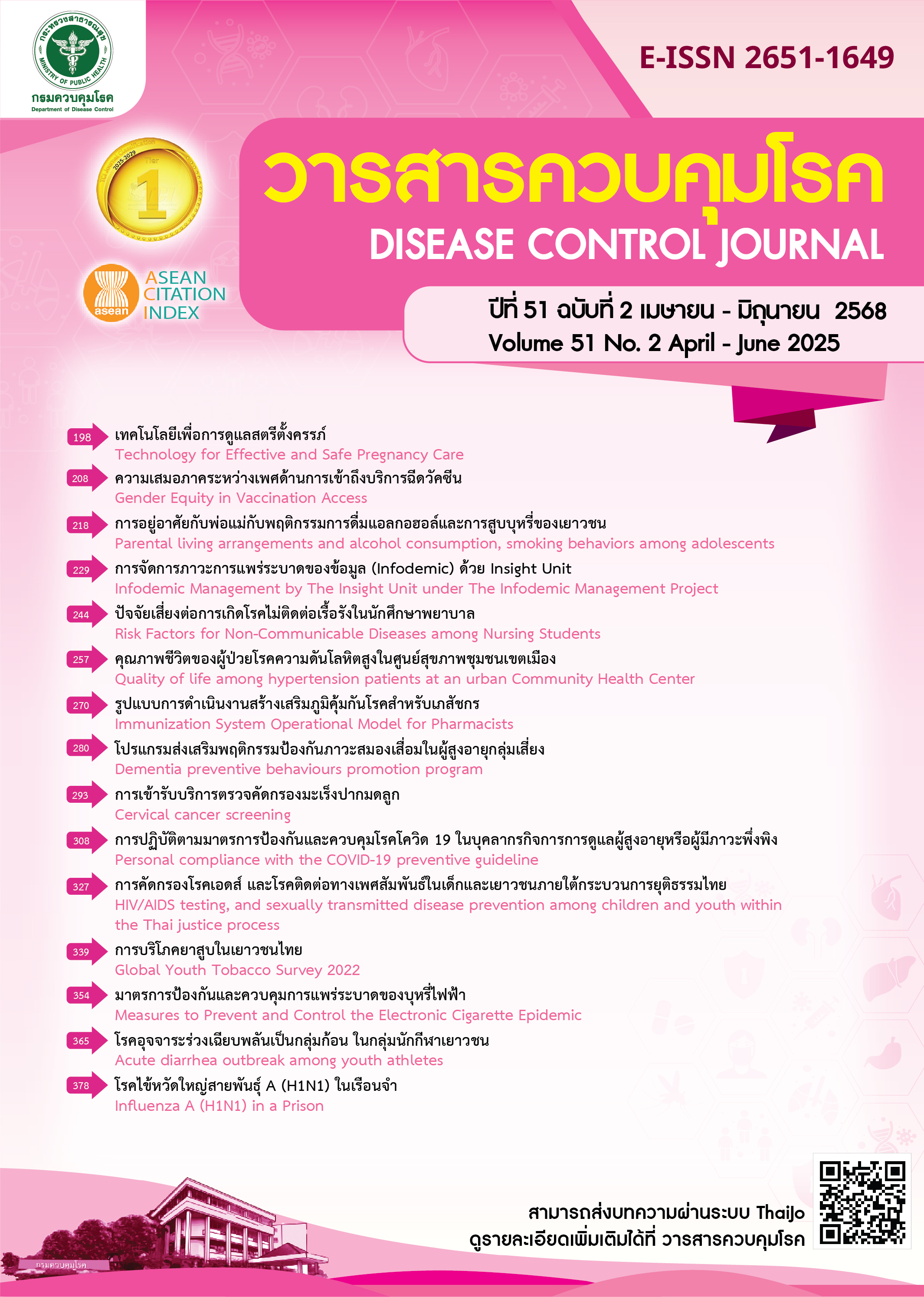
Effects of dementia preventive behaviours promotion program based on health belief model among older people at risk
DOI:
https://doi.org/10.14456/dcj.2025.24Keywords:
health promotion program, dementia prevention, older adults, health belief model, social supportAbstract
Dementia is a significant problem among Thai older adults. Behavior modification is one possible prevention approach. This quasi-experimental research with two-group pretest-posttest design aimed to study the effectiveness of a dementia preventive behaviors promotion program among at-risk older adults, by integrating the concept of Health Belief Model and social support theory. The sample consisted of 62 older adults who were at risk for dementia, was equally divided into an experimental and a comparison group. The experimental group received an 8-week dementia preventive behaviors promotion program, consisting of face-to-face and online activities. The comparison group received routine health care. Data was collected using interview questionnaires Data were analyzed using descriptive statistics and inferential statistics including Chi-square test and t-test. The results showed that after the experiment, the experimental group had significantly higher mean scores of perceived susceptibilities to dementia, perceived severity of dementia, perceived benefits of preventive behaviors, cues to action, perceived self-efficacy, and dementia preventive behaviors than before the experiment and the comparison group (p<0.05). Meanwhile, perceived barriers to performing dementia preventive behaviors were significantly lower than before the experiment and the comparison group (p<0.05). The findings highlight the effectiveness of the program in encouraging dementia preventive behaviors among older adults at risk.
Downloads
References
World Health Organization. Global status report on the public health response to dementia. Geneva: World Health Organization; 2021. Available from: https://www.who.int/publications/i/item/9789240033245
Foundation of Thai Gerontology Research and Development Institute (TGRI). Situation of the Thai Older Persons 2022. Bangkok: Institute for Population and Social Research, Mahidol University; 2022. (in Thai)
Office of the National Economic and Social Development Council. The 13th National Economic and Social Development Plan (2023-2027). Bangkok: NESDC; 2022. (in Thai)
World Health Organization. World Report on Ageing and Health. Geneva: World Health Organization; 2015.
National Statistical Office. Survey of Elderly in Thailand 2021. Bangkok: NSO; 2022. (in Thai)
Health Insurance System Research Office. Report on Healthcare Expenditure for Elderly Population in Thailand. Bangkok: HISRO; 2023. (in Thai)
Ministry of Public Health. Thailand Healthy Ageing Strategic Plan (2023-2027). Nonthaburi: MoPH; 2022. (in Thai)
Senanarong V, Harnphadungkit K, Poungvarin N, Vannasaeng S, Chongwisal S, Chakorn T, et al. The dementia and disability project in Thai elderly: rational, design, methodology and early results. BMC Neurol. 2013;13:3. doi: 10.1186/ 1471-2377-13-3. Available from: http://www.biomedcentral.com/1471-2377/13/3
Tanglakmankhong K, Hampstead BM, Prasunnakarn S, Seesing S, Potempa K. Cognitive screening assessment in Thai older adults: a prospective study of the reliability and validity of the Abbreviated Mental Test. J Health Res. 2022; 36(6):1027-37. doi: 10.1108/JHR-02-2020-0049.
Glanz K, Rimer BK, Viswanath K. Health Behavior and Health Education: Theory, Research, and Practice. 5th ed. San Francisco: Jossey-Bass; 2015.
Rosenstock IM. Historical origins of the health belief model. Health Educ Monogr. 1974;2(4):328-35.
Merrilees JJ, Bernstein A, Dulaney S, Heunis J, Walker R, Rah E, et al. The Care Ecosystem: Promoting self-efficacy among dementia family caregivers. Dementia (London). 2020;19(6) :1955-73. doi: 10.1177/1471301218814121
Lertkratoke S, Amnatsatsue K, Kerdmongkol P, Nanthamongkolchai S. Effectiveness of Thai integrated care program for older adults with dementia in the community: a quasi-experimental study. Pacific Rim Int J Nurs Res. 2021;25 (4):510-524. Available from: https://he02.tci-thaijo.org/index.php/PRIJNR/article/view/249108
Wang HX, Jin Y, Hendrie HC, Liang C, Yang L, Cheng Y, et al. Late life leisure activities and risk of cognitive decline. J Gerontol A Biol Sci Med Sci. 2013;68(2):205-13. doi: 10.1093/gerona/gls153.
Chaiwong P, Sungkarat S, Rattakorn P, Munkhetvit P. Cognitive assessment and intervention in occupational therapy for Thai older adults with neurocognitive disorders. J Associated Med Sci. 2022;55(2):16-22.
Borson S, Scanlan J, Brush M, Vitaliano P, Dokmak A. The Mini-Cog: a cognitive 'vital signs' measure for dementia screening in multi-lingual elderly. Int J Geriatr Psychiatry. 2000;15(11):1021-7.
Cooper LA, Roter DL, Carson KA, Bone LR, Larson SM, Miller ER 3rd, et al. A randomized trial to improve patient-centered care and hypertension control in underserved primary care patients. J Gen Intern Med. 2011;26(11):1297-304. doi: 10.1007/s11606-011-1794-6.
House JS. Work stress and social support. Reading, MA: Addison-Wesley; 1981.
Murayama H, Nishi M, Matsuo E, Nofuji Y, Shimizu Y, Taniguchi Y, et al. Do bonding and bridging social capital affect self-rated health, depressive mood and cognitive decline in older Japanese? A prospective cohort study. Soc Sci Med. 2013;98:247-52.
Fratiglioni L, Paillard-Borg S, Winblad B. An active and socially integrated lifestyle in late life might protect against dementia. Lancet Neurol. 2004;3(6):343-53.
Bandura A. Self-efficacy: the exercise of control. New York: W.H. Freeman; 1997.
Gitlin LN, Corcoran M, Winter L, Boyce A, Hauck WW. A randomized, controlled trial of a home environmental intervention: effect on efficacy and upset in caregivers and on daily function of persons with dementia. Gerontologist. 2001;41(1):4-14.
Janz NK, Becker MH. The Health Belief Model: a decade later. Health Educ Q. 1984;11(1):1-47.
Ngandu T, Lehtisalo J, Solomon A, Levalahti E, Ahtiluoto S, Antikainen R, et al. A 2 year multidomain intervention of diet, exercise, cognitive training, and vascular risk monitoring versus control to prevent cognitive decline in at-risk elderly people (FINGER): a randomised controlled trial. Lancet. 2015;385(9984):2255-63.
Downloads
Published
How to Cite
Issue
Section
License
Copyright (c) 2025 Disease Control Journal

This work is licensed under a Creative Commons Attribution-NonCommercial-NoDerivatives 4.0 International License.
Articles published in the Disease Control Journal are considered as academic work, research or analysis of the personal opinion of the authors, not the opinion of the Thailand Department of Disease Control or editorial team. The authors must be responsible for their articles.