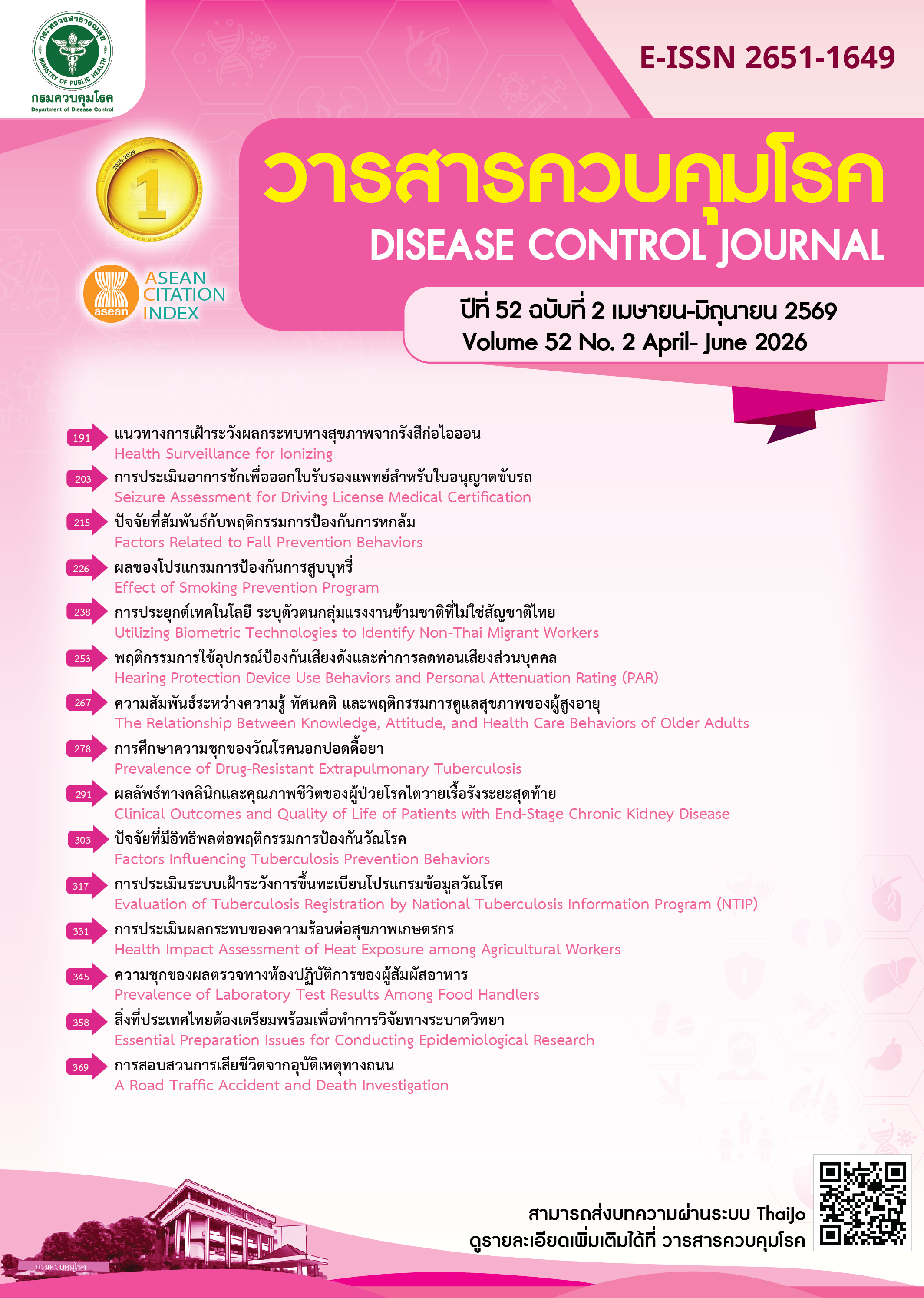
Utilizing Biometric Technologies to Identify Non-Thai Migrant Workers: The Integration of Iris and Facial Recognition for Disease Surveillance and Control
DOI:
https://doi.org/10.14456/dcj.2026.20Keywords:
migrant workers, personal identification, biometric technology, iris and facial recognition, public health systemAbstract
Inaccurate identification of migrant workers represents a structural barrier to Thailand’s disease surveillance and control systems. The COVID-19 pandemic significantly exposed these limitations in contact tracing and patient follow-up. This study aimed to analyze the evolution and lessons learned from implementing the Thai Red Cross Biometric Authentication System (TRCBAS), which utilizes iris and facial recognition technology for undocumented migrants. A qualitative study was conducted across five pilot provinces. Data was gathered from 49 key informants, including executives, data users, and operators, through focus group discussions and participant observation from February 2023 to May 2024. Thematic analysis was employed to synthesize findings. Results: The system’s development progressed through three distinct phases, successfully registering 139,184 individuals across 100 health facilities by early 2025. Key success factors included high technical precision in iris recognition (>99%), strong policy-level commitment, and system user-friendliness. Nevertheless, critical challenges persist, such as the lack of integration with Hospital Information Systems (HIS), fragmented identification numbers, and unstable internet connectivity in remote border regions. Biometric technology effectively bridges gaps in health security for mobile populations. Crucial policy recommendations include: (1) establishing a centralized "Health ID" to unify health data across sectors; (2) investing in digital infrastructure within border areas; and (3) implementing robust data governance and ethical framework aligned with international human rights standards to ensure long-term national sustainability.
Downloads
References
Division of General Communicable Diseases. Compendium of Guidelines for Surveillance, Prevention and Control of Coronavirus Disease 2019. In: Department of Disease Control, editor. Online; 2021. p. 2–3. (in Thai)
Department of Disease Control (TH). Department of Disease Control, in collaboration with partner networks, develops identity authentication technology for undocumented persons in Thailand for public health and humanitarian assistance [Internet]. Nonthaburi: Bureau of Risk Communication and Health Behavior Development; 2023 [cited 2024 Feb 25]. Available from: https://ddc.moph.go.th/brc/news.php?news=36361&deptcode= (in Thai)
Braun V, Clarke V. Using thematic analysis in psychology. Qual Res Psychol. 2006;3(2):77–101. doi: 10.1191/1478088706qp063oa
Umchusak K, Chunsutthiwat S, Khunaratnapruk S, Poovorawan Y, Chotpitayasunondh T, Hemachudha T, et al. Strategic proposals for controlling COVID-19 among migrant workers in Samut Sakhon Province [Internet]. 2021[cited 2024 Feb 25]. Available from: https://www.hfocus.org/content/2021/02/20990 (in Thai)
Kotsuwan O, Chokchaisiri C, Kongprawechnon W, Duangpummet S, Galajit K, Karnjana J, editors. Enhance biometric authentication: integrating iris and periocular verification through support vector classification. Singapore: Springer Nature Singapore; 2025.
Department of Disease Control (TH). Department of Disease Control collaborates with the Thai Red Cross Society and NECTEC to pilot biometric identity data collection technology for undocumented persons for healthcare services in five provinces [Internet]. Nonthaburi: Bureau of Risk Communication and Health Behavior Development; 2023. Available from: https://ddc.moph.go.th/brc/news.php?news=33420&deptcode=brc&news_views=8817 (in Thai)
Department of Disease Control (TH), Office of International Cooperation. Dashboard of Thai Red Cross Biometric Authentication System [Internet]. Google Looker Studio; 2025 [cited 2025 Feb 1]. Available from: https://trcbas.redcross.or.th/dashboard (in Thai)
Ministry of Public Health. Notification of the Ministry of Public Health on standards for health examination services for migrant workers B.E. 2567 (2024). In: Ministry of Public Health, editor. Royal Gazette. Bangkok: Royal Gazette; 2024. (in Thai)
Thai Red Cross Society. Announcement on termination of access to the Thai Red Cross Biometric Authentication System (TRCBAS) via username and password and transition to ThaID of the Department of Provincial Administration and iris image verification; 2024. (in Thai)
Bureau of Digital Health, Digital Health Service System Development Group, Office of the Permanent Secretary, Ministry of Public Health, editor. Consultation meeting on guidelines for linking migrant identity verification data with the Thai Red Cross Biometric Authentication System (TRCBAS). Nonthaburi: Bureau of Digital Health; 2025. (in Thai)
Chokkhanchitchai S. COVID-19: the new wave of outbreak in Thailand at the end of 2020. J Prev Med Assoc Thai. 2021 [cited 2026 Jan 12];10(3):i–iv. Available from: https://he01.tci-thaijo.org/index.php/JPMAT/article/view/247064 (in Thai)
UN Network on Migration in Thailand. Thailand Migration Report 2024. Bangkok: United Nations Network on Migration in Thailand; 2024.
Low CC. Digital technologies and migration management in Malaysia: the technology–migration nexus. Asian Pac Migr J. 2025;34(3):438–59. doi: 10.1177/01171968251374803
Matlin SA, Claron IM, Merone J, Netto G, Takian A, Zaman MH, et al. Artificial intelligence in migrant health: a critical perspective on opportunities and risks. Lancet Reg Health Eur. 2025 [cited 2026 Jan 12];57:101421. Available from: https://www.thelancet.com/action/showPdf?pii=S2666-7762%2825%2900213-3
Ziadah R. Surveillance, race, and social sorting in the United Arab Emirates. Politics. 2021;44(4):605-20. doi:10.1177/02633957211009719
Digital Government Development Agency (Public Organization). Notification of the Digital Government Development Committee on the Digital Government Development Plan of Thailand B.E. 2566–2570 (2023–2027). In: Digital Government Development Agency (Public Organization), editor. Online; 2024. (in Thai)
Department of Employment. Notification of the Ministry of Labour on permission for foreign nationals of Lao PDR, Myanmar, and Viet Nam to work in the Kingdom as a special case according to the Cabinet resolution dated 11 November 2025 [Internet]. 2026 [cited 2026 Jan 12]. Available from: https://ratchakitcha.soc.go.th/documents/98017.pdf (in Thai)
HFocus. “Deputy Minister Worachote” launches health check-up and insurance program for migrant workers, piloting in four border provinces with nationwide expansion in January 2026 [Internet]. 2026 [cited 2026 Jan 12]. Available from: https://www.hfocus.org/content/2025/10/35542 (in Thai)
Grünenberga K, Møhl P, Olwiga KF, Simonsena A. Issue introduction: IDentities and identity: biometric technologies, borders and migration. Ethnos. 2020;87(2):211–22. doi: 10.1080/00141844.2020.1743336
World Health Organization. World Health Organization (WHO) personal data protection policy [Internet]. Geneva: WHO; 2024 [cited 2026 Jan 12]. Available from: https://cdn.who.int/media/docs/default-source/world-health-data-platform/who_personal_data_protection_policy.pdf
Downloads
Published
How to Cite
Issue
Section
License
Copyright (c) 2026 Disease Control Journal

This work is licensed under a Creative Commons Attribution-NonCommercial-NoDerivatives 4.0 International License.
Articles published in the Disease Control Journal are considered as academic work, research or analysis of the personal opinion of the authors, not the opinion of the Thailand Department of Disease Control or editorial team. The authors must be responsible for their articles.