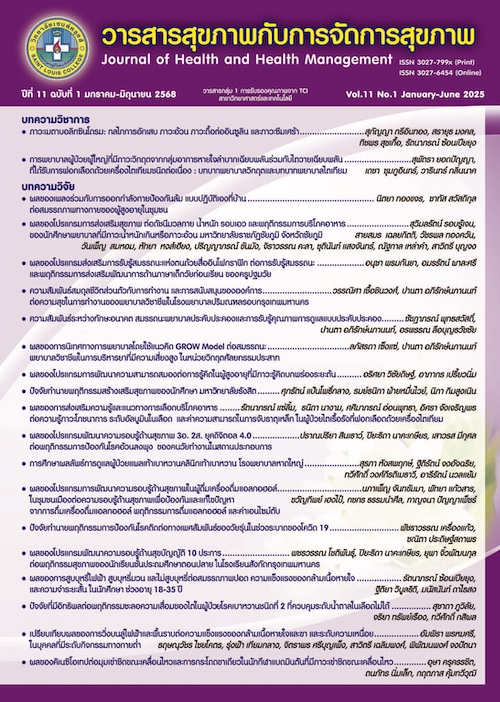
The Effects of E-cigarette Smoking, Cigarette Smoking, and Non-smoking on Lung Function, Respiratory Muscle Strength, and Short-term Memory in Undergraduate Student Aged 18-35 Years
Keywords:
E-cigarettes smoking, cigarettes smoking, lung function, respiratory muscle strength, short-term memoryAbstract
This research was a cross-sectional study aimed to comparison the effects of e-cigarette smoking, cigarette smoking, and non-smoking on lung function, respiratory muscle strength, and short-term memory among undergraduate students aged 18-35 years. A purposive sampling method was employed, with participants divided into three groups: e-cigarette smokers, cigarette smokers, and non-smokers, each consisting of 20 individuals. The participants were assessed for lung function parameters, including forced vital capacity (FVC), forced expiratory volume in one second (FEV1), the FEV1/FVC ratio, and peak expiratory flow rate (PEFR), respiratory muscle strength, assessed by maximum inspiratory pressure (MIP) and maximum expiratory pressure (MEP), and short-term memory. Differences between groups were analyzed using one-way ANOVA followed by Bonferroni post hoc analysis, with statistical significance was set at a p-value < .05. The results indicated statistically significant differences in lung function (FEV1, FVC, and PEFR), respiratory muscle strength (MIP and MEP), and short-term memory scores among the three groups (p < .05). Specifically, the e-cigarette and cigarette smoking groups exhibited significantly lower values in FEV1, FVC, PEFR, MIP, MEP, and short-term memory compared to the non-smoking group (p < .05). These findings provide important evidence for the development of strategies aimed at promoting prevention and awareness campaigns regarding the use of e-cigarettes and cigarettes, highlighting the potential long-term health implications of their use.
References
ชมพูนุช สินธุพิบูลยกิจ, และทินกร เพิ่มพงศ์ไพบูลย์. (2561). การประเมินระดับก๊าซคาร์บอนมอนอกไซด์ในลมหายใจเพื่อบ่งชี้การสูบบุหรี่ของกลุ่มนักศึกษาระดับอุดมศึกษาในเขตกรุงเทพมหานครและปริมณฑล. วารสารเทคนิคการแพทย์, 46(2), 6591-6601.
Baecke, J. A., Burema, J., & Frijters, J. E. (1982). A short questionnaire for the measurement of habitual physical activity in epidemiological studies. The American journal of clinical nutrition, 36(5), 936-942. doi: 10.1093/ajcn/36.5.936
Chamberlain, S. R., Odlaug, B. L., Schreiber, L. R., & Grant, J. E. (2012). Association between tobacco smoking and cognitive functioning in young adults. The American journal on addictions, 21, S14-S19. doi: org/10.1111/j.1521-0391.2012.00290.x
Conti, A. A., McLean, L., Tolomeo, S., Steele, J. D., & Baldacchino, A. (2019). Chronic tobacco smoking and neuropsychological impairments: A systematic review and meta-analysis. Neuroscience & Biobehavioral Reviews, 96, 143-154. doi: 10.1016/j.neubiorev.2018.11.017
Coppeta, L., Magrini, A., Pietroiusti, A., Perrone, S., & Grana, M. (2018). Effects of smoking electronic cigarettes on pulmonary function and environmental parameters. The Open Public Health Journal, 11(1), 360-368. doi: 10.2174/1874944501811010360
Kamarudin, S. N., Hashim, N. M., Daud, A. Z. C., Ahmedy, F., Salim, M. S., & Hassan, S. A. A. (2023). The Impact of E-cigarette Usage on Cognitive Performance Level among University Students in Malaysia: A case-controlled study. The Southeast Asian Journal of Tropical Medicine and Public Health, 54(5), 225-243.
Heatherton, T. F., Kozlowski, L. T., Frecker, R. C., & Fagerstrom, K. O. (1991). The Fagerström test for nicotine dependence: a revision of the Fagerstrom Tolerance Questionnaire. British journal of addiction, 86(9), 1119-1127. doi: 10.1111/j.1360-0443.1991.tb01879.x
Honeycutt, L., Huerne, K., Miller, A., Wennberg, E., Filion, K. B., Grad, R., ... & Eisenberg, M. J. (2022). A systematic review of the effects of e-cigarette use on lung function. NPJ primary care respiratory medicine, 32(1), 45-52. doi: 10.1038/s41533-022-00311-w
Johnson, J. M., Muilenburg, J. L., Rathbun, S. L., Yu, X., Naeher, L. P., & Wang, J. S. (2018). Elevated nicotine dependence scores among electronic cigarette users at an electronic cigarette convention. Journal of community health, 43(1), 164-174. doi: 10.1007/s10900-017-0399-3
Kim, D. Y., Jang, Y., Heo, D. W., Jo, S., Kim, H. C., & Lee, J. H. (2022). Electronic cigarette vaping did not enhance the neural process of working memory for regular cigarette smokers. Frontiers in Human Neuroscience, 16, 817538. doi: 10.3389/fnhum.2022.817538
Marques, P., Piqueras, L., & Sanz, M. J. (2021). An updated overview of e-cigarette impact on human health. Respiratory research, 22(1), 151. doi: 10.1186/s12931-021-01737-5
Meo, S. A., Ansary, M. A., Barayan, F. R., Almusallam, A. S., Almehaid, A. M., Alarifi, N. S., ... & Zia, I. (2019). Electronic cigarettes: impact on lung function and fractional exhaled nitric oxide among healthy adults. American Journal of Men’s health, 13(1), 1557988318806073. doi: 10.1177/1557988318806073
Novak, M. L., & Wang, G. Y. (2024). The effect of e-cigarettes on cognitive function: a scoping review. Psychopharmacology, 241(7), 1287- 1297. doi: 10.1007/s00213-024-06607-8
Obisesan, O. H., Mirbolouk, M., Osei, A. D., Orimoloye, O. A., Uddin, S. I., Dzaye, O., ... & Blaha, M. J. (2019). Association between e-cigarette use and depression in the behavioral risk factor surveillance system, 2016-2017. JAMA network open, 2(12), e1916800. doi: 10.1001/jamanetworkopen.2019.16800
Palamidas, A., Tsikrika, S., Katsaounou, P. A., Vakali, S., Gennimata, S. A., Kaltsakas, G., ... & Koulouris, N. (2017). Acute effects of short term use of ecigarettes on airways physiology and respiratory symptoms in smokers with and without airway obstructive diseases and in healthy non smokers. Tobacco prevention & cessation, 3, 5. doi: 10.18332/tpc/67799
Pitzer, C. R., Aboaziza, E. A., O’Reilly, J. M., Mandler, W. K., & Olfert, I. M. (2023). Nicotine and microvascular responses in skeletal muscle from acute exposure to cigarettes and vaping. International journal of molecular sciences, 24(12), 10208. doi: 10.3390/ijms241210208
Ribeiro, F., de Mendonça, A., & Guerreiro, M. (2006). Mild cognitive impairment: deficits in cognitive domains other than memory. Dementia and geriatric cognitive disorders, 21(5-6), 284-290. doi: 10.1159/000091435
Tehrani, H., Rajabi, A., Ghelichi-Ghojogh, M., Nejatian, M., & Jafari, A. (2022). RETRACTED ARTICLE: the prevalence of electronic cigarettes vaping globally: a systematic review and meta-analysis. Archives of Public Health, 80(1), 240-254. doi: 10.1186/s13690-022-00998-w
Siddiqi, K., Husain, S., Vidyasagaran, A., Readshaw, A., Mishu, M. P., & Sheikh, A. (2020). Global burden of disease due to smokeless tobacco consumption in adults: an updated analysis of data from 127 countries. BMC medicine, 18(1), 222-244.
Siddiqi, T. J., Rashid, A. M., Siddiqi, A. K., Anwer, A., Usman, M. S., Sakhi, H., ... & Hall, M. E. (2023). Association of electronic cigarette exposure on cardiovascular health: a systematic review and meta-analysis. Current Problems in Cardiology, 48(9), 101748. doi: 10.1016/j.cpcardiol.2023.101748
Simanjuntak, A. M., Putra, M. R. E., Amalia, N. P., Hutapea, A., Suyanto, S., & Siregar, I. E. (2024). Lung and Airway Disease Caused by E-Cigarette (Vape): A Systematic Review. MONTHLY ORIGINAL ARTICLE REVIEW ARTICLE, 76(5), 325-332. doi: 10.33192/ smj.v76i5.267185
Xie, Z., Ossip, D. J., Rahman, I., O’Connor, R. J., & Li, D. (2020). Electronic cigarette use and subjective cognitive complaints in adults. PloS one, 15(11), e0241599. doi: 10.1371/journal.pone.0241599
Zhao, H. Z., Guo, Z. W., Wang, Z. L., Wang, C., Luo, X. Y., Han, N. N., ... & Zhang, G. W. (2024). A comparative study of the effects of electronic cigarette and traditional cigarette on the pulmonary functions of C57BL/6 male mice. Nicotine and Tobacco Research, 26(4), 474-483. doi: 10.1093/ntr/ntad139
Downloads
Published
How to Cite
Issue
Section
License
Copyright (c) 2025 Journal of health and health management

This work is licensed under a Creative Commons Attribution-NonCommercial-NoDerivatives 4.0 International License.