Kernel Function Exploration in Support Vector Machine for Digit Handwritten Recognition
Keywords:
Handwriting digit recognition, Support Vector Machine, Linear kernel, Polynomial kernel, Radial Basis Function kernelAbstract
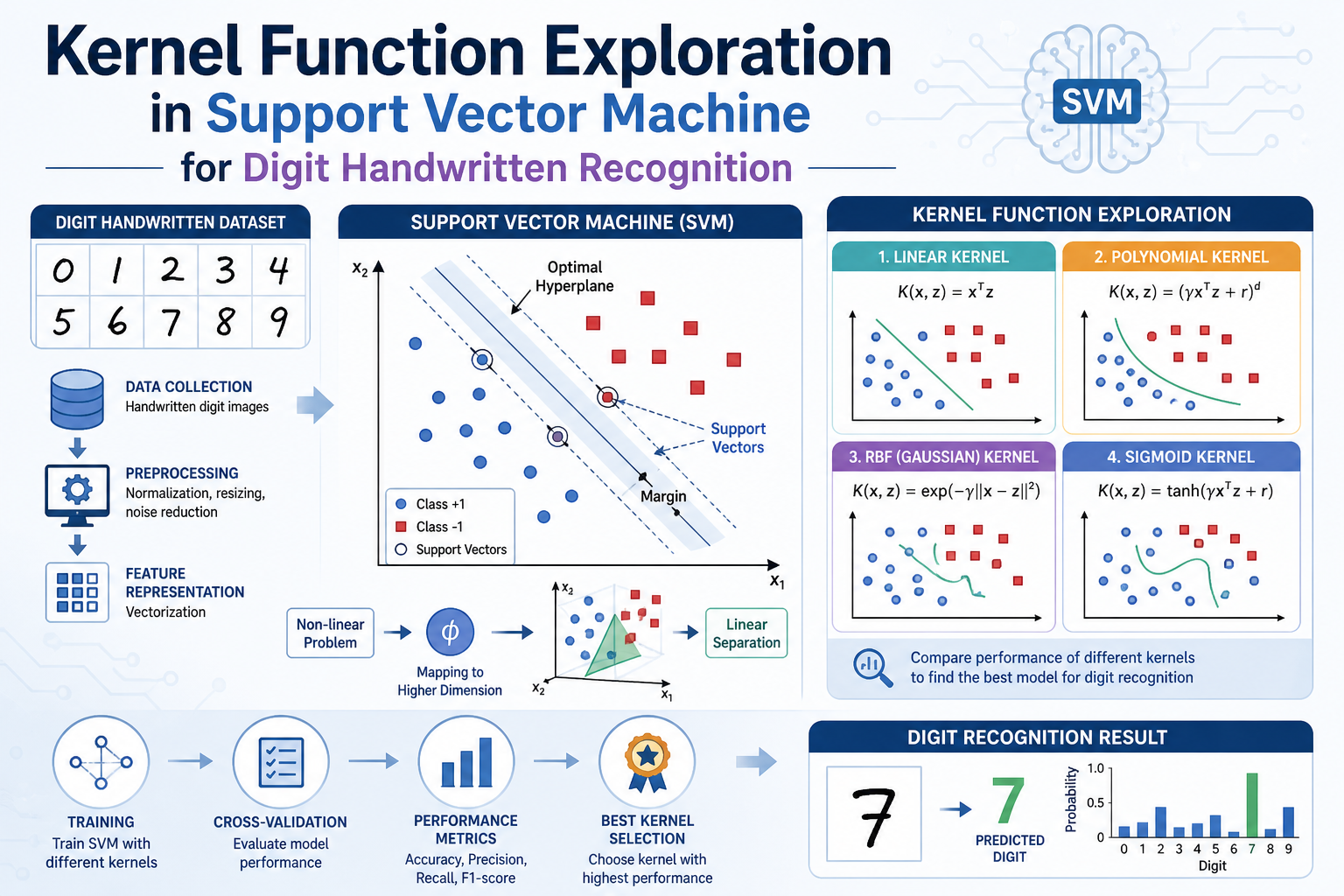
Handwriting classification plays a vital role in biomedical informatics, particularly for digitizing handwritten records and automating data entry. This technology can significantly benefit Thai public health by improving the efficiency of medical record digitization enhancing disease surveillance and outbreak response, and supporting research and development. These applications can lead to better healthcare access, improved patient outcomes, and more impactful health promotion and disease prevention efforts. This study aims to compare the performance of the difference kernel functions in Support Vector Machine, including linear kernel, polynomial kernel and Radial Basis Function (RBF) apply to the MNIST dataset, and the benchmark dataset EMNIST Digits, the extended size of MNIST. This study investigates the efficacy of three kernel function in Support Vector Machine (SVM) classification models including linear kernel, polynomial kernel and Radial Basis Kernel (RBF) to recognize digit handwriting. These classification methods initially to fitting and validate in “MNIST” as the starting dataset. The performance metrices resulting from these methods will be calculated together with the loss function to obtain the result of error analysis. These methods also will be implemented in “EMNIST Digits”, the extended dataset of MNIST as a generalization indicator. The tools for running model of training part and test part evaluate by Python programming (Google Colab Pro), supported by high-RAM NVIDIA T4 and/or GPU hardware accelerators to enhance processing efficiency. The result of model performance metrices analysis from R programming for statistical computation.
The results from three repeated measurements revealed that the average test accuracy of SVM by using linear kernel, polynomial kernel and RBF on the MNIST and EMNIST Digits datasets achieved as 94.28% and 91.90%, 98.42% and 99.14%, 98.67% and 99.25%, respectively, whereas hyperparameter tunning execution time on the MNIST and EMNIST Digits datasets are 50.61,2084.86, 556.99 and 62.93, 654.94,3936.94 seconds respectively.The results revealed that the linear kernel of SVM achieved the shortest execution time during hyperparameter tuning, making it suitable for applications with limited computational resources. In contrast, the RBF kernel of SVM demonstrated the highest classification accuracy but required significantly longer processing time. Notably, the polynomial kernel offered a balanced trade-off, yielding competitive performance with moderate computational demands. This study highlights the importance of selecting an appropriate kernel function based on the specific requirements of the task, such as accuracy, interpretability, and computational efficiency.
References
Alexander Filatov IK, Arseni Seregin, inventor HOLISTIC-ANALYTICAL RECOGNITION OF HANDWRITTENTEXT 2009.
Al-Hamadani M. Classification and analysis of the MNIST dataset using PCA and SVM algorithms. 2023; 71
Arica N, Yarman-Vural FT. An overview of character recognition focused on off-line handwriting. IEEE Transactions on Systems, Man, and Cybernetics, Part C (Applications and Reviews). 2001;31(2):216-33.
Cohen G, Afshar S, Tapson JC, Schaik Av. EMNIST: an extension of MNIST to handwritten letters. ArXiv.2017; abs/1702.05373.
Ghadekar P, Ingole S, Sonone D. Handwritten Digit and Letter Recognition Using Hybrid DWT-DCT with KNN and SVM Classifier2018. 1-6 p.
Ge, inventor Method and apparatus for recognizing cursive writing from sequential input information 1994 17 May 1994.
Guberman S, Rozentsveig VV. Algorithm for the recognition of handwritten text. Avtomatika Telemekanika. 1976;5:122-9.
Lavrenko V, Rath TM, Manmatha R, editors. Holistic word recognition for handwritten historical documents. First International Workshop on Document Image Analysis for Libraries, 2004 Proceedings; 2004 23-24 Jan. 2004
Liu C-L, Fujisawa H. Classification and Learning Methods for Character Recognition: Advances and Remaining Problems. 902007. p. 139-61.
Panjaitan FS, Simbolon RS, Batubara J. Handwritten Digit Recognition Using Support Vector Machin (SVM) with Radial Basis Function (RBF) Kernel. Journal Basic Science and Technology.2025;14(1):10-8.
Sayre KM. Machine recognition of handwritten words: A project report. Pattern Recognition.1973;5(3):213-28.
Yann LeCun CC, Chris Burges. MNIST handwritten digit database. http://yann lecun com/exdb/mnist. 2010;7(23):6.
Downloads
Published
Issue
Section
License
Copyright (c) 2026 International Journal of Public Health and Health Sciences

This work is licensed under a Creative Commons Attribution-NonCommercial-NoDerivatives 4.0 International License.
If the manuscript is accepted for publication, copyright of the article shall be assigned to the IJPHS. After acceptance of a manuscript, the authors will be requested to complete a copyright transfer agreement form